Firmware Features – Energy & Demand Response Strategies
A Bitcoin miner's superpower isn't hashing. It's that a mining load can vanish in seconds and return just as fast. Demand response strategy is the art of getting paid for that.

This post is part of Luxor's Firmware Features Series, which covers the core Bitcoin mining concepts behind the flexible firmware features that give operators custom control over performance and profitability.
A Bitcoin miner's superpower isn't hashing. It's that a mining load can vanish in seconds and return just as fast. Demand response strategy is the art of getting paid for that.
TLDR
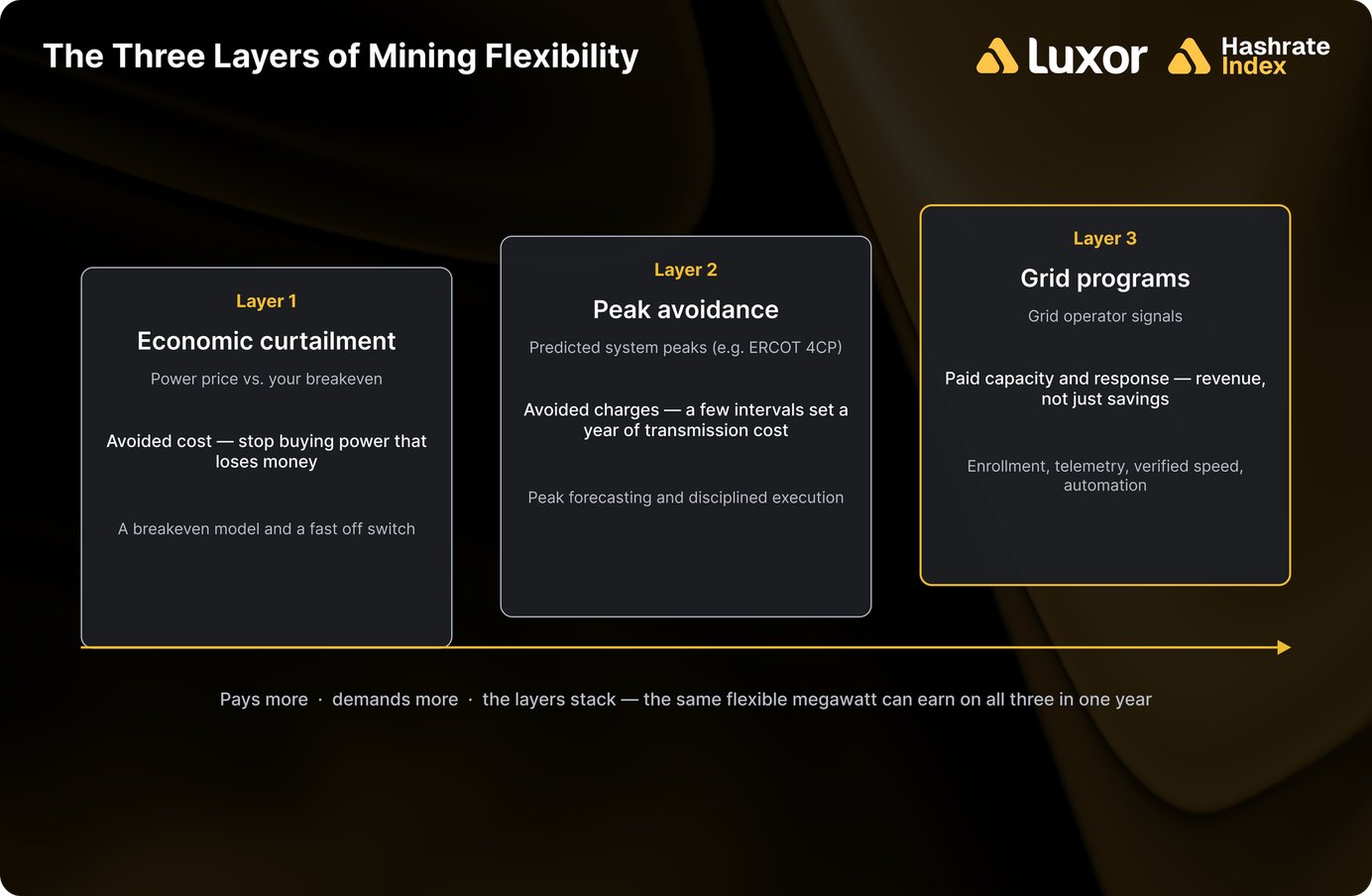
- Mining flexibility monetizes in three stacking layers: price-responsive curtailment, peak-charge avoidance, and formal grid programs.
- Each layer up pays more and demands more — faster response, tighter precision, more automation.
- The firmware floor for the upper layers: seconds-level curtailment and watt-level control. LuxOS drops a miner to roughly 25 W in under 5 seconds.
- The layers compound: the same flexible megawatt can avoid peaks, sell into programs, and curtail on price — in the same year.
- Flexibility is a market position, not just an ops setting — see our Energy Markets for Bitcoin Miners series for how it interacts with your power contract.
Why Mining Is Unusually Good at This
Most large industrial loads can't stop on command. A smelter, a data center serving live users, a chemical process mid-batch — interrupting them is expensive, slow, or impossible. A mining load is different: it's interruptible, location-agnostic, and can be shed in seconds without damaging anything or breaking a customer promise. That combination makes a mining facility one of the most controllable large loads on a grid.
The strategic consequence is that your flexibility is a product. You can consume power when it's cheap and abundant, and stop (and get paid to do so) when it isn't. What follows is how that gets monetized, in ascending order of sophistication.
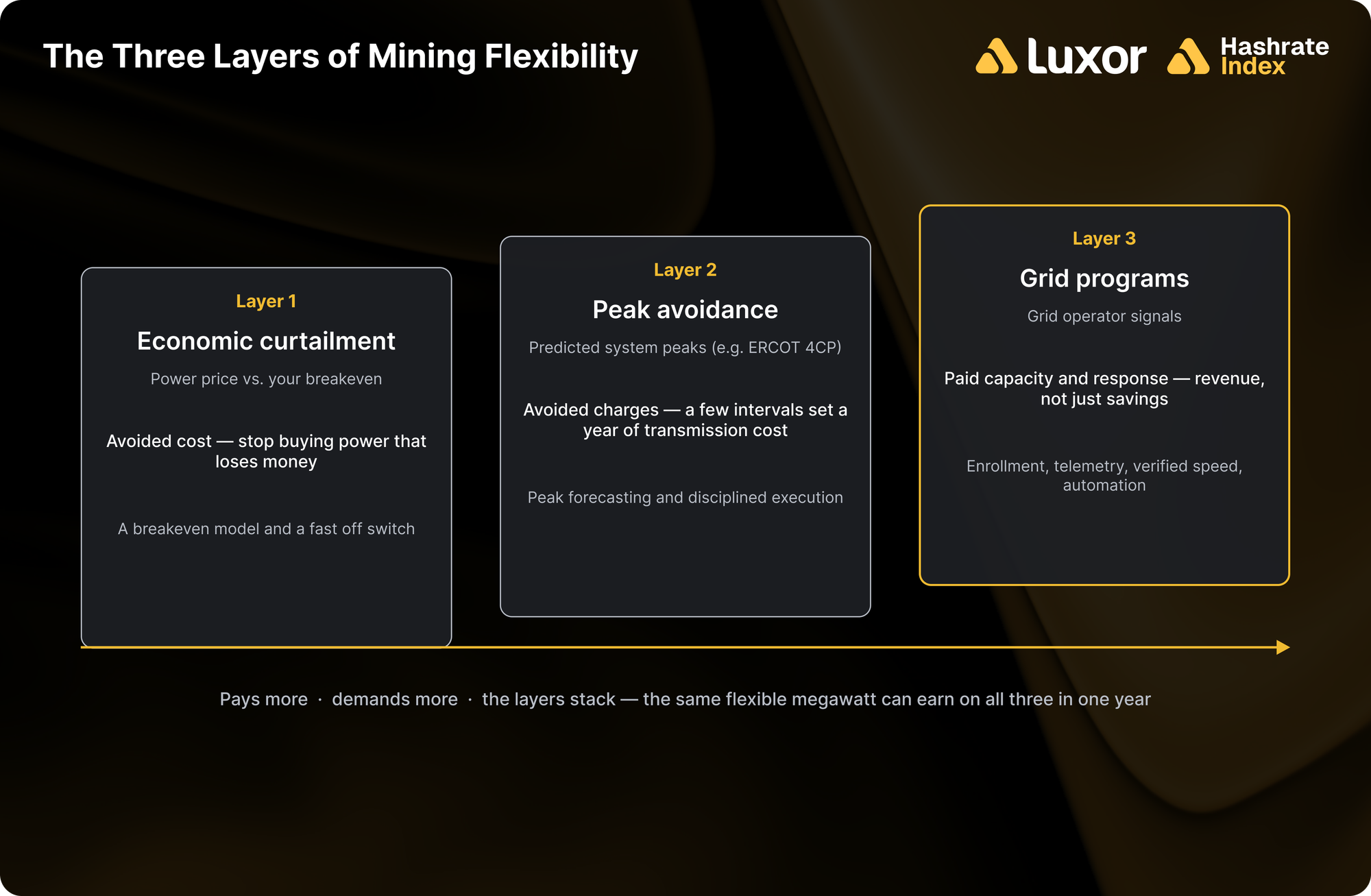
The Strategy Stack
Layer 1 — Economic curtailment
Pure economics: when the spot price exceeds your breakeven (i.e., hashcost), every hour you keep hashing is a loss, so you curtail. It requires no enrollment and no counterparty — just a model and the will to act on it. That makes it the layer available to everyone, today, regardless of size. It also depends entirely on knowing your hashcost number, which is a function of your J/TH and your power price. Whether it's even available to you depends on your contract: spot exposure versus a fixed price determines how much of this upside you can actually capture.
Layer 2 — Peak avoidance
Prediction turned into savings. In ERCOT, a handful of peak intervals set a year of transmission charges — the 4CP mechanism — so curtailing through forecasted peaks is among the highest-ROI hours a Texas miner has. The difficulty is that you're betting on a forecast, and the intervals are only known with certainty after the fact, which is why automating 4CP defense beats leaving it to a human on shift.
Layer 3 — Grid programs
Where flexibility becomes a product you sell. Formal demand-response and flexibility programs pay miners for committed, verifiable response, and mining's seconds-level interruptibility is exactly why fleets suit these programs better than almost any other large load. Ancillary services sit here too — the products where you're paid for standing ready, not only for responding. If you're building new capacity in Texas, the large-load interconnection process is the gate you pass through first.
What the Upper Layers Demand From Your Stack
- Speed you can prove. Program qualification turns on verified response time. LuxOS curtails to roughly 25 W in under 5 seconds and restores full power in under 60 seconds, with customizable wake-up sequences. Soluna cut its curtailment ramp time roughly in half after switching.
- Precision, not just on/off. Partial response (shedding 30% of load, not 100%) requires watt-level control. Power Targeting holds an exact wattage, which is what interval-level participation runs on.
- Automation. Grid signals don't wait for a shift change; curtailment must be API-driven and fleet-wide. That's dispatch-system territory: a firmware API plus a management layer, or one of the energy management platforms built for it. A curtailment strike-price API is a clean way to wire the decision to the execution.
- Machine health through cycling. Frequent curtailment is only free if waking back up is gentle. Stepped power-up and low-wattage idling rather than cold shutdowns are what make fequent cycling sustainable.
Demand Response Strategy FAQ
Do small miners qualify for grid programs? Program minimums vary and are often megawatt-scale, but aggregators pool smaller sites, and Layers 1 and 2 require no minimum at all.
Does frequent curtailment damage machines? Modern firmware is built for it: stepped wakeups and low-wattage idling rather than cold shutdowns minimize thermal and electrical stress.
How much is flexibility worth? It varies by market and year, but in ERCOT, peak-charge avoidance alone is material, and program revenue stacks on top.
Can I do this on a fixed-price power contract? Partly. Fixed pricing removes the Layer 1 arbitrage but not the Layer 2 and 3 opportunities, and it introduces its own strategies, covered in our fixed-price power piece.
What's the first step? Layer 1, today: compute your breakeven hashcost and act on it. Layers 2 and 3 are enrollment and infrastructure decisions.
Conclusion
Hashrate earns the same everywhere; flexibility earns more where it's engineered. Stack the three layers and the same megawatt pays you several ways, but only if the firmware underneath can respond fast enough, precisely enough, and without a human in the loop.
More From the Firmware Features Series
- What Is AutoTuner? LuxOS Autotuning Explained
- Bitcoin Mining Curtailment: How LuxOS Powers Down Fast
- Miner Thermal Management: Inside LuxOS ATM
- ASIC Overclocking & Underclocking: LuxOS Profiles
- Power Targeting: Watt-Level Fleet Control
Related Reading: Energy Markets & Grid Programs
- What Is Demand Response?
- Bitcoin Mining Curtailing, Demand Response, and Controllable Load
- Why Mining Fleets Are Well-Suited for ERCOT's Flexibility Programs
- 4CP for Bitcoin Miners: How One Hour Sets a Year of ERCOT Transmission Costs
- 4CP Defense Without an Operator in the Loop
- ERCOT's New Large-Load Interconnection Process
- Energy Markets for Bitcoin Miners: Spot vs. Fixed Power Prices
- Energy Markets for Bitcoin Miners: Ancillary Services
- Top 5 Bitcoin Mining Energy Management Platforms for 2026
- LuxOS Case Study: Soluna Cuts Curtailment Time by Half
Ready to put your fleet's flexibility to work? Luxor's energy team can walk you through enrollment, dispatch, and the firmware side.
If you'd like to learn more about Luxor's full-stack Bitcoin mining services, reach out to [email protected] or visit luxor.tech.
About Luxor Technology Corporation
Luxor delivers hardware, software, and financial services that power the global compute and energy industry. Its product suite spans Bitcoin Mining Pools, ASIC Firmware, Hardware trading, Hashrate Derivatives, Energy services, a Miner Management software, Commander, and a bitcoin mining data platform, Hashrate Index.
Disclaimer
This content is for informational purposes only, you should not construe any such information or other material as legal, investment, financial, or other advice.

Hashrate Index Newsletter
Join the newsletter to receive the latest updates in your inbox.