Bitcoin Mining and Demand Response: Why Mining Fleets Are Well-Suited for ERCOT's Flexibility Programs
What makes Bitcoin mining a practical fit for demand response participation in ERCOT.

TLDR
- Bitcoin miners can curtail to near zero in seconds, faster than most large industrial loads connected to the ERCOT grid.
- The only cost of curtailment for a mining fleet is hashrate not produced during the event window — no equipment damage, no process restart, no lost product. This tradeoff is the basis of Demand Response (DR) participation.
- Curtailment speed determines program eligibility. Faster response opens access to higher-paying ancillary services programs, and the right infrastructure makes the difference.
- Luxor's Intelligent Miner automates curtailment decisions, removing the human bottleneck that limits access to faster-acting programs, and continuously optimizes the fleet against real-time ERCOT prices.
The Ideal DR Participant, Revisited
Part 1 of this series described what demand response is and how ERCOT's programs work. We ended with a profile of the ideal DR participant: a large, fast, reliable load that can curtail without consequence and ramp back up just as cleanly when the event ends.
Most large industrial loads meet some of those criteria but not all. A steel mill can curtail, but not instantly, and restart carries real cost. A data center running latency-sensitive workloads can shed some load, but not all of it, and not on a seconds-level signal. Chemical processors and manufacturing lines often have minimum runtime requirements that make deep curtailment impractical or expensive.
Bitcoin mining has a different operational profile. The characteristics that define a useful DR load — speed, reliability, and low curtailment cost — are structural features of how a mining fleet works.
Curtailment Is Low-Cost for a Mining Fleet
The economics of demand response participation depend on curtailment being genuinely low-cost for the participant. For many industrial loads, it isn't. Shutting down production means losing output, potentially damaging equipment, and incurring time and cost to restart. DR compensation has to be large enough to overcome this friction.
For a Bitcoin mining fleet, that friction is low. Three reasons:
- No process penalty. When a mining fleet curtails, it stops producing hashrate. There is no partially completed product to scrap, no chemical reaction to interrupt, no batch ruined. The Bitcoin network adjusts difficulty over time regardless of whether any individual miner was online during a given window. Hashrate not produced during a curtailment event is simply hashprice not earned — this is the tradeoff the miner agrees to in exchange for DR compensation.
- No equipment damage. ASICs can shut down and restart cleanly. Modern mining hardware is designed to handle power cycling without wear or recovery time. A miner that curtails during an Emergency Response Services (ERS) dispatch event returns to full output as soon as the signal clears, without requiring a warm-up period or equipment inspection.
- No minimum runtime requirement. Many industrial processes require a minimum continuous operating window — e.g., a furnace that cools down takes hours to reheat. A mining fleet has no equivalent constraint. It can curtail for ten seconds or ten hours with the same operational ease. This is relevant because ERCOT's faster programs, Responsive Reserve Service (RRS) in particular, require response times measured in seconds. Mining is one of the few large load types where this is practically feasible.
Response Speed Determines Program Eligibility
In Part 1, we covered ERCOT's four main DR programs and their response requirements. That framework becomes practically important when mapped against what a mining fleet can actually do.
| Program | Response Required | Notes |
|---|---|---|
| Non-Spinning Reserve | 30 minutes | Accessible to loads with basic controls |
| ERS-30 | 30 minutes | Accessible to loads with basic controls |
| ERS-10 | 10 minutes | Requires reliable automated controls |
| ECRS | ~10 minutes | Requires reliable automated controls |
| RRS | ~Seconds | Requires automatic frequency response; no human-in-the-loop |
The programs are structured this way because the grid needs different types of reliability coverage. Non-Spin and ERS-30 address longer-duration shortfalls where there is time to coordinate a response. RRS is designed for sudden, large generation losses, the kind of event where frequency deviation begins immediately and the response has to be automatic.
A mining fleet that can only curtail on a manual signal qualifies for the slower programs. A fleet with automated curtailment infrastructure can qualify across the full program stack, including RRS, which carries among the higher capacity payment rates in the ancillary services market.
The practical implication: infrastructure investment in automation is also an investment in program accessibility. Miners who have built or adopted automated dispatch systems are not limited to accessing programs with the lowest barriers to entry, they have the full range available.
Scale Amplifies the Revenue Opportunity
ERCOT's DR compensation is denominated per MW of enrolled capacity. A 10 MW fleet and a 100 MW fleet qualify for the same programs under the same terms, but the 100 MW fleet earns proportionally more in capacity payments and generates proportionally more performance payment revenue per dispatch event.
This means that as a mining operation grows, its DR revenue opportunity scales with it. Each additional MW of capacity is not only additional hashrate, it is additional enrolled DR capacity with its own revenue stream.
There are also practical benefits to scale from the Qualified Scheduling Entity (QSE) perspective. Larger enrolled loads are easier to work with administratively and move more meaningful MWs when dispatched. Miners planning hashrate capacity expansion in Texas should factor DR enrollment into their power economics.
How DR Reshapes Power Economics
The useful frame for demand response is not how much it pays in isolation, but how it changes the effective cost and revenue structure of a mining operation over time.
Two mechanisms work simultaneously:
- Capacity payments reduce effective $/MWh during normal operations. A miner enrolled in an ERCOT DR program receives capacity payments for the duration of their enrollment period, regardless of whether any dispatch event is called. Those payments offset energy costs during hours when the miner is running normally at full load. The effective cost of power consumed during non-event hours is lower than the nominal contract rate because part of that cost is being offset by the capacity payment stream.
- Performance payments convert high-price hours into a revenue event. ERCOT dispatch events tend to cluster around high-stress, high-price periods, the same hours when energy costs rise and mining margins compress. During those intervals, a miner may curtail anyway to avoid paying elevated spot prices. DR enrollment converts that curtailment from a cost-avoidance measure into an active revenue stream: the miner is compensated for the load reduction rather than simply avoiding the cost of running.
Together, these two mechanisms mean that DR participation affects mining economics across the full operating period, not just during intervals when curtailment events are actually called.
What Participation Looks Like: Intelligent Miner
The Bitcoin miner’s case for DR participation is clear. However, the practical barrier for many mining operations has been the infrastructure required to act on dispatch signals quickly enough to qualify for the programs with more demanding response requirements.
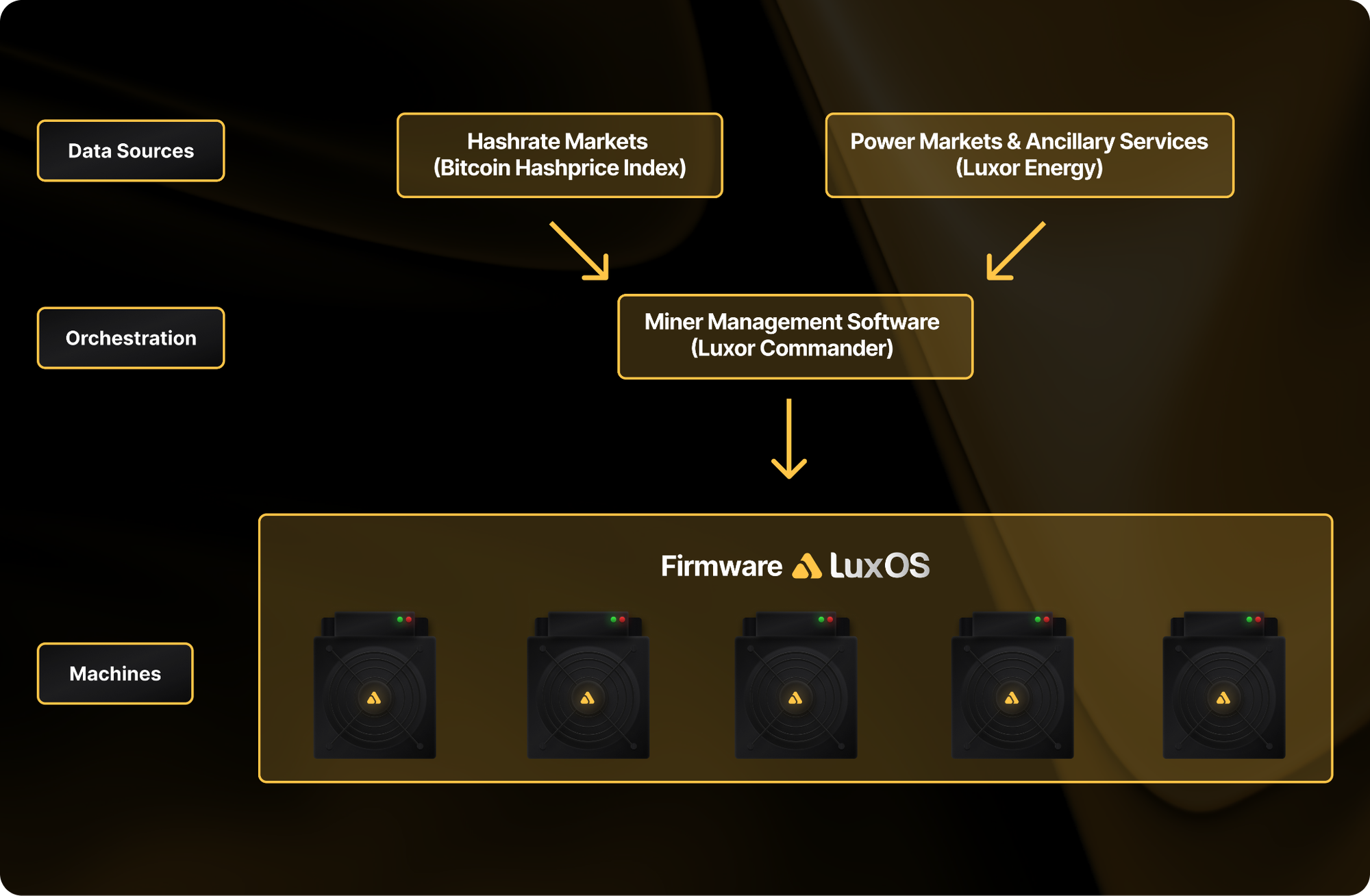
Luxor's full-stack mining platform is built to address that barrier. Commander’s Intelligent Miner connects ERCOT market signals to fleet-level execution, monitoring real-time power prices and dispatch conditions, and acting on them automatically without requiring manual intervention at the moment of dispatch.
When a signal arrives, Intelligent Miner executes a curtailment plan that accounts for miner health and margin: curtailing the least efficient machines first, within predefined operational boundaries, to meet the committed load reduction. When the event ends, the fleet ramps back up starting with the most profitable machines. The full process is automated.
![Intelligent Miner dashboard — Real Time Conditions view showing mining load, ERCOT spot price, breakeven energy price, and dispatch events]](https://storage.ghost.io/c/5f/b9/5fb98cf7-67da-41b5-a184-b1b39752525f/content/images/2026/05/data-src-image-90fc2321-30e5-46f2-98fe-6c5a80d8858b.png)
![Intelligent Miner dashboard — Real Time Conditions view showing mining load, ERCOT spot price, breakeven energy price, and dispatch events]](https://storage.ghost.io/c/5f/b9/5fb98cf7-67da-41b5-a184-b1b39752525f/content/images/2026/05/data-src-image-6d49bdf1-d4f6-47fc-aacd-e0163d0ef4e3.png)
This matters for RRS eligibility in particular. RRS requires automatic frequency response: the curtailment system must act without human input, and within seconds of the signal. Intelligent Miner is designed to meet that requirement, which means miners on Luxor's full-stack mining platform can access the full ERCOT program stack rather than being limited to the programs with longer response windows.
What's Next: Four Coincident Peak (4CP)
Part 1 and 2 of this series have covered the foundation: how ERCOT's demand response programs work, and why the operational profile of a Bitcoin mining fleet makes it a practical candidate for participating in them.
Part 3 explores another mechanism through which Bitcoin miners in ERCOT can reduce their effective cost of power: Four Coincident Peak (4CP) peak avoidance. We will cover what 4CP is, how it works, and what it means for mining operations in Texas.
Luxor Energy is a registered REP and Level 4 QSE in ERCOT. To learn more about demand response enrollment for your Bitcoin mining operations, visit luxor.tech/energy.
About Luxor Technology Corporation
Luxor delivers hardware, software, and financial services that power the global compute and energy industry. Its product suite spans Bitcoin Mining Pools, ASIC Firmware, Hardware trading, Hashrate Derivatives, Energy services, a Miner Management software, Commander, and a bitcoin mining data platform, Hashrate Index.
Disclaimer
This content is for informational purposes only, you should not construe any such information or other material as legal, investment, financial, or other advice.

Hashrate Index Newsletter
Join the newsletter to receive the latest updates in your inbox.