
4CP for Bitcoin Miners: How One Hour Sets a Year of ERCOT Transmission Costs
Each summer, four 15-minute windows on the ERCOT grid determine Texas mining sites transmission costs for the next 12 months.

TLDR
- ERCOT's Four Coincident Peak (4CP) mechanism sets a site's transmission charge for the next year based on its average load during the four highest 15-minute system peaks across June–September.
- Exposure can run up to ~$50,000 per MW per year. A 25 MW site running at full load through every peak faces ~$1.25M in 4CP transmission charges, billed monthly across the following 12 months.
- Miners with a 4CP strategy turn it from an operational burden into a competitive advantage by lowering effective power costs ($/MWh).
- Texas hosts a large share of North American hashrate, and synchronized 4CP curtailment is now a visible feature of the summer hashrate curve.
What is 4CP?
4CP is a mechanism ERCOT uses to allocate transmission costs among their largest industrial customers. The main message is this: your share of the bill is set by what your site does during four 15-minute windows each summer, and it stays locked in for the next twelve months.
The mechanism is simple. ERCOT records the four highest 15-minute load intervals on its grid during June, July, August, and September. Your site's average power usage across those four windows becomes your peak load contribution. Multiply that by next year's transmission rate (set by the Public Utility Commission of Texas) and you have your transmission bill, charged monthly across the next twelve months.
Transmission charges are one component of the total electricity bill (energy, distribution, and ancillary charges stack on top), however, they can significantly influence an operation’s overall power-cost economics. The charge scales linearly: half load during peaks means half the charge; full curtailment during all four means close to zero. At full load through every peak, the charge can run up to ~$50,000 per MW per year. For example, a 25 MW site with no downtime could be facing roughly $1.25M in 4CP transmission charges across the following 12 months.
How Miners Can Prepare and Take Advantage
ERCOT does not announce when 4CP peaks will occur. The four peak intervals are only confirmed after the season closes. Operators are forecasting them in real time.
In practice, the timing is more predictable than the dates. Recent 4CP intervals have clustered in a narrow late-afternoon window — the 2025 peaks fell between 16:00 and 18:00 Central Time, and historically the band rarely strays outside this range. Each month produces one peak, with dates spreading across June, July, August, and September.
Most Bitcoin mining operators manage 4CP manually. They monitor the ERCOT real-time load forecast and curtail their site when a peak looks imminent. It works, but it is imprecise. Curtailing too aggressively leaves unharvested hashrate revenue on the table, and curtailing too rarely risks locking in higher transmission costs for the next year. Manual curtailment also leaves the recovery on the table. The faster the fleet ramps back to operating power, the more hashrate is harvested per event.
The upside of strategic 4CP curtailment is meaningful for bitcoin mining operators who get it right. A site that perfectly avoids all four peaks would pay a small fraction of the transmission cost that a less-disciplined competitor would pay. That difference flows directly into their all-in power cost profile ($/MWh), and therefore their overall mining margin.
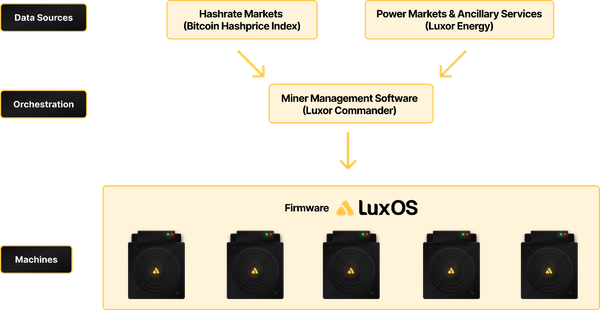
Intelligent miners are automating their 4CP decisions. Real-time load forecasts, probabilistic models of peak likelihood, and direct integrations with fleet management software mean the curtailment signal can be automatically dispatched once a certain threshold is met.
Why 4CP Matters for Hashrate Markets
Texas hosts a significant share of global Bitcoin mining hashrate — approximately 17% as of mid-2026. When a large fraction of that capacity curtails simultaneously to avoid a 4CP peak, the effect shows up across multiple on-chain signals: slower block times, downward difficulty adjustments, and elevated hashprice volatility.
This pattern is becoming a reliable seasonal signature, similar to the wet/dry season migrations in China that defined the pre-2021 bitcoin mining era. Last summer made the case clearly. June 2025 produced two negative difficulty adjustments (-0.45% on the 14th, -7.48% on the 29th), the first back-to-back negative epoch since July 2024. During “likely 4CP peak” hours that month, block times averaged ~51 seconds slower than non-4CP hours as mining sites curtailed.
Across 2022–2025, “4CP-month” (June–September) difficulty adjustments averaged +0.53%, compared to +2.34% for the rest of the year. October typically posts the strongest rebound as curtailment pressure eases, releasing hashrate like a beach ball pushed underwater and released.
Forward hashrate markets price in this seasonality. Luxor's Hashrate Forward Curve reflected it in 2024 and 2025, with forward hashrate contracts through June–September trading in contango (premium to spot hashprice) compared to backwardation (discount to spot) across the rest of the curve. Forward hashrate sellers demand higher hashprice rates in anticipation of weaker hashrate (and stronger hashprice) during 4CP peak avoidance.
Luxor's 4CP Optimizer Automates Peak Avoidance
Luxor's 4CP Optimizer monitors ERCOT load in real time, probabilistically predicts coincident peaks, and automatically curtails sites through Commander.
Interested in getting started? Visit luxor.tech/energy or reach out to [email protected].
— Happy Hashing!
About Luxor Technology Corporation
Luxor delivers hardware, software, and financial services that power the global compute and energy industry. Its product suite spans Bitcoin Mining Pools, ASIC Firmware, Hardware trading, Hashrate Derivatives, Energy services, a Miner Management software, Commander, and a bitcoin mining data platform, Hashrate Index.
Disclaimer
This content is for informational purposes only, you should not construe any such information or other material as legal, investment, financial, or other advice. Nothing contained in our content constitutes a solicitation, recommendation, endorsement, or offer by Luxor or any of Luxor’s employees to buy or sell any derivatives or other financial instruments in this or in any other jurisdiction in which such solicitation or offer would be unlawful under the derivatives laws of such jurisdiction.
There are risks associated with trading derivatives. Trading in derivatives involves risk of loss, loss of principal is possible.

Hashrate Index Newsletter
Join the newsletter to receive the latest updates in your inbox.