Firmware Features Series – ASIC Overclocking & Underclocking: LuxOS Profiles
Every ASIC is a dial, not a switch. LuxOS profiles are the detents.

This post is part of Luxor's Firmware Features Series, which covers the core Bitcoin mining concepts behind the flexible firmware features that give operators custom control over performance and profitability.
TLDR
- Every ASIC is a dial, not a switch. Preset profiles are the detents on that dial — incremental checkpoints for voltage and frequency pairings which lock in a specific performance in terms of hashrate and/or efficiency. You can move between profiles in a single click, ranging from a "deep efficiency" underclock to a "full-tilt" overclock.
- Frequency sets hashrate; voltage sets stability. Overclocking raises frequency for more hashrate; underclocking lowers it for efficiency.
- LuxOS ships 25 built-in profiles per miner (16 underclock steps, 8 overclock steps, and the factory default) in linear steps of 25 MHz and 0.1 V from the miner's nameplate specification.
- As a rule of thumb, each step moves hashrate about 5 TH/s, varying by machine model.
- AutoTuner optimizes whichever profile you pick, finding the minimum stable voltage for that frequency.
Frequency, Voltage, and What a Profile Actually Is
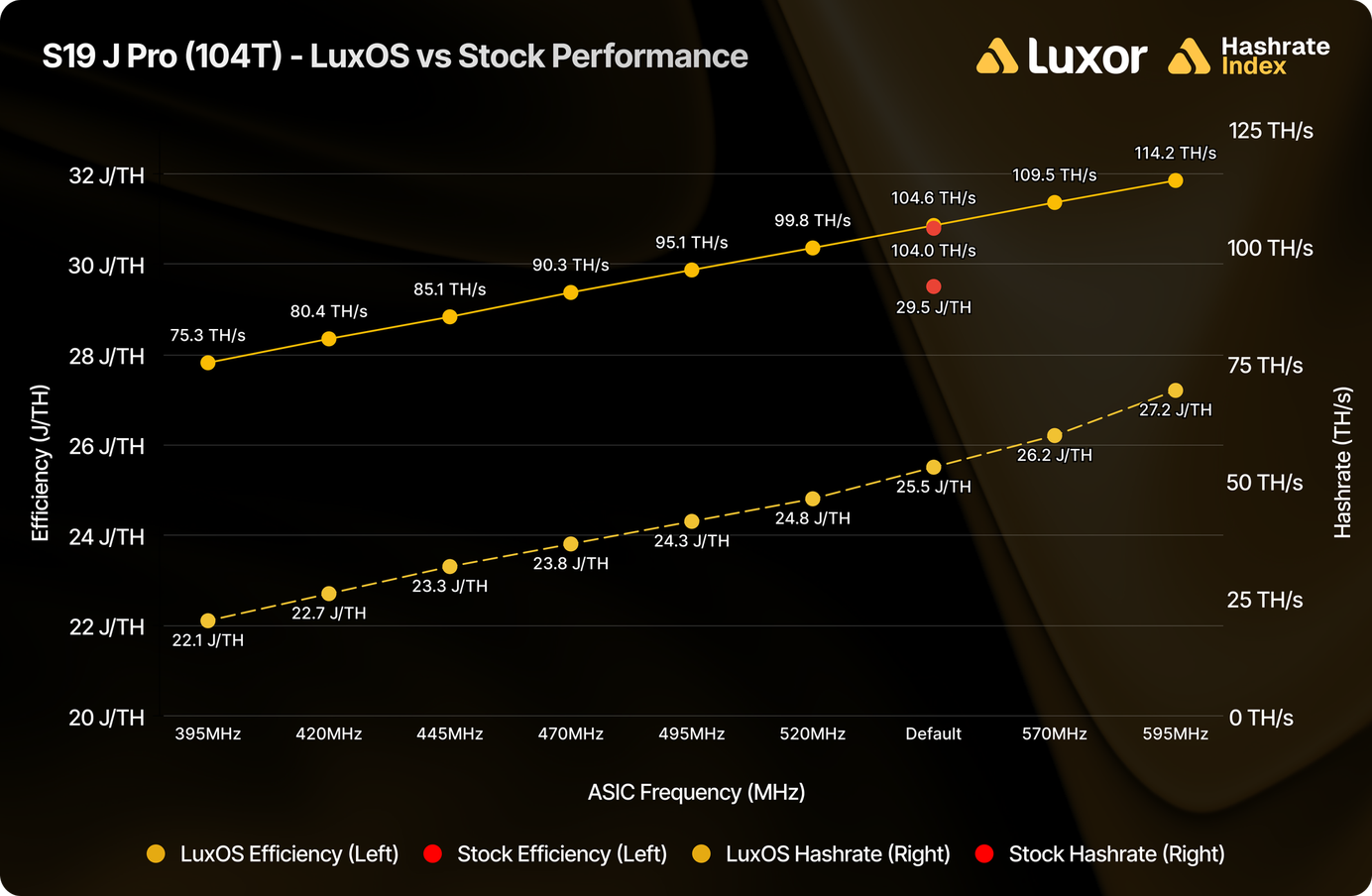
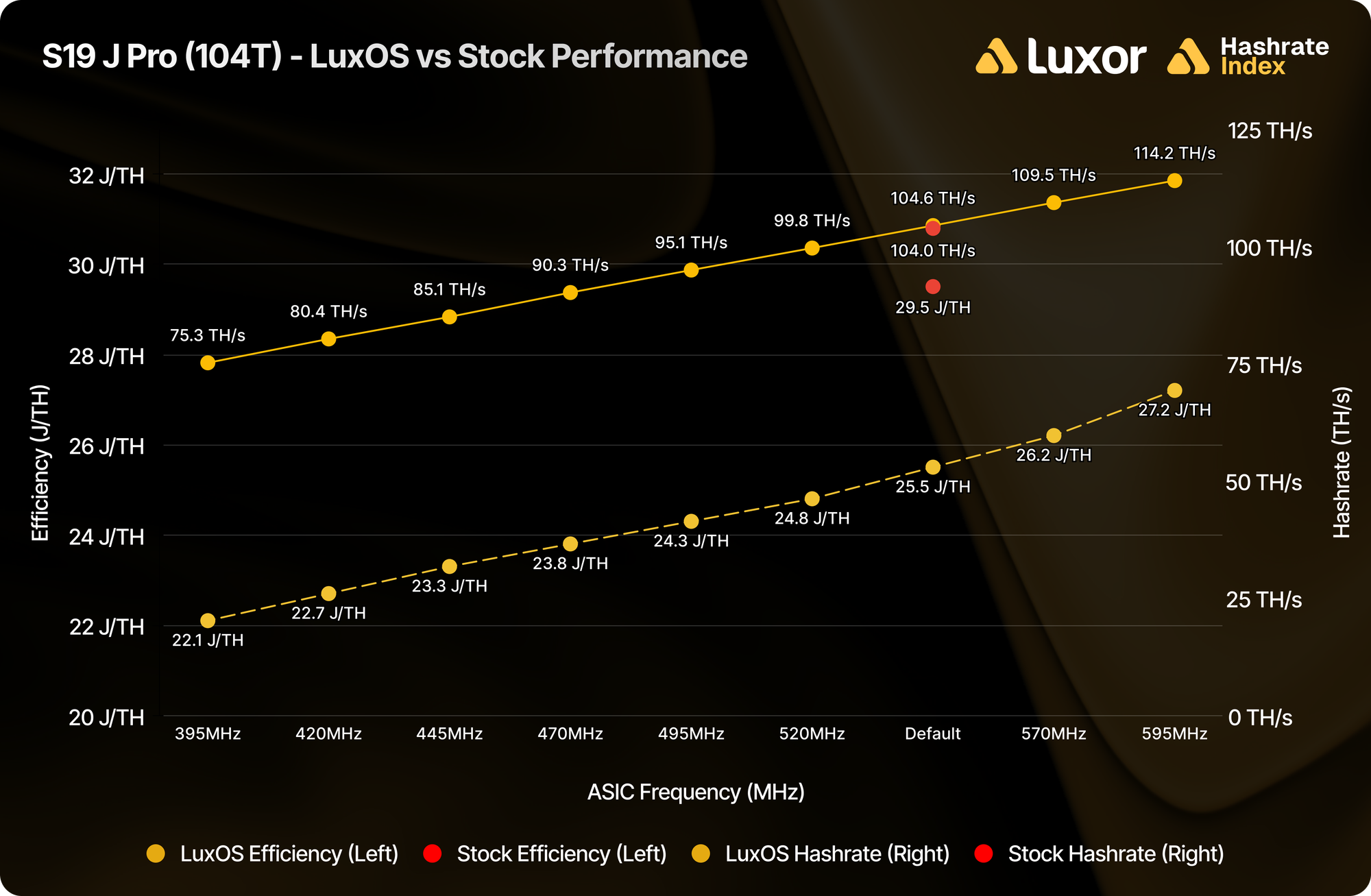
A profile is a paired voltage and frequency setting. An Antminer S19j Pro at its default (545 MHz) produces roughly ~104 TH/s. Step down 25 MHz to 520 MHz and it produces ~99 TH/s, and 495 MHz produces ~94 TH/s. Increasing frequency means the board needs more voltage to stay stable; how much more depends on many factors (including temperature, chip quality, age, and even PSU health), which is why no two machines tune identically.
LuxOS generates its profile ladder from each miner's own EEPROM (Electrically Erasable Programmable Read-Only Memory) nameplate, not a generalized 'one-size-fits-all' template. A j Pro that shipped from factory at 13.4 V and 545 MHz gets steps at 13.3 V / 520 MHz and 13.2 V / 495 MHz below, and 13.5 V / 570 MHz and 13.6 V / 595 MHz above, while a unit that shipped at 13.6 V gets a ladder built around that instead.
When to Underclock, When to Overclock
- Underclock when hashprice is weak or power is expensive. Lower frequency cuts power (W) faster than it cuts hashrate (TH/s), improving efficiency (J/TH). A core strategy in low-hashprice environments, and one hosts and clients both benefit from.
- Overclock when hashprice runs hot and you have thermal headroom. The 8 overclock steps trade-off efficiency (J/TH) for output (TH/s), sensible when each marginal hash earns more than its marginal watts cost.
- Be careful at the top of the ladder. Heavy overclocking in high temperatures can, on some hardware, raise the odds of failures and damage. Pair overclock profiles with Advanced Thermal Management (ATM) to prevent overheating.
How to Change Profiles
- Open Preset Profiles in the LuxOS Web UI (or select miners in Commander).
- Pick a step (+1, −2, Default, and so on) from the dropdown.
- The miner ramps immediately to the new state and the chip HealthChecker re-evaluates it under the new settings. AutoTuner then finds the minimum stable voltage for that frequency.
Note: On models that support Power Targeting, the same profile labels are interpreted as predefined power targets under the hood.
ASIC Overclocking & Underclocking FAQ
How much hashrate does one profile step change? Roughly 5 TH/s per step as a rule of thumb, but it depends on the chip type and the number of chips per board.
Does underclocking damage a miner? No. Running cooler at lower voltage is more gentle on hardware than stock. The risk sits at the other end: aggressive overclocking, especially in high heat conditions.
Why do two identical miners have different profiles? Profiles are generated from each unit's own nameplate voltage. Units of the same machine model can ship at various voltages.
Do I need to retune after switching profiles? No. Every profile change triggers AutoTuner to recalibrate for the new frequency automatically.
Conclusion
Performance profiles turn fleet economics from slow and static into a one-click dynamic decision: step down when margins compress, step up when hashprice pays for it. LuxOS does it automatically, building the ladder from each machine's nameplate and re-optimizing voltage at every step.
Ready to tune your fleet? Download LuxOS across your fleet:
If you’d like to learn more about Luxor’s full-stack Bitcoin mining services, please reach out to [email protected] or visit https://luxor.tech.
About Luxor Technology Corporation
Luxor delivers hardware, software, and financial services that power the global compute and energy industry. Its product suite spans Bitcoin Mining Pools, ASIC Firmware, Hardware trading, Hashrate Derivatives, Energy services, a Miner Management software, Commander, and a bitcoin mining data platform, Hashrate Index.
Disclaimer
This content is for informational purposes only, you should not construe any such information or other material as legal, investment, financial, or other advice.

Hashrate Index Newsletter
Join the newsletter to receive the latest updates in your inbox.