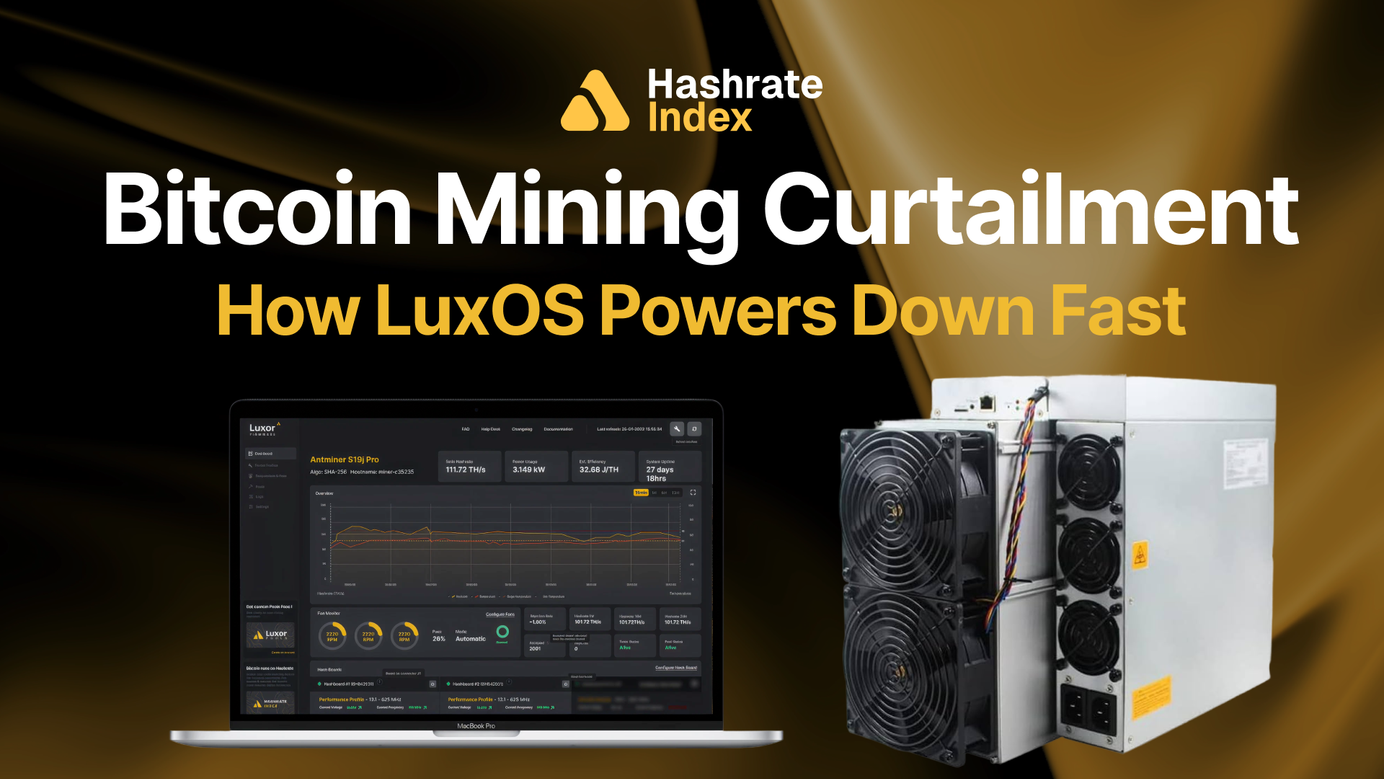
Firmware Features Series – Bitcoin Mining Curtailment: How LuxOS Powers Down Fast
Flexible firmware drops load on demand, and miners get to sell it as a service.

This post is part of Luxor's Firmware Features Series, which covers the core Bitcoin mining concepts behind the flexible firmware features that give operators custom control over performance and profitability.
Flexible firmware drops load on demand, and miners get to sell it as a service.
For a grid-tied mining operation, the ability to drop load in seconds is more than a nice-to-have feature. Curtailment is how a miner turns flexibility into revenue.
TLDR
- Curtailment is the controlled reduction of a mining load, on command, to respond to grid signals or energy prices.
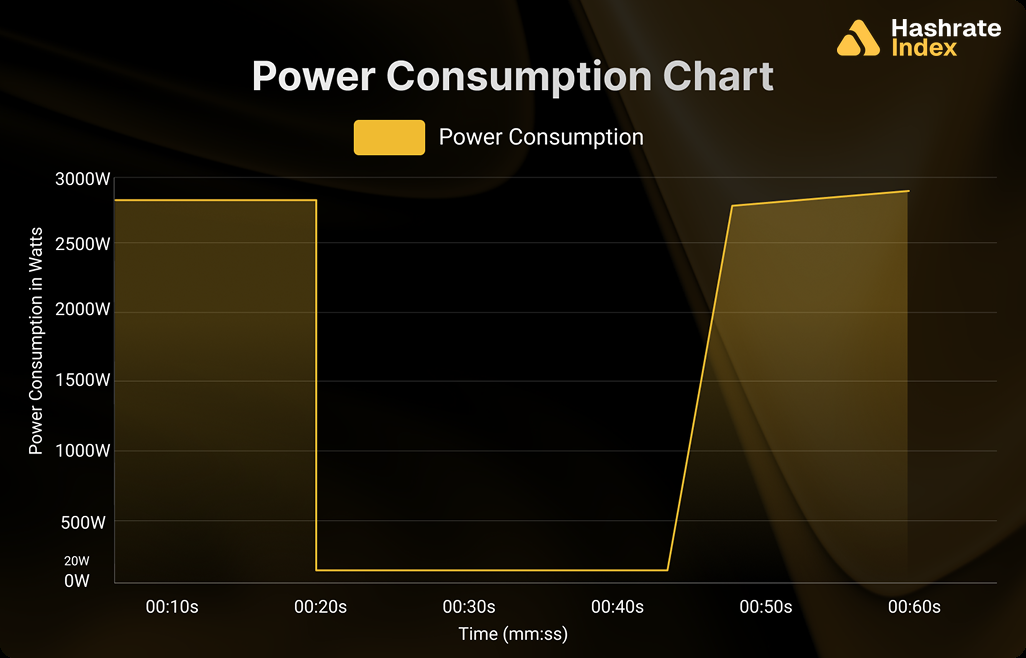
- LuxOS drops a miner to roughly 25W in under five seconds and restores full power in under ten.
- Customizable wakeup steps ramp power back gradually to limit thermal and electrical stress.
- Instead of switching machines fully off, operators can underclock a percentage of the fleet — shedding load with less hashrate lost.
- Precise watt-level control via Power Targeting is the foundation for demand response and interval energy trading (Intelligent Mining).
What is Curtailment?
Curtailment is the deliberate reduction or pausing of a bitcoin mining load in response to an outside signal — a grid operator’s demand-response event, a spike in power prices, or a site-level load limit. Bitcoin mining operations are uniquely good at this. The load is interruptible, location-agnostic, and can be shed in seconds, which makes a mining facility one of the most controllable large loads on a grid.
That controllability is why miners get paid to participate in demand-response programs across grids like ERCOT, MISO, and NYISO. When the grid needs capacity back, a miner that can power down fast (and come back just as cleanly) is worth more than one that cannot.
How LuxOS Curtails (Fast)
Speed is the name of this game, and LuxOS is built for it. On a curtail signal, a miner drops to roughly 25 watts in under five seconds. On the restore signal, it returns to full power in under ten. Wakeup is delivered in customizable steps rather than a single jolt, which limits the thermal and electrical stress of ramping a fleet back online all at once. While a miner is curtailed, its fans throttle down to 20% — it is genuinely idling, not just paused.
Why Curtailment Matters for Miners
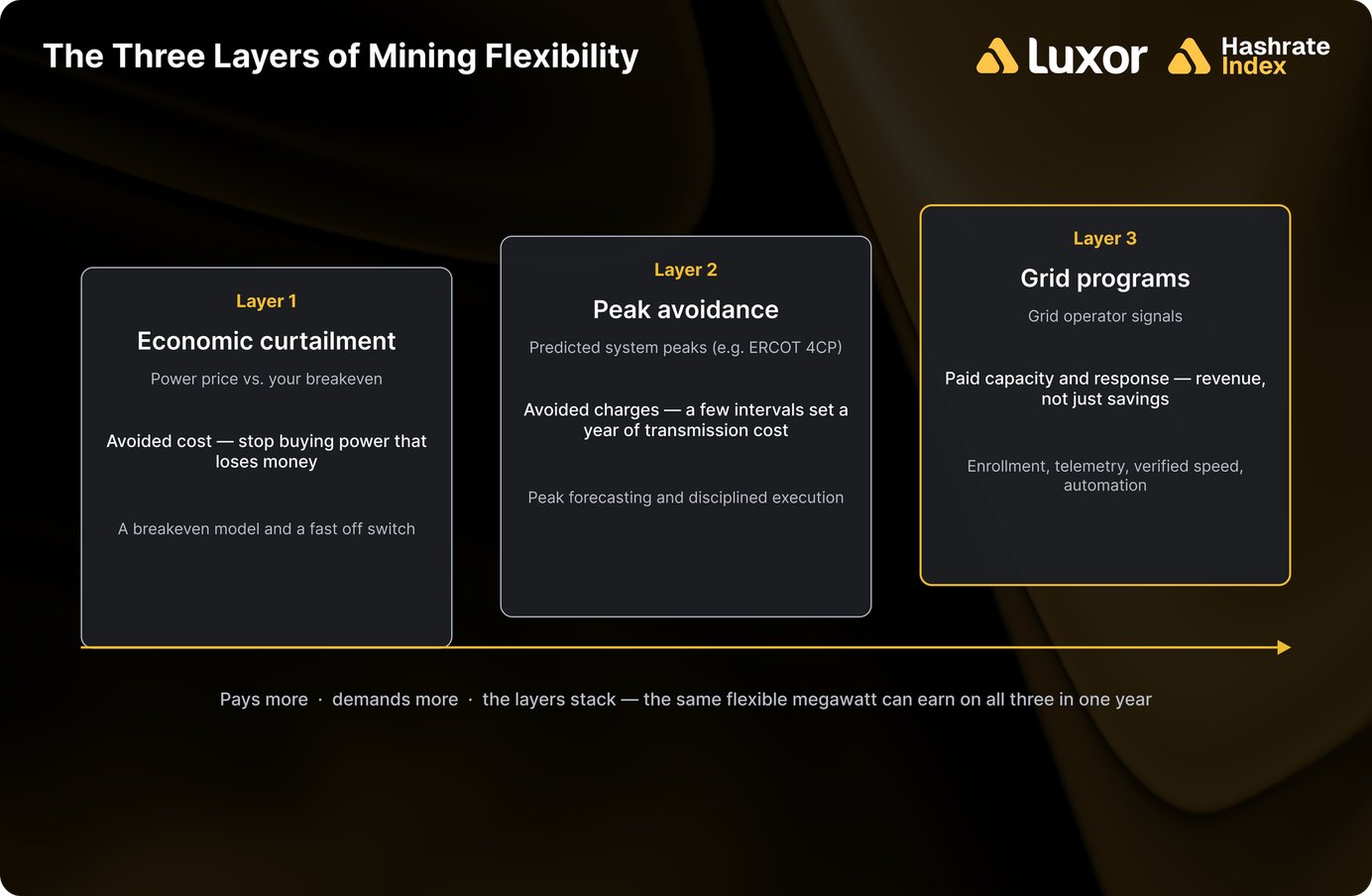
- Curtailment is compliance, not just revenue. Demand-response payments and avoided peak charges — like ERCOT’s 4CP transmission costs — turn downtime into income.
- Mining operations can shed load in two ways. Turn a subset of machines fully off, or underclock the whole fleet. Underclocking is often the better trade: drop the fleet 10% and you cut roughly 10% of power for less than 10% of hashrate.
- No cold-start tax. With Power Targeting, a miner can idle at a low wattage during a curtailment window instead of shutting off — preserving internal heat and skipping a cold-start when it ramps back up.
- It is the foundation for Intelligent Mining. Precise, watt-level control is what makes demand response, interval energy trading, and other load-based optimization strategies possible in the first place.
How to Setup Curtailment
Curtailment on LuxOS runs through Power Targeting — you tell the miner exactly how many watts to draw, and the firmware holds it there. You can set and update targets from Commander, the Web UI, or API command (powertargetset), which makes it straightforward to wire curtailment into an automated dispatch system. Pair it with Advanced Thermal Management (ATM) and the miner keeps managing its own temperature throughout the event.
If you are curtailing to participate in a formal demand-response program or energy market, the economics and enrollment are worth getting right — that is a conversation with Luxor’s Energy team.
FAQ
How fast can a Bitcoin miner curtail? With LuxOS, a miner reaches about 25 watts in under five seconds and restores full power in under ten.
Is curtailment the same as turning miners off? Not quite. Curtailment can be partial — underclocking rather than a full stop — and it is reversible without a cold-start from a hard shutdown.
Does frequent curtailment damage miners? Stepped wakeup and preserved internal heat are designed to minimize the strain of repeated cycling.
Which grids support mining demand response? Programs exist across ERCOT, MISO, NYISO, and others; specifics vary by market and program.
Conclusion
Curtailment is where Bitcoin mining meets the power grid. The faster and cleaner a fleet can shed and restore load, the more of the energy market it can monetize — and the more valuable it becomes to the grid it's tied to. LuxOS gives operators sub-five-second control over that lever.
Want to put your fleet’s flexibility to work? Talk to Luxor’s team about curtailment and demand response.
If you’d like to learn more about Luxor’s full-stack Bitcoin mining services, please reach out to [email protected] or visit https://luxor.tech.
About Luxor Technology Corporation
Luxor delivers hardware, software, and financial services that power the global compute and energy industry. Its product suite spans Bitcoin Mining Pools, ASIC Firmware, Hardware trading, Hashrate Derivatives, Energy services, a Miner Management software, Commander, and a bitcoin mining data platform, Hashrate Index.
Disclaimer
This content is for informational purposes only, you should not construe any such information or other material as legal, investment, financial, or other advice.

Hashrate Index Newsletter
Join the newsletter to receive the latest updates in your inbox.