Compute Derivatives, Token Factories, Modular Builds: 5 Takeaways from Yotta 2026
We were on the floor at Yotta 2026. Here are the 5 takeaways that matter for infrastructure operators and capital allocators.

Yotta 2026 brought more than 6,500 digital infrastructure leaders to Caesars Forum in Las Vegas, including over 600 CEOs, 300+ speakers, and 350+ exhibitors across 180+ sessions. The event has doubled in size again and outgrew the MGM Grand to get here.
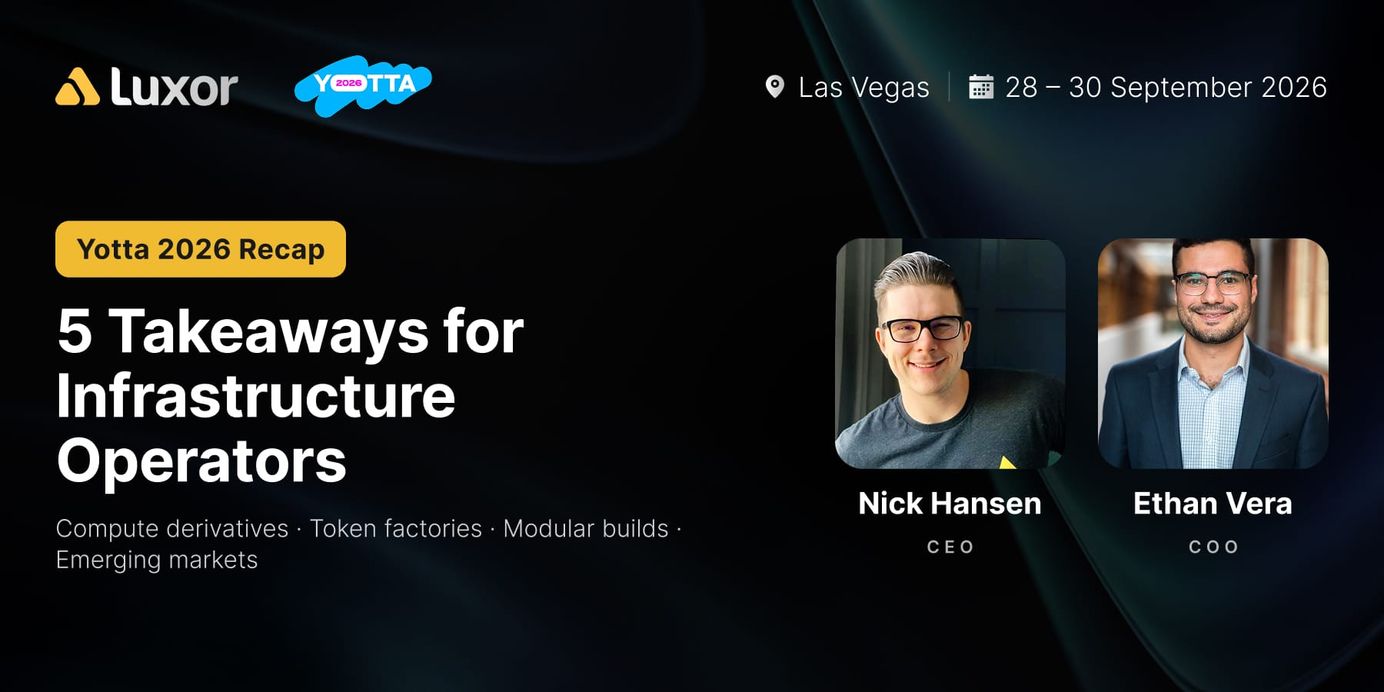
Luxor was on the floor. CEO Nick Hansen and COO Ethan Vera spent three days moving between powered shell, data center software, hardware scoping, and financing conversations, and Ethan joined Blockspace Live from the press room to talk compute derivatives and Luxor's AI product suite.

Most Yotta coverage focuses on chips and megawatts. Here's what mattered for the people who build, finance, and operate physical compute infrastructure.
1. The Language of Compute is Changing
Yotta co-founder George Rockett framed the event around a convergence that has already happened: the building, the power, the chip, and the capital "stopped being separate conversations a long time ago." The agenda reflected it. Tracks revolved around financing the buildout, grid interconnection, GPU economics, permitting, and public acceptance.
What's newer is the vocabulary. Offtake. Index. Forward curve. Residual value. Basis risk. These are commodity-market terms, and they are now the default for discussing GPUs. A buyer who three years ago asked "how many H100's can I get" now asks what the asset yields, who takes on the utilization risk, and what the residual value is worth in five years.
Miners have been here before. Bitcoin's application-specific compute (SHA-256 hashrate) evolved from a technical specification to a transparently priced and hedgeable commodity. The steps it took to get there were a public reference price (hashprice, 2020), then over-the-counter (OTC) forwards (2022), and finally CFTC-approved listed futures (2024). General-purpose compute (AI/HPC) is somewhere between steps one and two.
2. Compute Derivatives Are Stuck on Index Construction, Not Demand
Three cash-settled compute futures initiatives are in motion: CME Group with Silicon Data's H100 and B200 rental indexes, ICE with Ornn's Compute Price Index, and Nodal Exchange with Compute Desk benchmarks. None have launched yet. The CFTC extended its review of the CME contracts by 45 days, pushing a targeted October 5 listing to November 9 while it examines "novel or complex" questions, including how manipulable a GPU rental price is when the market runs through brokers, cloud platforms, and bilateral deals.
Ethan's diagnosis on the delay is index construction, not appetite. The indexes are built on on-demand bare metal rental, which is a thin slice of how compute actually trades:
"Most of the industry trades on long-term bare metal rental, or the short-term nature contracts are mostly via token generation. They're looking at a very small sliver of the market."
— Ethan Vera, COO (Luxor)
The data problem is structural. Long-term contracts are proprietary, and the marketplaces that hold the pricing (SF Compute, Hydra Host, Vast.ai, RunPod etc.) only share it when there's a commercial reason to. Ethan's understanding is that index providers have signed some of them, but not enough to clear a CFTC listing standard.
Luxor's Bitcoin Hashprice Index became public in 2020, OTC hashrate forwards followed in 2022, and the Bitnomial-listed hashrate futures that settle on hashprice cleared CFTC review and went live in May 2024. The sequence took four years, and the exchange-listed product came last, after the index proved itself in OTC markets.
In the meantime, a conflation worth correcting is that cash-settled, exchange-listed futures are the compute derivatives market. They aren't. As Ethan put it, "the compute derivatives market exists in a very big way today, which is physically delivered compute": a three-to-five-year bare metal contract from a Neocloud to a frontier AI lab is essentially a physically delivered forward contract.
This is the same OTC-first sequence the SHA-256 hashrate forward market followed, and the gap that Luxor's compute desk is working on.
On the data side, Hashrate Index now publishes the Ornn Compute Price Index alongside the AI Hardware Price Index launched in August, for the same reason the ASIC Price Index existed in 2020: transparency and price discovery.
3. Token Margins Are Thin. Compute Revenue Is Bankable.
Every operator conversation at Yotta reached the same place. Everyone agrees the product is tokens. Almost nobody can explain how to underwrite one.
The problem is that selling tokens looks less like software and more like a commodity business. Four dynamics drive that:
- Margins are thin from the start. Even a lab that owns its model and pays nothing for the weights earns a modest gross margin on tokens. A reseller serving someone else's open-weights model starts lower, and model owners are now taking a cut of the endpoint on top.
- The model is never paid off. Labs spend several times their API revenue on training. Staying competitive means re-training, so the model is a recurring cost, not a one-time build.
- Customers don't stay put. A free model release can swing platform share in days, and a lab can lose most of its traffic within a quarter.
- Capability is the only pricing power. Labs can raise prices when their model gets smarter. Not much else gives them that leverage.
If margins are already thin, prices can't keep falling indefinitely. That is why open-weights token prices should eventually find a floor. A provider that owns its servers and runs an optimized endpoint on them is taking real risk, and it can't sell below a double-digit gross margin for long. Frontier model pricing has already stopped falling; open-weights pricing should follow.
The hardware data shows why that risk keeps growing. Our current medians on the AI Hardware Price Index put an 8-GPU B300 node at $544,280, or $68,035 per GPU, against $40,555 per GPU for a new H100 node. Each new generation does more work per dollar, but it costs 1.68x more per GPU, so the capital a provider has at risk on every node keeps climbing. That capital has to earn a return whether token prices cooperate or not.
This is the part that matters for mining operators. The most dependable revenue in the stack doesn't sit with whoever sells tokens. It sits one layer down, with whoever sells compute. Labs either rent capacity or buy hardware, but either way they commit hundreds of millions of dollars upfront. That commitment is the compute provider's revenue: contracted in advance, and indifferent to whether a given model is still popular or not. Inference providers are squeezed between cheap tokens and expensive GPUs. The compute layer sells to all of them.
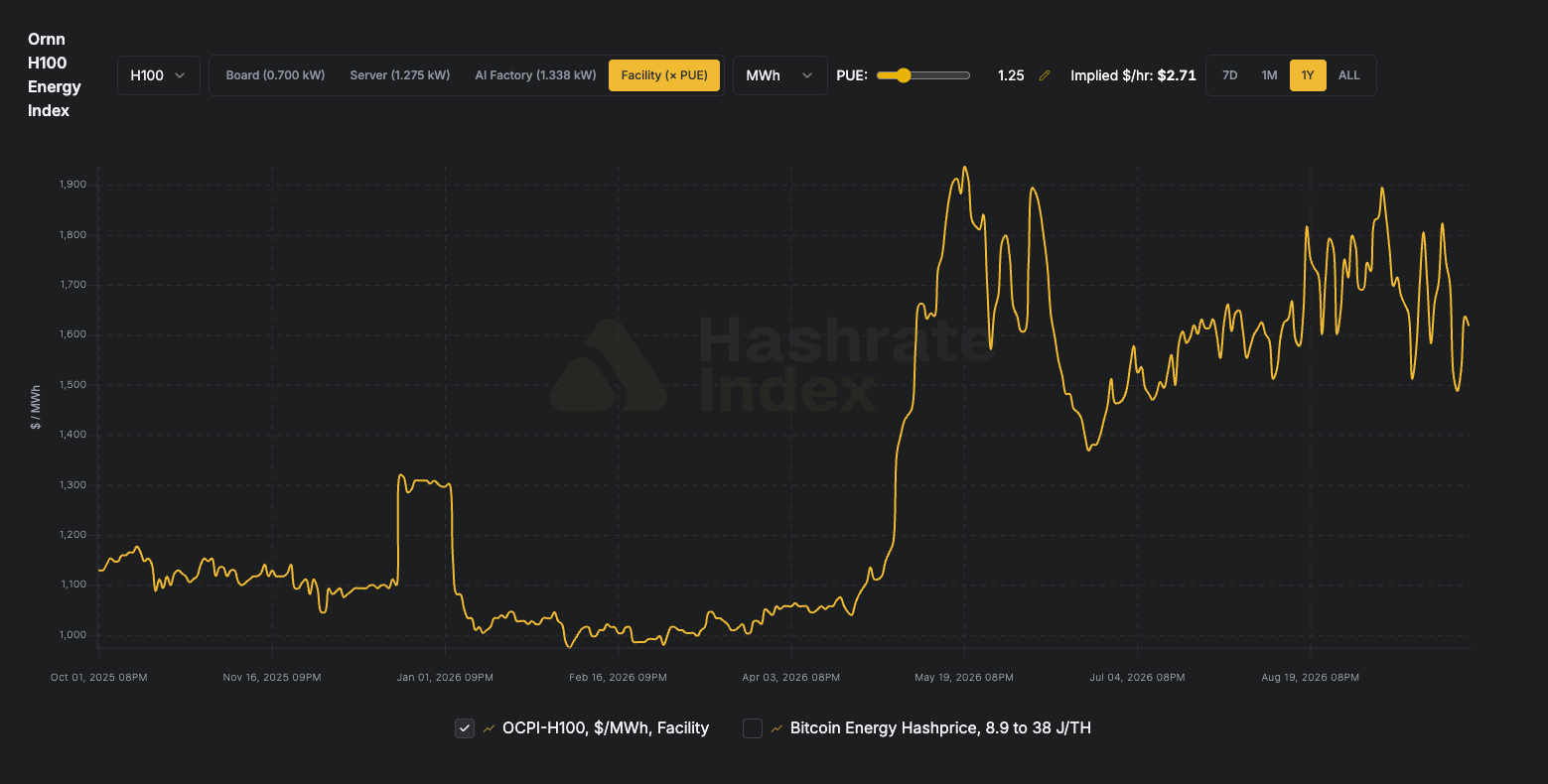
For a site owner, that changes which metrics matter. For data center operators, its not the token price, but what a unit of power earns when it runs GPUs. The energy-denominated view of the Ornn Compute Price Index tracks exactly that for H100 capacity, the AI equivalent of energy hashprice.
The financing is arriving fast. In August, NVIDIA signed memoranda of understanding with Apollo, BlackRock, Blackstone, Brookfield, Goldman Sachs, and KKR to build compute financing platforms targeting more than $500B of third-party capital, with the GPUs themselves as collateral. The idea is to finance a GPU cluster the way you would a toll road or a power plant. That only works if the cluster's revenue is predictable, which is exactly what thin, volatile token margins make hard to prove.
Luxor is tackling that from the contract side. Ethan described a structure, inspired by NVIDIA, that guarantees a Neocloud a minimum level of revenue per node and splits the profit above it. The operator keeps the upside if compute prices rise, and holds a revenue floor a lender will accept.
Bitcoin miners will recognize this logic. A hashprice forward and a compute revenue floor answer the same question: what is the minimum revenue per unit of capacity that makes an operation financeable? Our AI factory breakdown maps who earns what at each layer, and Neocloud Unit Economics walks through the inputs for operators sizing a compute position rather than a token position.
4. Modular Data Centers Moved From Pitch Deck to Working Unit
Yotta's clearest physical signal was outdoors. The new Campus Exhibit on Forum Plaza installed modular data centers, microgrid generators, and closed-loop liquid cooling systems at working scale, so attendees could walk inside them. Dozens of providers were showing modular products, and a meaningful share now have production deployments to reference rather than renders.
The driver is sequencing. Interconnection, permitting, and long-lead electrical equipment set the schedule, but a prefabricated pod can compress timelines that an operator actually controls. The trade-off is familiar to miners: factory-built capacity costs more per megawatt and constrains customization, but it buys back time in months.
Bitcoin's mining container market is a direct ancestor of what was parked on Forum Plaza. The difference is in density and cooling. A mining container generally moves air across ASICs. An AI pod is a liquid-cooled system built around 120 kW-class racks, with manifolds, coolant distribution units, and leak detection features. The shell logic carries over, but the thermal engineering is quite different.
Quality dispersion is a risk here. Ethan's view is that the broader resale and white-label market is genuinely "Wild West", but that Luxor's clients are largely not playing in it. They want Dell, HPE, or Supermicro, three-year warranties, and on-site support, and they will pay a premium for the assurance that a multi-million dollar cluster gets fixed within 24 hours. That procurement instinct is the opposite of how ASICs are bought, which we unpacked in T-Shirts vs Tailored Suits.
5. International Interest Is Rising as US Permitting Tightens
The domestic constraint stopped being purely electrical this year. New York enacted the first statewide moratorium on new hyperscale data centers in July, pausing discretionary environmental permitting for facilities above 50 MW for up to a year. Lawmakers in roughly 15 states have considered bans or moratoriums, local restrictions number in the hundreds, and a federal moratorium bill was introduced in March. Layer that on top of regional demand forecasts that already outrun generation and transmission timelines, and a multi-year wait for power in a market that may then add regulatory hurdles is not a risk profile that clears an investment committee.
Capital responds to that by moving. Yotta conversations pointed toward emerging markets, and the notable shift is on the financing side: lenders and offtakers who previously treated emerging-market compute as un-investable are now underwriting it. Offtake quality is doing the work. A creditworthy contract makes jurisdiction a pricing input rather than a disqualifier.
This is a similar stranded-power arbitrage that moved hashrate into Paraguay, Brazil, Ethiopia, and Oman, visible in the Global Hashrate Heatmap, but with a tighter constraint on latency and a harder requirement for political and economic stability. Mining operators who've previously built in those markets have site control, grid relationships, and local operating experience that AI capital is now actively shopping for. Our State of Bitcoin Mining in Latin America and Brazil reports cover some of that ground.
What Yotta 2026 Means for Operators
The capital question got a straight answer. Asked whether lenders are running dry against trillion-dollar CapEx commitments, Ethan's response was that private credit and equity show no signs of slowing. Any company meeting a credit fund's profiling criteria is getting funded, with the interest rate pricing the risk. What changes is which input becomes the bind and when:
"At some points it'll be the electrons and the energy. Some other points it'll be the data center. Sometimes the capital, sometimes the end client."
This dynamic is the operator's planning problem. Right now capital is abundant, electrons and permits are scarce, and end-client demand is strong but concentrated. Bitcoin miners sit on the scarce side: energized sites, grid relationships, flexible load experience built on curtailment, and a decade of lifecycle management on depreciating compute. An AI GPU responded to an ERCOT 4CP signal for the first time in August, which is the clearest evidence yet that the flexibility playbook can transfer.
AI compute is becoming a commodity with a price, a forward curve, and a credit market. Miners have seen that story once with SHA-256 compute already. The tokenomics indicate that the durable position is the one closest to the power.
If you'd like to learn more about Luxor's full-stack compute commodity services, please reach out to [email protected] or visit https://luxor.tech.
About Luxor Technology Corporation
From Bitcoin mining to AI infrastructure, Luxor delivers the hardware, software, finance and energy tools that power the world's compute. Its Bitcoin product suite spans Mining Pools, ASIC Firmware, Hardware trading, Hashrate Derivatives, Energy services, a Miner Management software, Commander, and a bitcoin mining data platform, Hashrate Index; its AI product suite spans Hardware, Compute, and Tenki: cloud infrastructure for code and agents.
Disclaimer
This content is for informational purposes only, you should not construe any such information or other material as legal, investment, financial, or other advice.

Hashrate Index Newsletter
Join the newsletter to receive the latest updates in your inbox.