Firmware Features Series – Power Targeting: Watt-Level Fleet Control
You pick the watts, LuxOS holds that target, within a range you define.

This post is part of Luxor's Firmware Features Series, which covers the core Bitcoin mining concepts behind the flexible firmware features that give operators custom control over performance and profitability.
Preset profiles ask you to pick a frequency and accept whatever wattage follows. Power Targeting flips the script: you pick the wattage, and LuxOS firmware makes it true, within a range you set yourself.
TLDR
- With Power Targeting, you set an exact wattage and LuxOS continuously adjusts frequency and voltage to hold the miner there, regardless of temperature swings or changing conditions.
- Set a power target, a power limit (ceiling), and a power minimum (floor) independently, defining the exact band your machine overclocks and underclocks within.
- Targets update live: send a new wattage from Commander, the Web UI, or the API and the miner ramps smoothly. No restart, no profile reset.
- A watt-based target normalizes mixed fleets. Any supported miner takes the exact draw a site-level load plan needs.
- It is the foundation for demand response, Intelligent Mining, curtailment without cold starts, and BTU-budgeted heat recycling.
What Is Power Targeting?
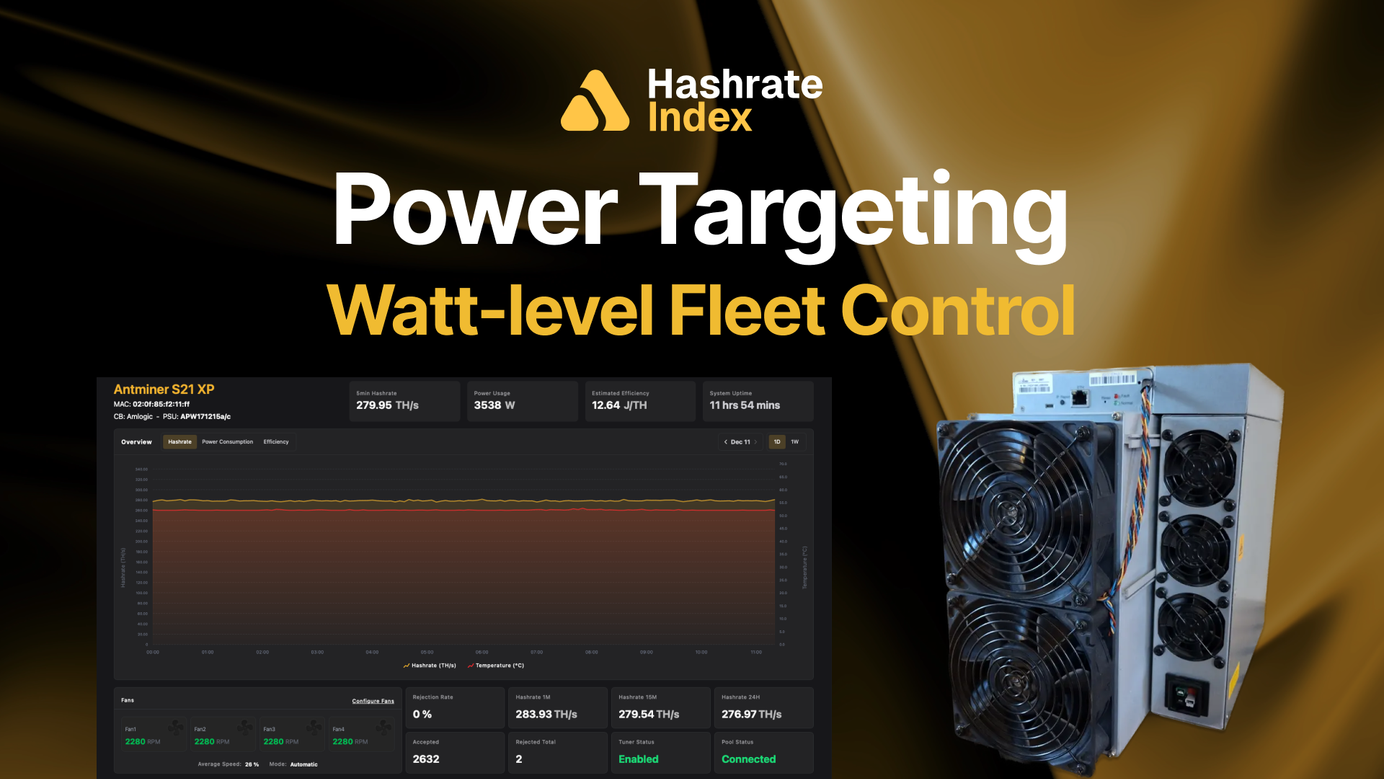
Power Targeting is watt-anchored tuning. Instead of selecting a frequency preset, the operator sets a power target (e.g., 3,400 W) and the AutoTuner picks whatever frequency and voltage land on it, then keeps re-picking as conditions change. On supported models the familiar preset profiles (+1, −2, Default) still work at the surface, but under the hood each one is interpreted as a predefined power target. Luxor introduced the architecture in its Power Targeting launch announcement in late 2025, and has been deepening it since.
One detail: LuxOS reads the power supply directly (a power-supply heartbeat) rather than inferring draw from a model. The wattage on your dashboard is measured, not estimated, which is what makes a hard target (and the bounds below) meaningful at the wall, not just on a chart.
Why Watts Beat Frequency for Operators
- Predictable consumption. The number on your load plan is the number the miner draws — full stop. That stability also keeps machines clear of PSU over-power protection thresholds, avoiding unnecessary downtime.
- Mixed-fleet coordination. S19s and S21s don't share a frequency table, but they all speak the same watts. A site-level megawatt budget decomposes cleanly into per-machine power targets.
- Curtailment without cold starts. Machines can be idled at low wattage through a curtailment window instead of a complete powering off. This maintains internal heat and avoids cold-start penalties. Soluna (NASDAQ: SLNH) cut its curtailment ramp time roughly in half on LuxOS.
- Energy-market participation. Watt-level precision is the entry ticket to demand response, interval energy trading, and 4CP-style peak avoidance.
- Heat reuse you can budget. BTU output is proportional to watt input, so heat-recycling sites can plan thermal output precisely.
Setting the Bounds: Target, Limit, and Minimum
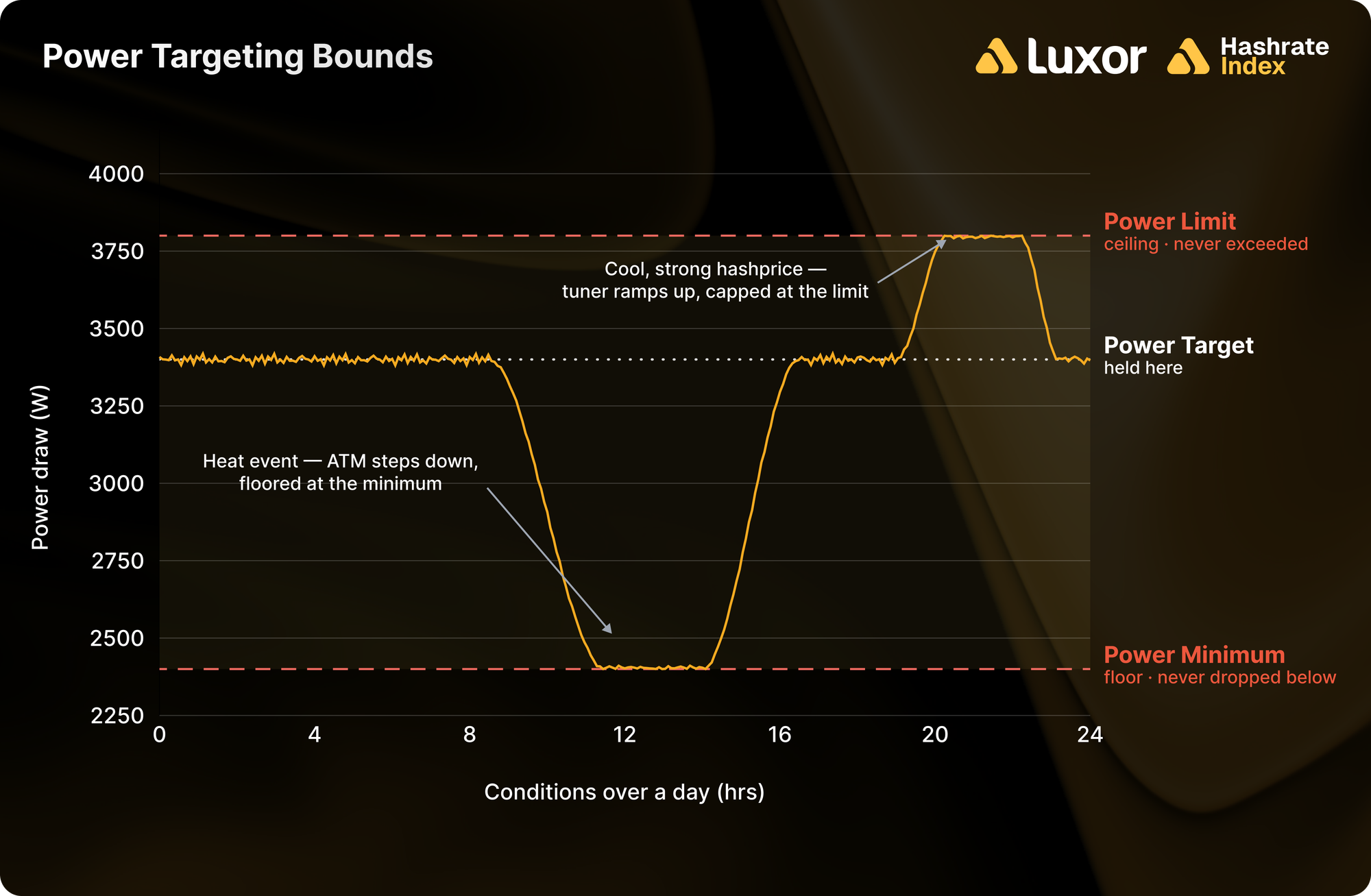
Power Targeting now exposes three independent controls instead of one. The power target is the wattage the tuner holds. The power limit is a ceiling the machine will not exceed. And the power minimum is a floor it will not drop below. Together they define the exact corridor your fleet is allowed to over- and underclock within, far more precisely than a single target with an implicit cap.
That corridor is what lets automation run unattended. When heat builds, Advanced Thermal Management (ATM) steps the miner down toward the floor — but stops at your minimum, so a machine you need online for load stability never falls below it. When conditions cool and hashprice runs hot, the tuner can ramp back up toward the ceiling, but stops at your limit, so you never blow past a circuit rating or a contracted draw. You set the range once; LuxOS firmware continuously works inside it.
How to Set a Power Target
- LuxOS Web UI — open the miner's IP, go to Preset Profiles, enter a wattage in the Power Target field (and your limit and minimum), and save.
- Commander — select miners, open Configure Miners → Power, enter the target and bounds, then Review and apply fleet-wide.
- API — set targets programmatically with a session ID and a wattage; ideal for wiring targets into an automated dispatch system.
Two interactions worth knowing. With ATM enabled, heat can pull the miner below target (but no lower than your minimum), and once temperatures stabilize it ramps back toward target inside the corridor. While Power Targeting is active, manual frequency and voltage commands are rejected; disable it first if you want hands-on control of an individual board.
Power Targeting FAQ
What's the difference between the target, the limit, and the minimum? The target is the wattage the tuner aims to hold; the limit is the ceiling it won't exceed; the minimum is the floor it won't drop below. The target lives inside the limit-to-minimum band.
Which miners support Power Targeting? Select newer Antminer models (S19 XP and S21 families, among others), with hydro models added over time. Check the LuxOS compatibility list for your exact unit and hashboard.
Can I change the target without restarting? Yes. Send a new value any time and the miner ramps smoothly from its current draw. Each new value replaces the last.
Does it work with ATM? Yes, they run alongside each other. ATM enforces thermal limits by moving the miner within your corridor, never below the minimum you set.
What happens if I set a target the model can't do? Targets outside the model's supported range are rejected.
Conclusion
Power Targeting turns a mining fleet into a precise dispatchable load — the property every intelligent energy strategy downstream of it depends on. With a target, a limit, and a minimum, you no longer just pick a number; you define the entire range the fleet is free to move in, and let the firmware optimize inside it.
Building toward demand response, interval energy trading, or precise heat recycling? Talk to Luxor about putting Power Targeting to work.
If you'd like to learn more about Luxor's full-stack Bitcoin mining services, reach out to [email protected] or visit luxor.tech.
If you’d like to learn more about Luxor’s full-stack Bitcoin mining services, please reach out to [email protected] or visit https://luxor.tech.
About Luxor Technology Corporation
Luxor delivers hardware, software, and financial services that power the global compute and energy industry. Its product suite spans Bitcoin Mining Pools, ASIC Firmware, Hardware trading, Hashrate Derivatives, Energy services, a Miner Management software, Commander, and a bitcoin mining data platform, Hashrate Index.
Disclaimer
This content is for informational purposes only, you should not construe any such information or other material as legal, investment, financial, or other advice.

Hashrate Index Newsletter
Join the newsletter to receive the latest updates in your inbox.