Case Study: Full-stack Mining With Steelhead Power Company
A look inside an end-to-end Luxor deployment.

Most miners assemble their stack piecemeal: hardware from a broker, firmware from one vendor, a pool from another, and financial services from a desk that has never seen their site(s). Steelhead Power Company took a different approach.
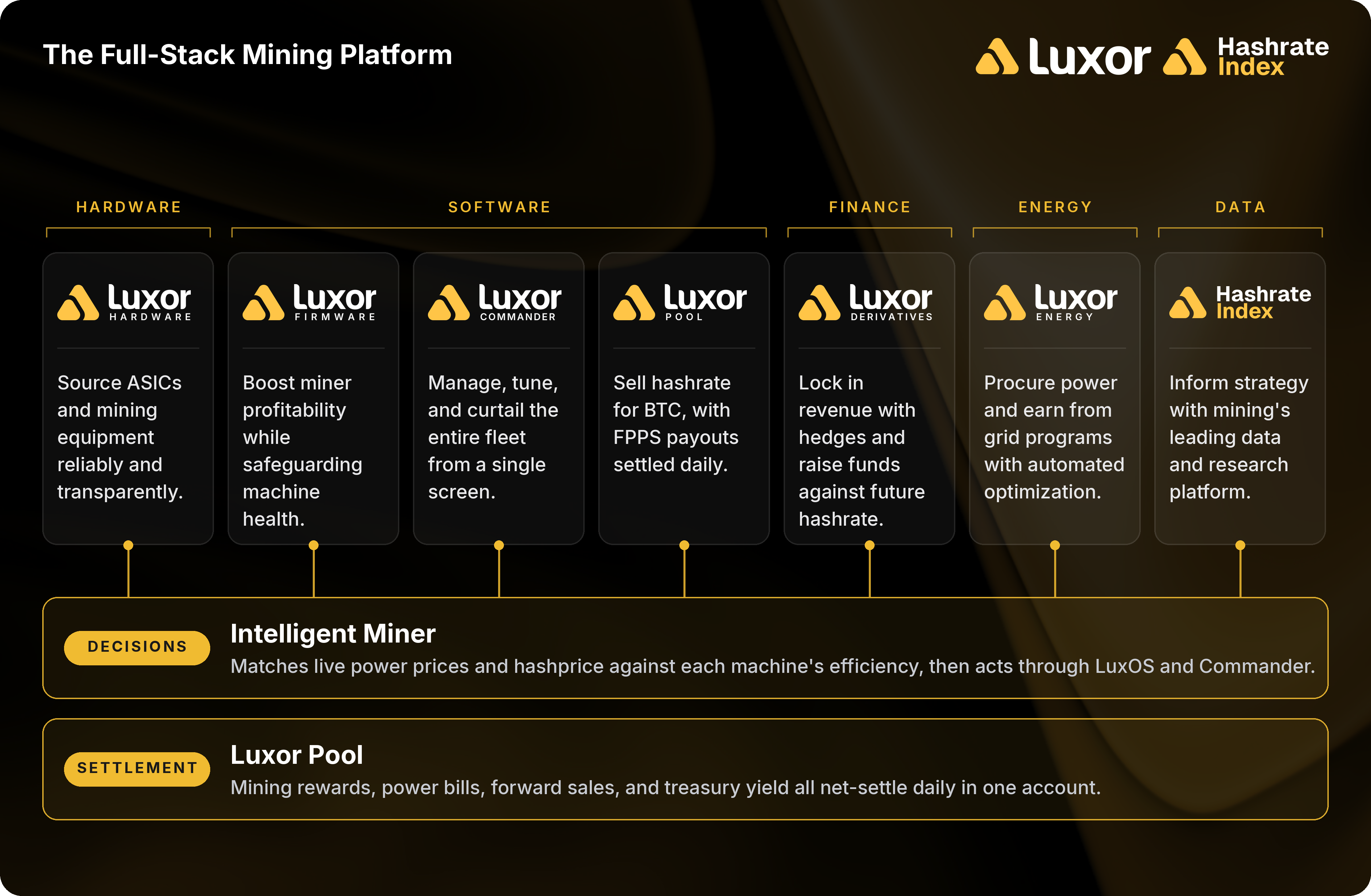
This case study demonstrates what it's like to run every layer of Luxor's ecosystem. Hardware, software, finance, and energy: everything a Bitcoin miner needs in a unified platform.
TLDR
- Steelhead Power Company is based in Fort Worth, TX, and operates industrial-scale Bitcoin mining facilities running hydro and immersion-cooled hardware.
- Steelhead's mining operation utilizes the complete Luxor stack: ASIC hardware procurement, LuxOS firmware, Commander for fleet management, Luxor Pool for payouts, hedging, financing, and energy services, and Hashrate Index Premium for data.
- Steelhead sourced a wide range of miner makes and models through Luxor's hardware desk, including a mix of Antminer S21 XP Hydro and S19 XP+ Hydro units, WhatsMiner M63S and M63S+ hydro units, Canaan A1566I immersion units, and S19 Pro air units.
- ~40% of Steelhead's total hashrate runs on LuxOS today (more than half of its LuxOS-compatible Bitmain hashrate), mining at a 0% pool fee.
- On financial services, Steelhead engages in hashprice hedging by selling hashrate forward for fixed pool payouts. It earns a BTC-denominated yield on its BTC treasury by acting as a liquidity provider for other miners via Luxor's hashrate-backed upfront pool payouts. All settlements occur daily on Luxor Pool.
- On energy services, Steelhead buys electricity from Luxor and automatically pays power bills through Luxor Pool, auto-settled against daily mining revenue. The operation earns additional revenue through active power market participation in Demand Response, Ancillary Services, and 4CP Peak Avoidance. Via Intelligent Mining, an automated profitability optimizer, Steelhead continuously maximizes fleet-wide profitability across all intervals by matching live locational marginal prices (LMPs) and hashprice against each miner's efficiency.
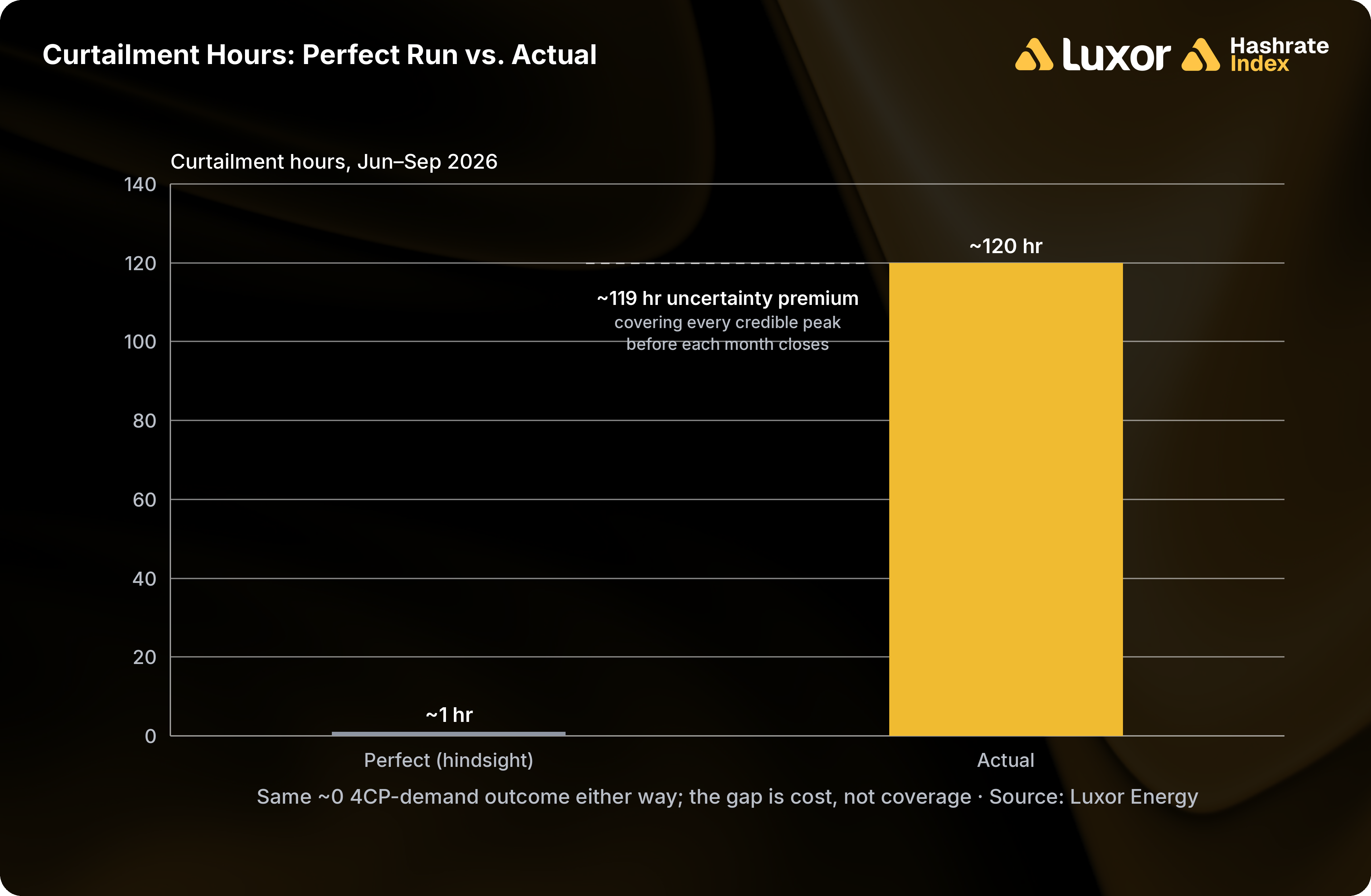
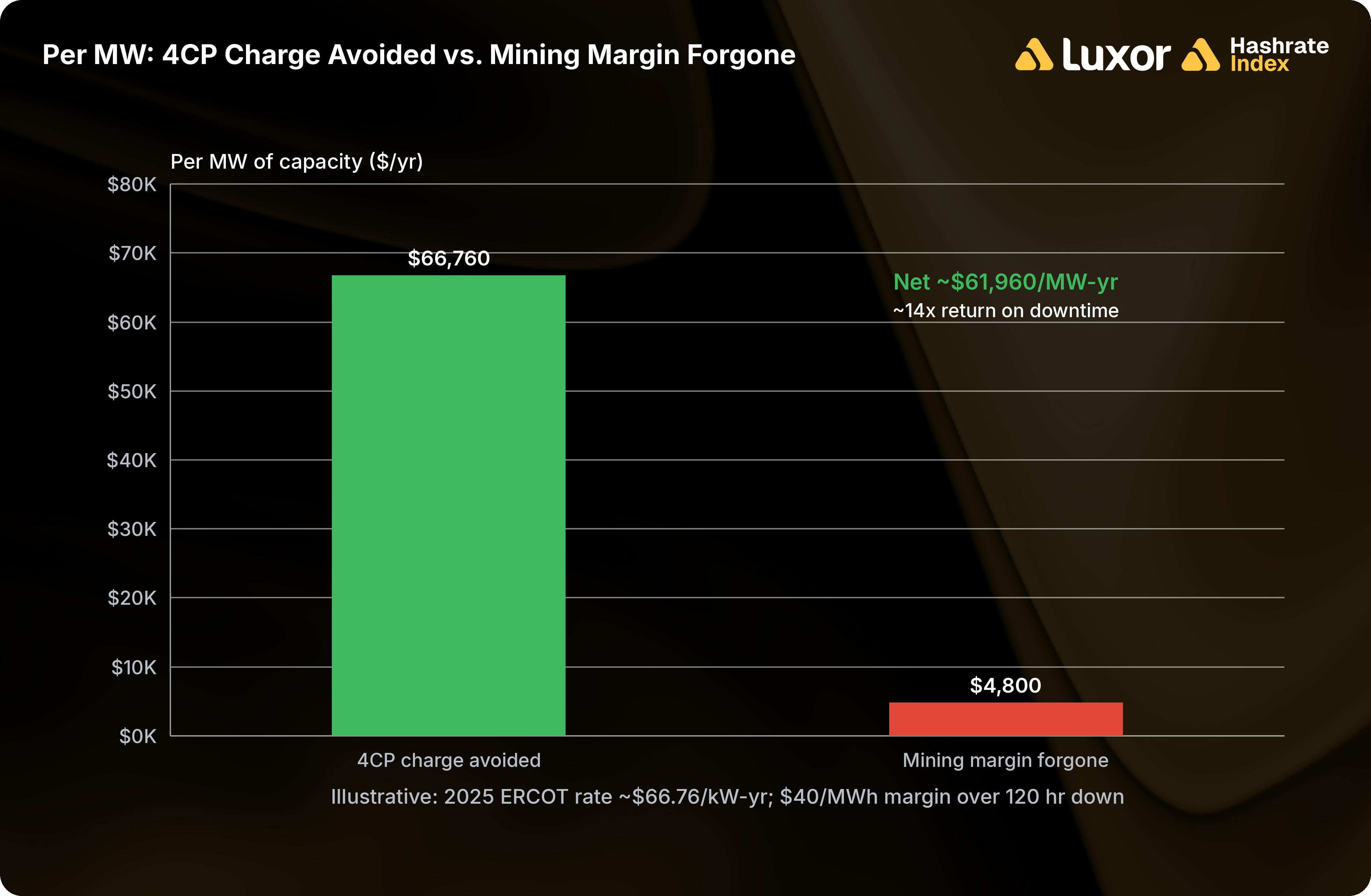
- During the 2026 ERCOT 4CP season, Luxor's Intelligent Miner agent dispatched curtailment through all four coincident-peak intervals, targeting a 4CP demand of effectively zero. Covering the ~1 hour that sets the charge took ~120 hours of curtailment; on an illustrative per-MW basis, the avoided charges outweigh the forgone mining margin roughly 14:1.
- For a representative 1 MW ERCOT fleet, Hashrate Index estimates the full Luxor stack adds ~$94,000 per MW per year in gross margin (~$63,000–$103,000 across scenarios) versus stock firmware on a third-party pool with no 4CP curtailment, with about 60% of it coming from 4CP avoidance.
Background: Who Is Steelhead
Founded in 2023, Steelhead Power Company is an independent operator of industrial-scale bitcoin mining facilities, focused on deploying hashrate with liquid-cooling architectures. Its first deployment used immersion-based infrastructure, which it still operates. Since then, Steelhead has adopted hydro cooling as its preferred infrastructure, deploying both skid-mounted and containerized hydro systems.
Texas heat determines Steelhead's facility design. Liquid cooling keeps the mining fleet at an optimal thermal range through summers where ambient temperatures routinely clear 40°C (104°F).
The Full Mining Stack
A Bitcoin mining operation is really a four-in-one business. Miners buy infrastructure, hardware, and power; consume electricity and produce application-specific Bitcoin compute (SHA-256); sell the compute to earn bitcoin (BTC) in return; and manage many risks throughout the process. Most operators stitch these layers together through different counterparties, but this leaves a lot on the table.
Steelhead's mining strategy overcomes that leak. Hardware procurement, software services (firmware, fleet management), finance (pool payouts, hedging, investments), energy (procurement and ancillary services), and market-specific data are all delivered through a single vendor, so every layer talks to the others. The hardware purchase decision is data-driven, and compatible units run flexible firmware. The fleet management tool automatically receives curtailment dispatch signals from the energy desk. The pool that pays out daily rewards is the same counterparty that structures hedging and financing programs. The data platform provides the metrics that matter, including the underlying compute price index that contracts settle against.
"Luxor bridges the gap between everyday operations and power procurement, management, and cost settlement in a single, vertically integrated stack, improving process flows and letting operators focus on growth rather than vendor management and revenue/cost settlement."
— Steven Hood, President, Steelhead Power Company
The Hardware Layer: Purchasing ASICs
Steelhead has sourced in excess of a thousand machines across three manufacturers and six models through Luxor's Hardware desk, currently operating fleets running Bitmain's hydro flagship models, MicroBT's hydro flagship models, and Canaan's immersion-ready units.
"Luxor has always gone above and beyond when it comes to ongoing client care, and their hardware desk consistently provides valuable insights into market trends to inform purchasing decision-making. They take a 'partner approach', and make the purchasing, delivery, and OEM warranty management processes seamless."
— Steven Hood, President, Steelhead Power Company
The Software Layer: Pool, Firmware, and Fleet Management
How Steelhead Earns Mining Rewards
The full fleet points at Luxor Pool, converting hashrate into predictable daily BTC earnings. LuxOS machines mine at a 0% pool fee. Daily FPPS (Full-pay-per-share) settlement is also what makes the financial and energy layers work: Steelhead procures electric power through Luxor and pays those bills directly from its pool mining revenue via Auto-Settlement, netted against daily earnings. Luxor Pool also acts as the clearing house for Steelhead's forward hashrate sales (fixed pool payouts) and liquidity provision for other miners to borrow BTC against their future hashrate production (upfront payouts).
"We run a separate subaccount per site on Luxor Pool, so each site's production and performance are easy to monitor on their own. Payouts come daily and we pull them into our own reporting off the API."
— Mario Mojarro, Analyst, Steelhead Power Company
Flexible Firmware and Fleet Management
Roughly 40% of Steelhead's total hashrate production capacity runs on LuxOS today, deployed across its Bitmain S19 and S21 series models. For liquid-cooled Texas sites, the relevant firmware features are thermal: water-inlet-aware Advanced Thermal Management (ATM), and watt-level Power Targeting. These custom controls make the energy layer executable.
Commander is Steelhead's fleet management system: bulk actions, fleet-wide performance profile changes, and coordinated curtailment workflows across hundreds of machines from a single screen. The engine making dynamic decisions, Intelligent Miner, is fed with real-time telemetry from power markets, LuxOS, and Hashrate Index to continuously optimize fleetwide profitability across all intervals.
"Our S21 fleet runs fully on LuxOS. We use Power Targeting to tune individual miners' target draw, which matters a lot in the Texas summer heat. Commander also lets us run fleet-wide changes in a matter of minutes, and stage them so the miners aren't all ramping up or down at once."
— Mario Mojarro, Analyst, Steelhead Power Company
The Financial Layer: Forward Sales and Treasury Management
This is where Steelhead's deployment goes beyond the typical operator. Two financial strategies run in parallel.
Hashprice Hedging
Forward hashrate sales. Steelhead sells a portion of its future hashrate production to lock in revenue certainty against hashprice volatility with fixed pool payouts. The result is more predictable earnings and a stronger credit profile.
BTC Yield on Treasury
BTC-collateralized upfront payout liquidity provision for miners. Steelhead pledges a portion of its BTC treasury as a lending liquidity provider, allowing miners on the other side to receive upfront payout funds through Luxor Pool. Steelhead's pledged BTC earns yield as borrowing miners' daily production flows into its pool position, turning the treasury from idle weight on the balance sheet into a Bitcoin-native yield generator.
"We sell a portion of our production forward through Luxor for fixed pool payouts. It settles on Luxor Pool along with everything else, so it isn't a separate process on our end. We run our own hashprice modeling off Hashrate Index data."
— Mario Mojarro, Analyst, Steelhead Power Company
The Energy Layer
Steelhead's sites sit in ERCOT, where power prices define a miner's strategy. Volatile (and sometimes negative) spot power price action, demand-response programs, and 4CP transmission charges all make a flexible load's megawatts worth materially more than an inflexible one. Steelhead uses Luxor Energy services to procure power, participate in demand-response and ancillary services, and dynamically curtail on dispatch signals.
"We buy our power and settle our bills through Luxor Energy. At one of our sites, Luxor's Intelligent Miner agent handles curtailment for us, so the fleet comes down on price automatically as the agent is constantly looking for the most profitable performance profile to run at."
— Mario Mojarro, Analyst, Steelhead Power Company
The 2026 4CP Season: Protecting the Hour That Sets the Next Year
ERCOT sets a load's annual transmission charge from four 15-minute intervals: the single highest system-demand interval in each of June, July, August, and September. The charge is the average of a load's demand across those four intervals, so each one carries equal weight. Miss one, and a quarter of that interval's load stays in the transmission bill for the next 12 months.
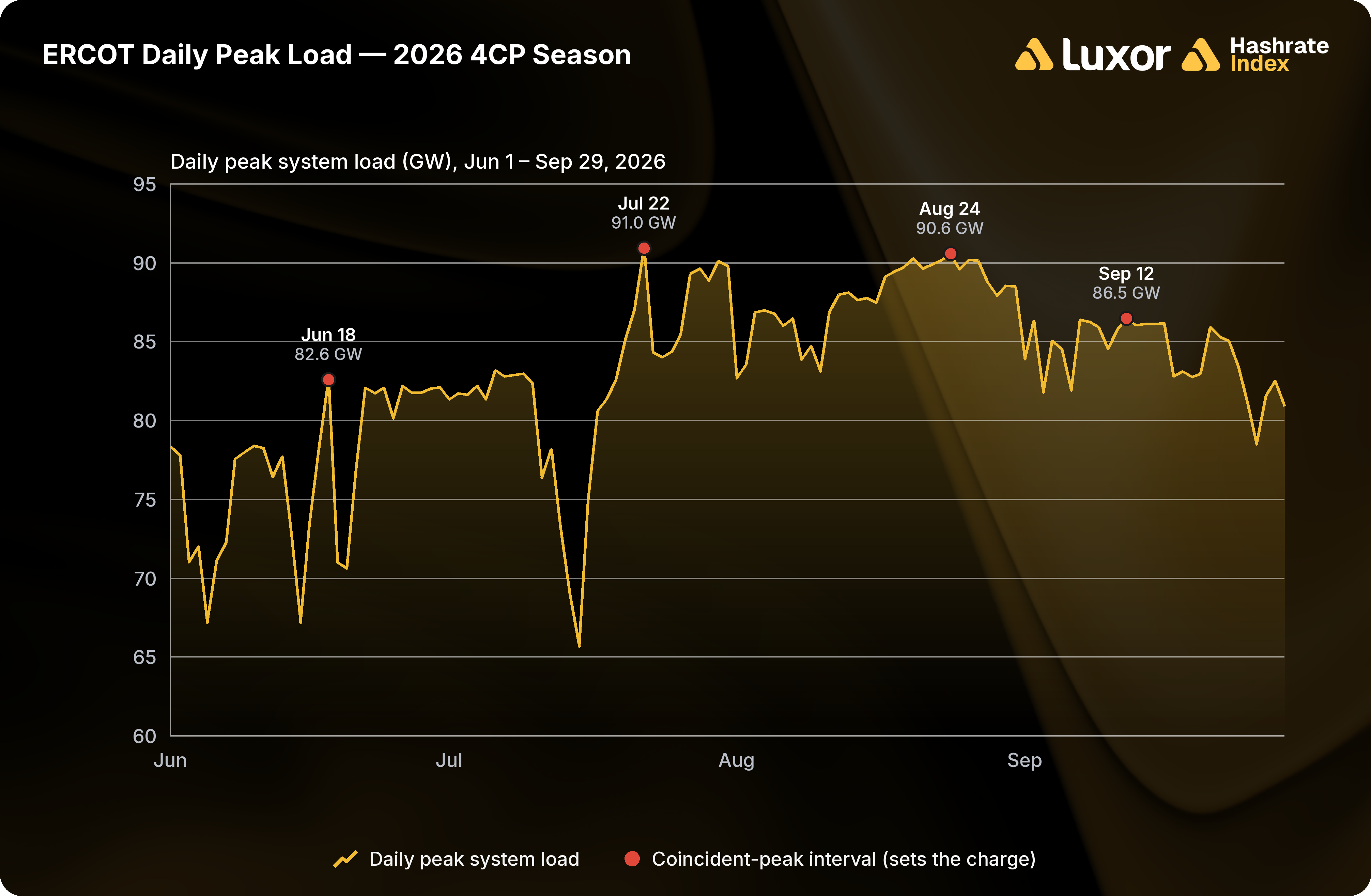
Net of wholesale storage, the four intervals came in at 81.95 GW (June 18), 90.81 GW (July 22), 90.20 GW (August 24), and 86.20 GW (September 12), for a 4CP basis of 87.29 GW. Hashprice averaged ~$33.87 per PH/s/day over the same four months, from a low of $27.74 on June 6 to a high of $41.01 on September 22, which kept the opportunity cost of each curtailed afternoon low.
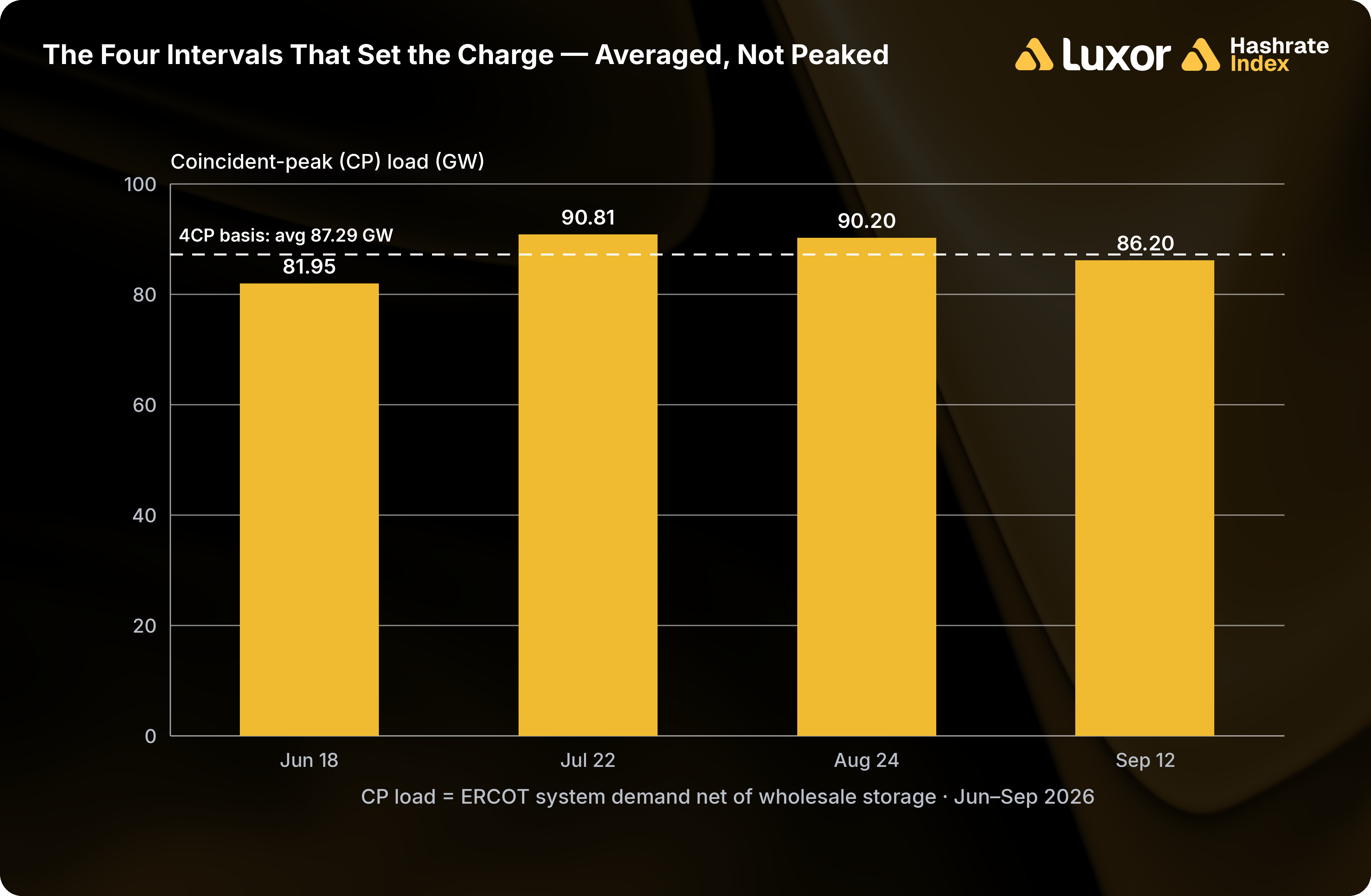
Luxor's Intelligent Miner agent dispatched curtailment at all four monthly peaks, targeting a four-interval average (the basis for next year's transmission charge) of effectively zero. Metered interval data already confirms the August result; ERCOT's settlement data for the full season is finalized after the summer closes. Curtailment coverage held from June through September.
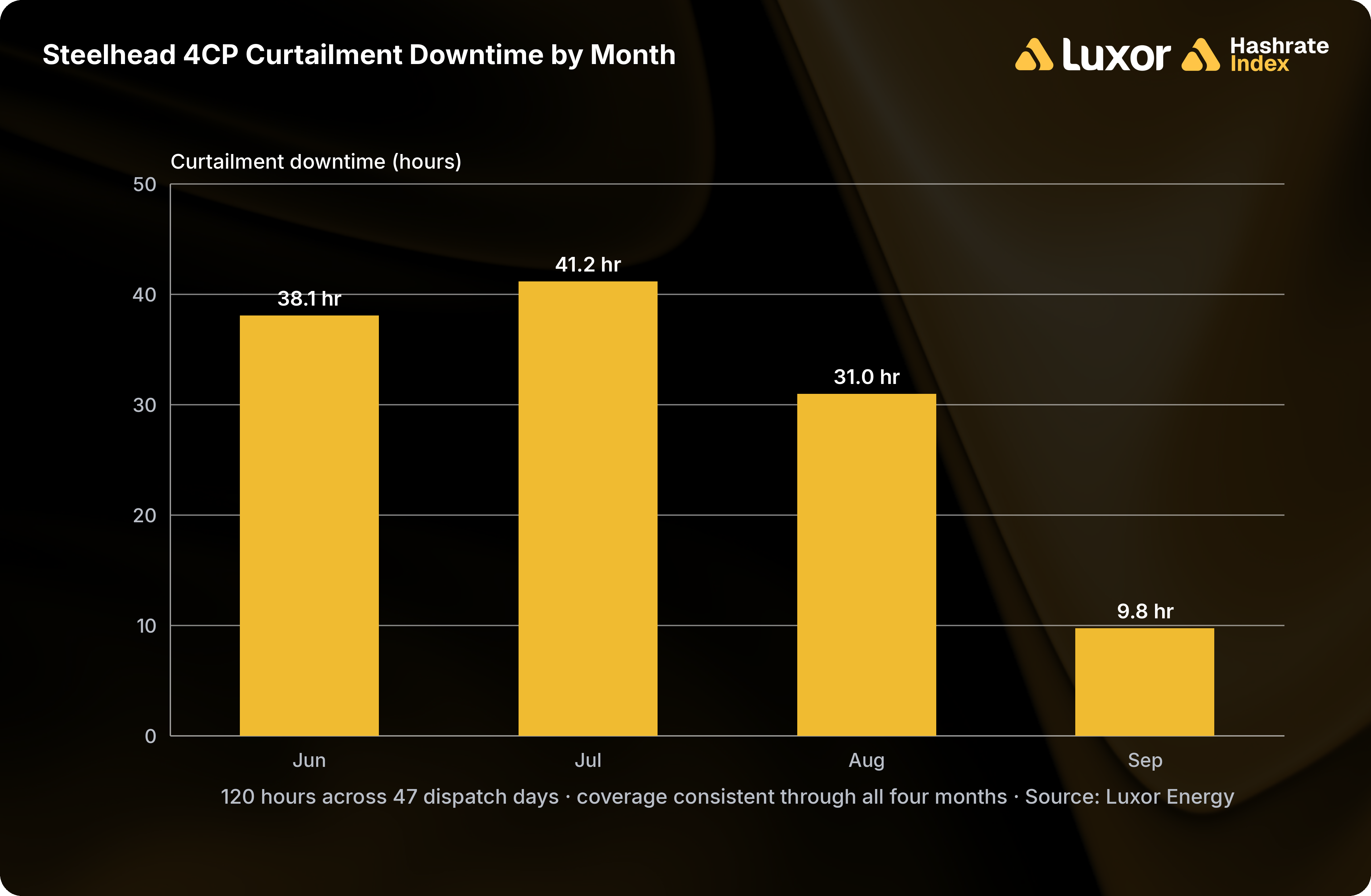
Only about one hour of intervals sets the charge, but that hour is unknown until each month closes. Steelhead logged ~120 hours of curtailment across 47 dispatch days to cover every credible peak; the extra ~119 hours of curtailment was the price of never missing a peak. September was the most efficient month and June was the least, spending the most dispatch events on what turned out to be the season's lowest peak.
The economics still favor curtailing. At 2025 ERCOT transmission rates (~$66.76/kW-yr), each MW of 4CP demand avoided is worth ~$66,760 a year. Against an illustrative $40/MWh of forgone mining margin over ~120 hours (~$4,800 per MW), that is a ratio of roughly 14:1. The margin estimate is conservative: 4CP peaks fall in the highest-power-price afternoon hours, when mining margin is already at its thinnest.
The rules may change after this season. The Public Utility Commission of Texas has proposed replacing 4CP with a 12CP methodology (one 30-minute coincident peak in every month) alongside a minimum billing demand for large loads, with a decision expected in December 2026. If adopted, peak avoidance becomes a year-round discipline rather than a summer one, which favors operations that already curtail automatically.
The Intelligence Layer: Hashrate Index Premium
The dynamic decisions described above run on metrics, prices, and signals. ASIC prices for hardware procurement, hashprice for pool payouts and hedging, and other Bitcoin network and compute metrics for ongoing operations. Steelhead utilizes Hashrate Index Premium as the data layer across all of them. Together with the rest of the mining stack, this Intelligent Mining strategy continuously optimizes the fleet for profitability. It works because every layer runs in coordination.
What the Full Stack Is Worth per MW
Steelhead's own economics stay private, but the levers behind them are not. To size the value of the full stack for any operator, we modeled a representative 1 MW ERCOT fleet of S21 XP-class hardware two ways: a peer running stock firmware on a third-party FPPS pool with no 4CP curtailment, and the same fleet running on Luxor's stack.
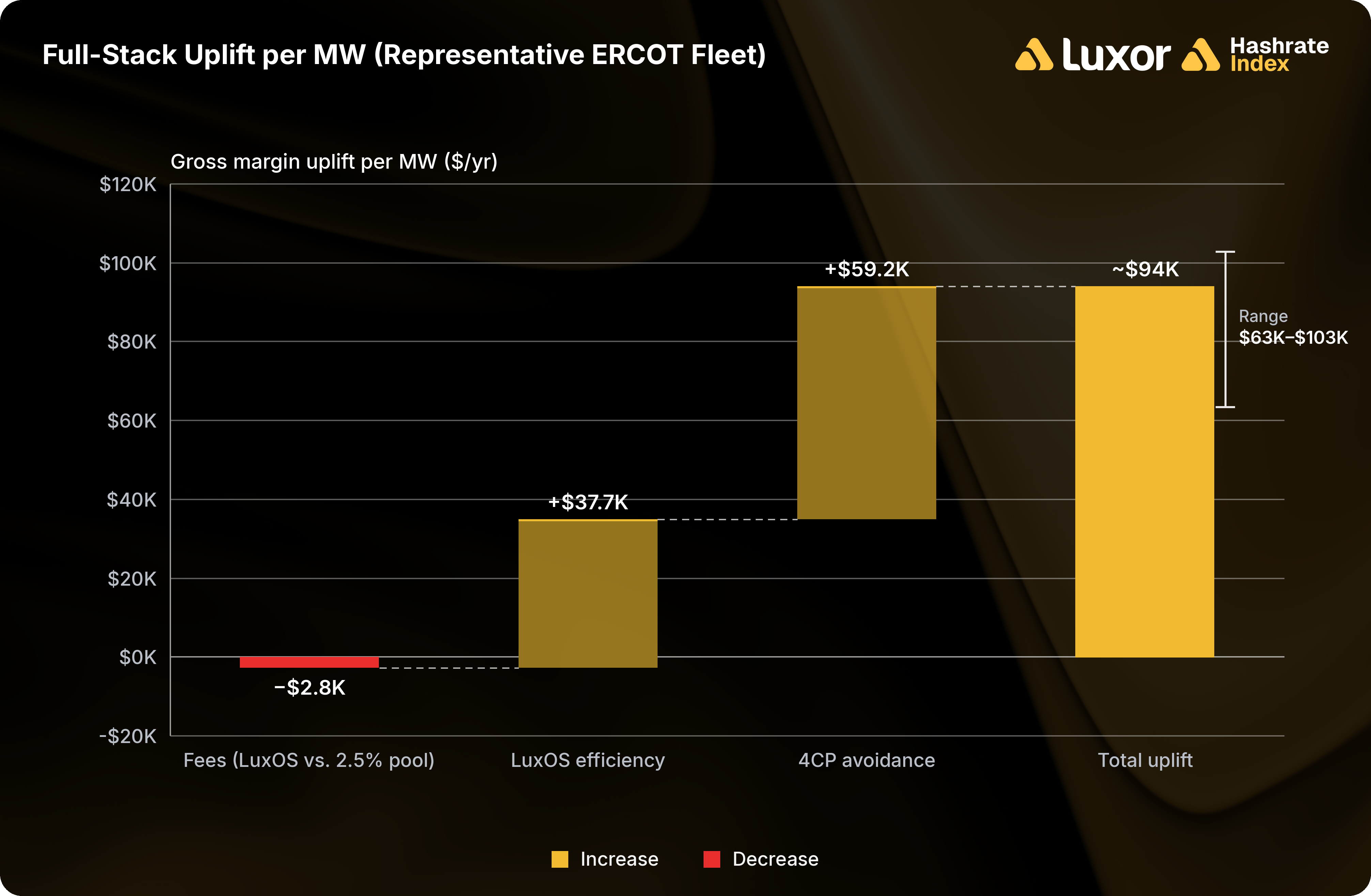
The stack adds an estimated ~$94,000 per MW per year in gross margin, about 18% more than the peer at these inputs. 4CP avoidance does most of the work (~$59,000, net of the mining margin given up over ~120 curtailed hours), followed by LuxOS efficiency (~$38,000, based on the published S21 XP benchmark of 8.4% lower power draw at default settings). Fees are roughly a wash: LuxOS' 2.8% fee with 0% pool fees on Luxor Pool, against a typical 2.5% FPPS fee elsewhere.
The dollar figure is steadier than the percentage. Across power prices of $35–55/MWh, hashprice of $34–45 per PH/s/day, and half to full published firmware gains, the uplift holds at ~$63,000–$103,000 per MW, while the percentage swings with each operator's margin. Against a pool with a 0% listed fee, the uplift narrows to ~$71,000; against a 4% FPPS pool, it rises to ~$108,000. Outside ERCOT, or if Texas moves to 12CP, the 4CP lever shrinks and firmware plus fees leave ~$35,000 per MW at base inputs.
The estimate is conservative by construction. It leaves out Intelligent Miner's price-based curtailment, demand-response and ancillary services revenue, hardware pricing, and treasury yield, and it gives hashprice hedging no credit because forward sales reduce volatility rather than raise expected margin.
Model inputs: 13.5 J/TH stock efficiency, 95% uptime, a trailing 12-month average hashprice of $35.96 per PH/s/day (through October 12, 2026), illustrative all-in power of $45/MWh, the 2025 ERCOT transmission rate of ~$66.76/kW-yr, and ~120 hours of 4CP curtailment.
Conclusion
Each Luxor product stands on its own, but the advantage is in the combination. Hashrate Index prices hardware and compute. LuxOS tunes the fleet. The pool net-settles daily payouts, and forward contracts lock in the earnings. The energy layer taps into additional revenue streams, and Commander coordinates it all. The hardware desk stands ready to supply the next batch of hardware for growth, which the financial layer helps fund. One miner, one counterparty, and a flywheel for growth. This is what a full-stack bitcoin mining operation looks like.
Operations that take advantage of a vertically integrated full-stack partner, such as Luxor, stand to not only survive but thrive. Steelhead Power Company is an exemplary operation running this playbook end to end.
To learn more about Luxor's full-stack mining experience (hardware, firmware, pool, derivatives, energy, or data), visit luxor.tech or reach out to us.
About Luxor Technology Corporation
From Bitcoin mining to AI infrastructure, Luxor delivers the hardware, software, finance and energy tools that power the world's compute. Its Bitcoin product suite spans Mining Pools, ASIC Firmware, Hardware trading, Hashrate Derivatives, Energy services, and Miner Management software, Commander. Its AI product suite spans Hardware, Compute, and Luxor AI: cloud infrastructure for code and agents. Across both, Hashrate Index is Luxor's data and research platform.
Disclaimer
This content is for informational purposes only, you should not construe any such information or other material as legal, investment, financial, or other advice.
Nothing contained in our content constitutes a solicitation, recommendation, endorsement, or offer by Luxor or any of Luxor's employees to buy or sell any derivatives or other financial instruments in this or in any other jurisdiction in which such solicitation or offer would be unlawful under the derivatives laws of such jurisdiction. There are risks associated with trading derivatives. Trading in derivatives involves risk of loss, loss of principal is possible.

Hashrate Index Newsletter
Join the newsletter to receive the latest updates in your inbox.