
Luxor Hashrate Lookback Series — September 2026
September 2026’s hashrate and hashprice trends, forward market participation, trading activity and contract performance.




Luxor’s Monthly Lookback Series is a deep dive into Bitcoin hashrate market activity. In this post, we cover September 2026’s hashrate market and hashprice trends, forward market participation, trading activity and contract performance.
Summary
- Network Difficulty Took Some Gains Back: Bitcoin rose 7.3% from open to close in September. Hashprice rose 1.8% to $39.92 per PH/s/day. Difficulty absorbed the difference with a +5.52% increase across two upward retargets, including +4.16% on September 19, the largest since June.
- Bitcoin Through the Gauntlet: Clarity Act cloture failed on September 15 and the Fed raised rates 25 bp on September 16. Bitcoin printed its monthly low that day ($75,791), then closed the month at $83,687 behind the largest single-day spot-ETF inflow of 2026.
- Hashrate Is Back: The 7-day network hashrate average climbed from 926 to 975 EH/s as ERCOT's final 4CP peak passed on September 12, and blocks averaged 9m23s, the fastest month since February. BTC hashprice averaged 0.00048965 BTC per PH/s/day (−2.0%) and closed the month 5.1% lower.
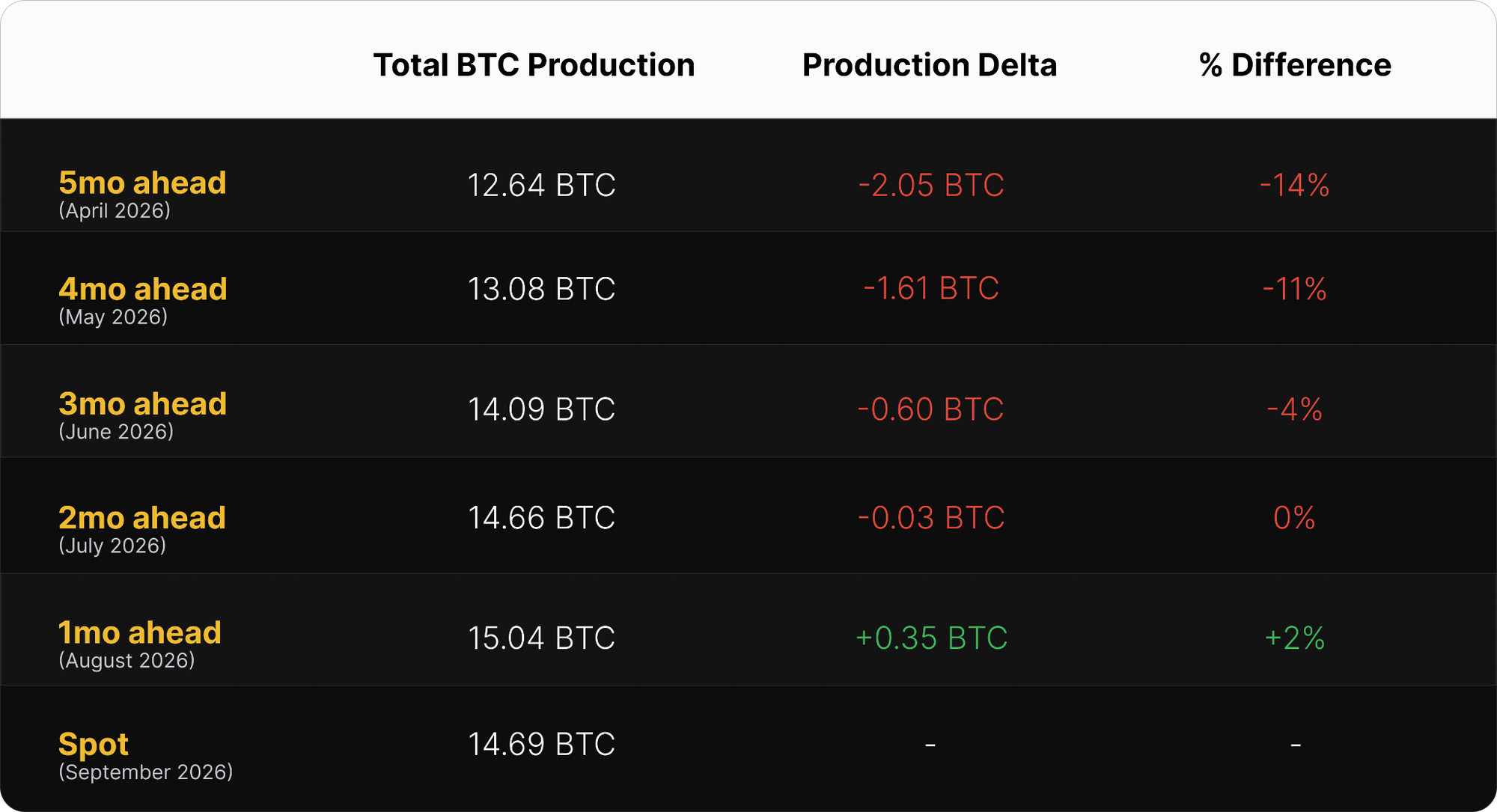
- One Hedge Won: Spot hashprice settled at $39.33, above all five USD forward sales of the September contract by 12% to 23%. In BTC terms, only the one-month forward sale beat spot (+2.4%), ending a five-month run in which every BTC-denominated hedge had lost.
- The Forward Curve Priced the Comeback: USD forwards rose 3–5% while BTC forwards fell 1–4%, and implied network hashrate now crosses 1 ZH/s in January 2027 at 1,029 EH. The network may get there first: the 7-day average reached 999 EH/s on October 8, and the current epoch is pacing a retarget near +4.6%.
September 2026 Spot Hashprice & Its Constituents
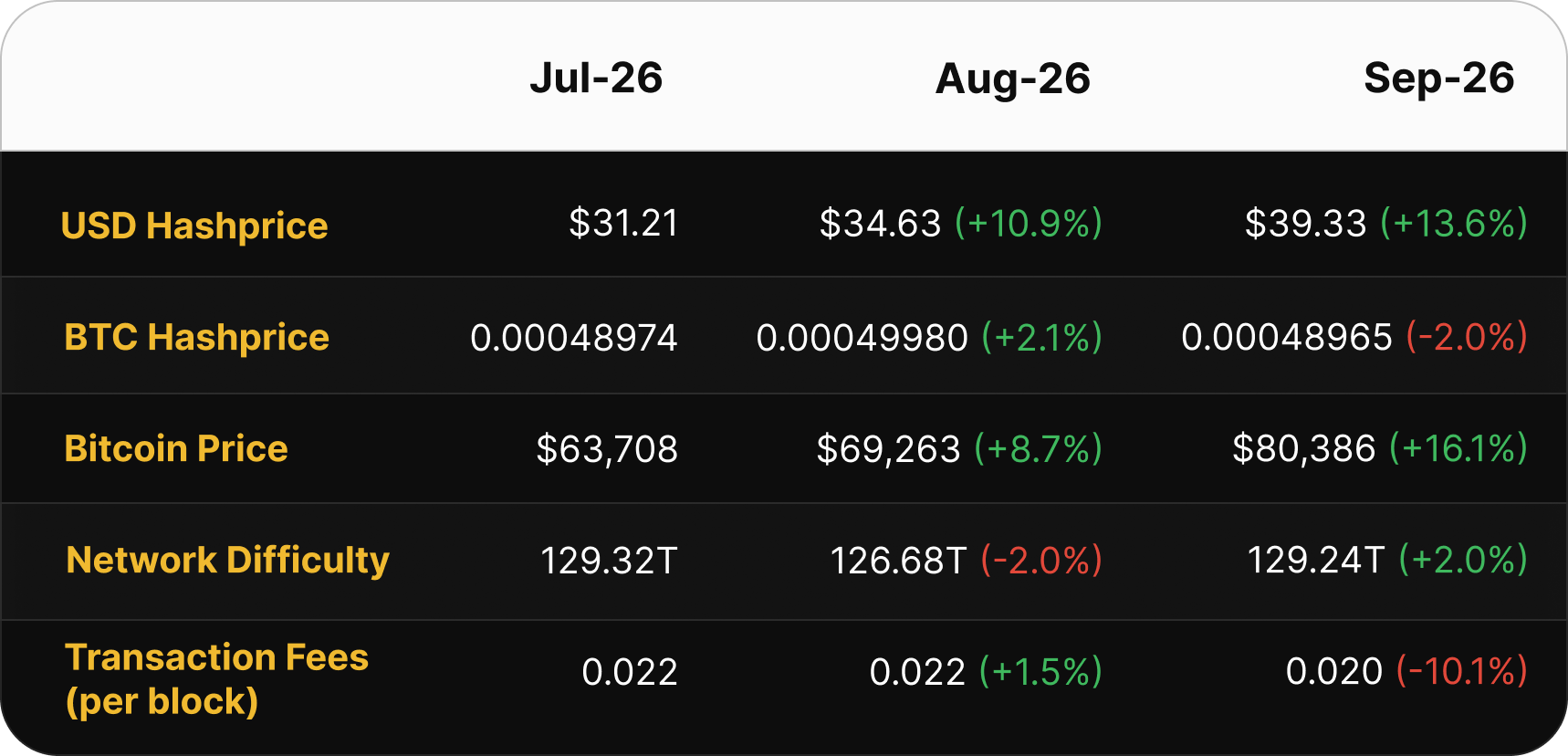
August's BTC rally added $7.70 to hashprice in twelve days and closed on a question: would Bitcoin keep climbing or would network difficulty take the hashprice raise back? September delivered a bit of both. Bitcoin climbed another 7.3% from open to close; difficulty added 5.5% across two upward retargets. Hashprice closed within $0.71 of where it opened.
USD Hashprice — Held Where August Left Off
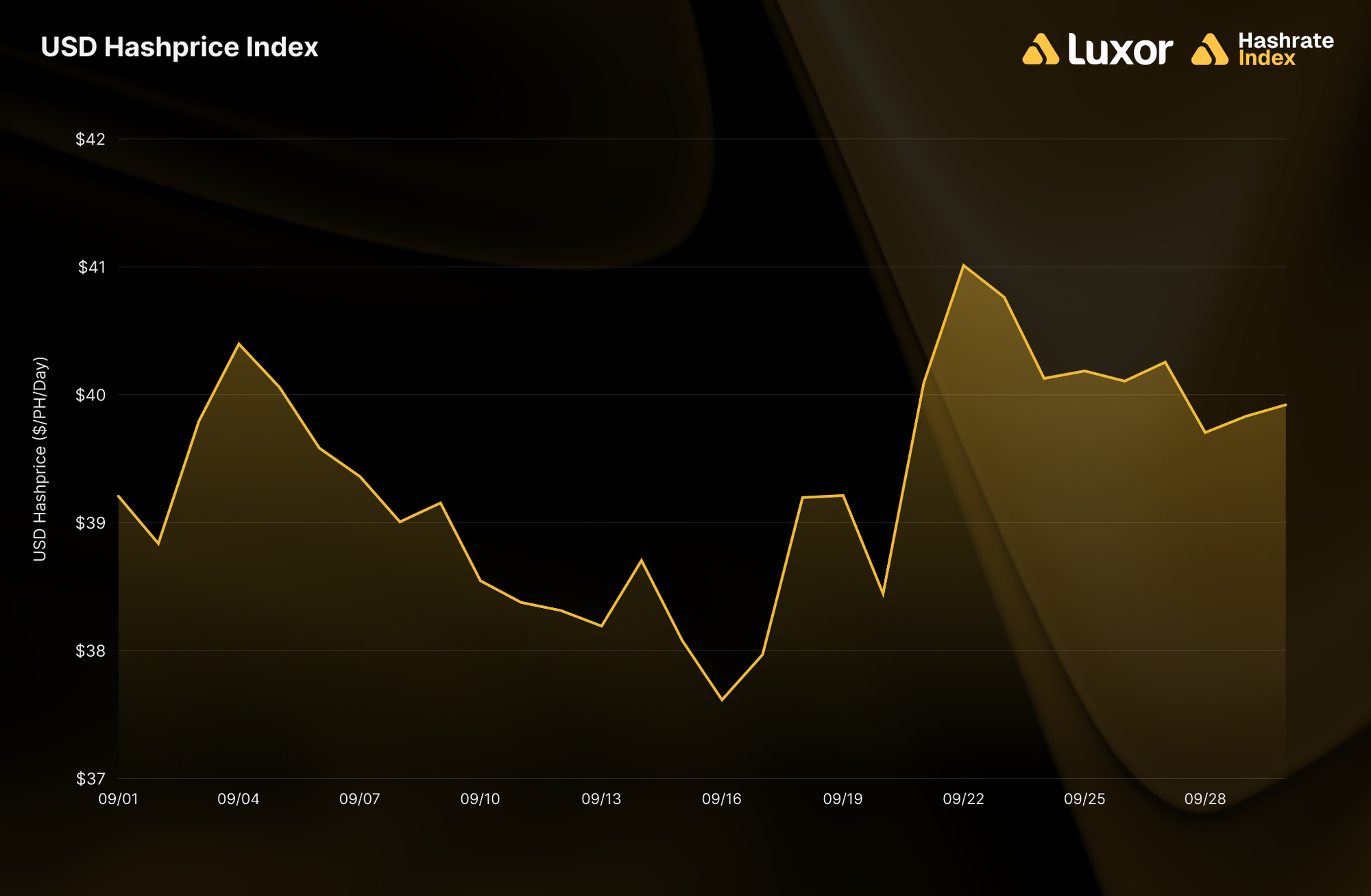
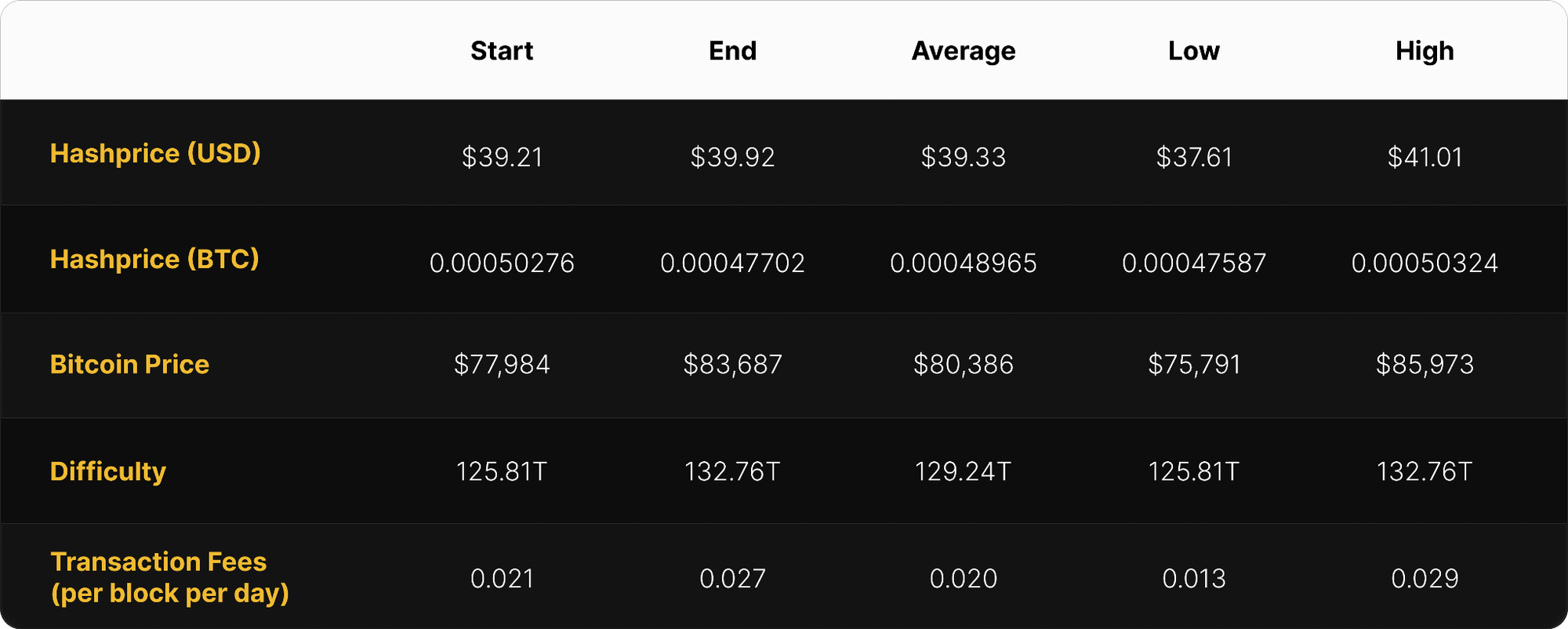
Hashprice kept the ground August won and gained little more. The month opened at $39.21 per PH/s/day, closed at $39.92 (+1.8%) and averaged $39.33, the highest monthly average since January. Nine days settled above $40, the most in any month since November 2025, against one in August.
The range was narrow by 2026 standards: a $37.61 low on September 16 and a $41.01 high six days later. Underneath, Bitcoin’s price pulled hashprice up but difficulty pulled it back down in nearly equal measure.
BTC Price — Two Bad Days, Then a 13% Week
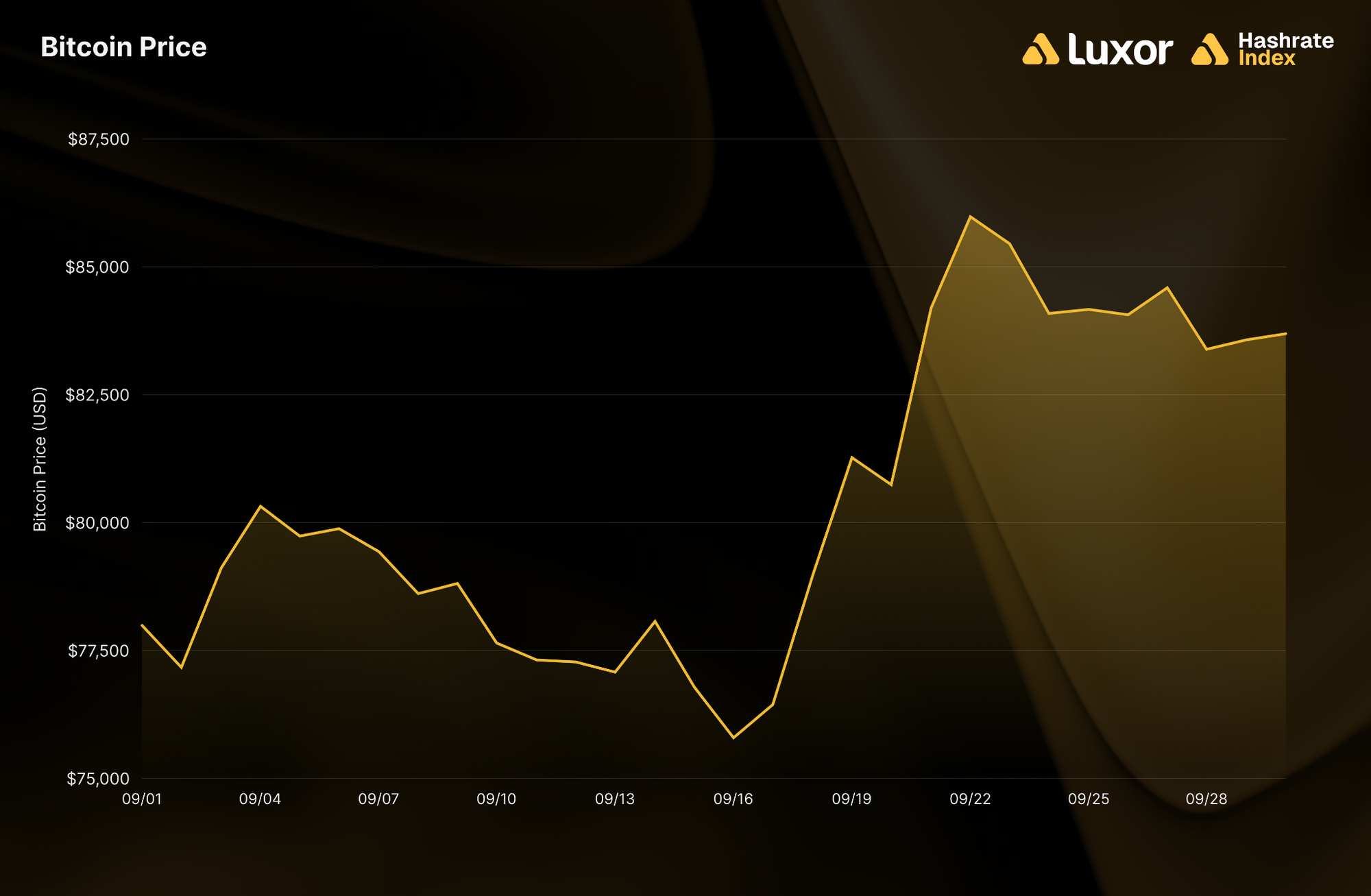
Bitcoin opened September at $77,984 and closed at $83,687 (+7.3%), averaging $80,386 (+16.1%) month-over-month. The high was $85,973 on September 22.
Two scheduled risks landed inside 24 hours, and both landed badly. On September 15 the Senate failed to invoke cloture on the Clarity Act (41 votes against), leaving the bill effectively dead for 2026. On September 16 the FOMC raised rates 25 bp to 3.75–4.00% (unanimously), the first hike since July 2023. Bitcoin's monthly low of $75,791 was that day.
Then it rallied. From September 16 to 22, Bitcoin gained 13.4% to $85,973 (its largest six-day gain since the August breakout), as spot ETFs took in $999M on September 21 (the year's largest single day and the most since October 2025), and $2.65B for the month, which lifted 2026 net flows back into positive territory. By Bloomberg Intelligence's estimate, the average US spot-ETF holder was back above cost for the first time since January.
At $83,687, Bitcoin ended September 32.8% below its October 6, 2025 peak of $124,485, versus −37.1% at the end of August. It remains 13.1% below the 2026 high of $96,278 (January 15). For the quarter, Bitcoin gained 41.8%, its best quarter since Q4 2024.
Network Difficulty — Two Retargets Up
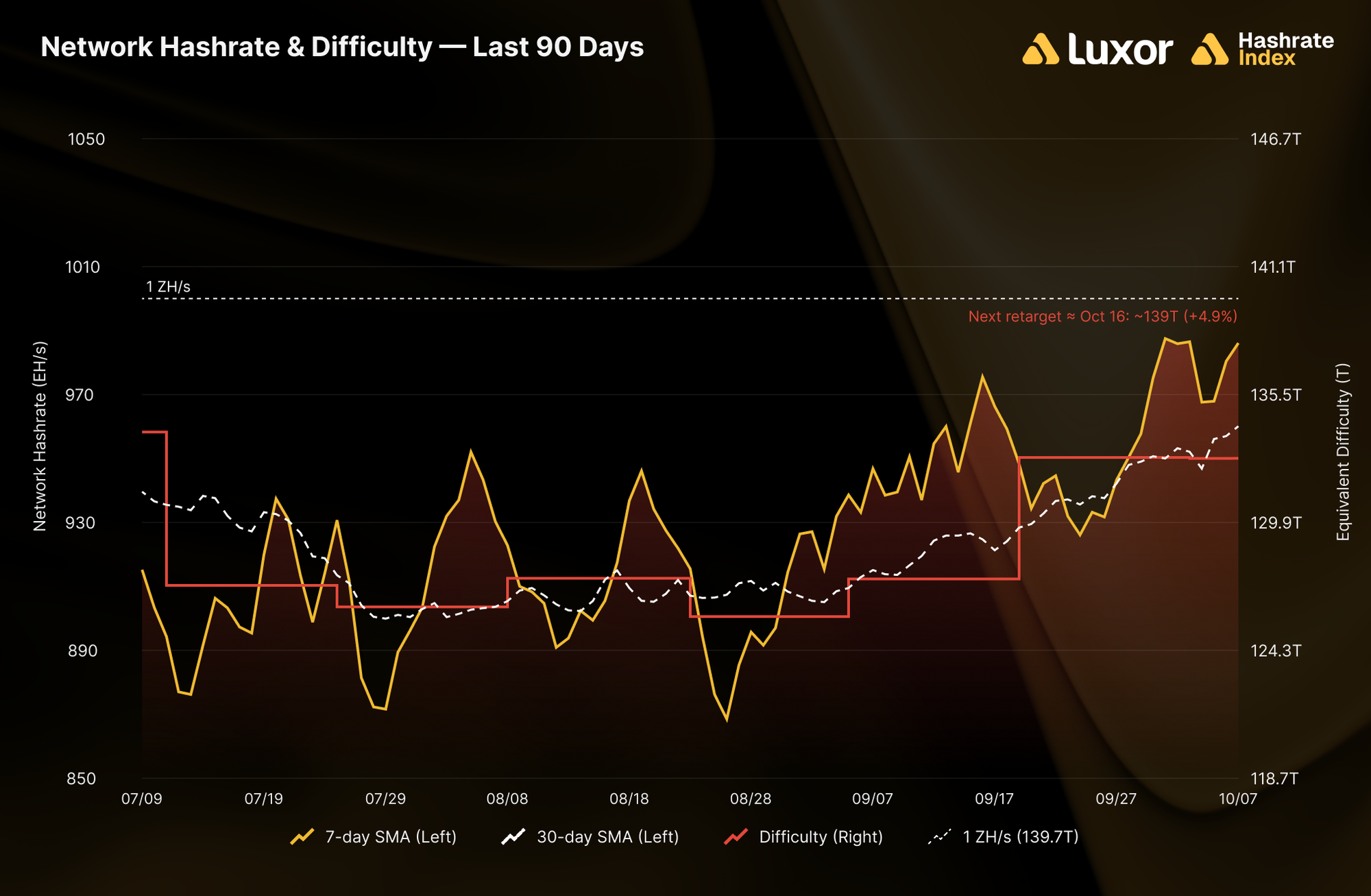
Difficulty averaged 129.24T (+2.0%), and finished the month at 132.76T. Two adjustments occurred and both were upward: +1.31% on September 5 and +4.16% on September 19, the largest single retarget since June 27. With a net gain of +5.52% across its two retargets, September saw the largest month of difficulty growth since October 2025.
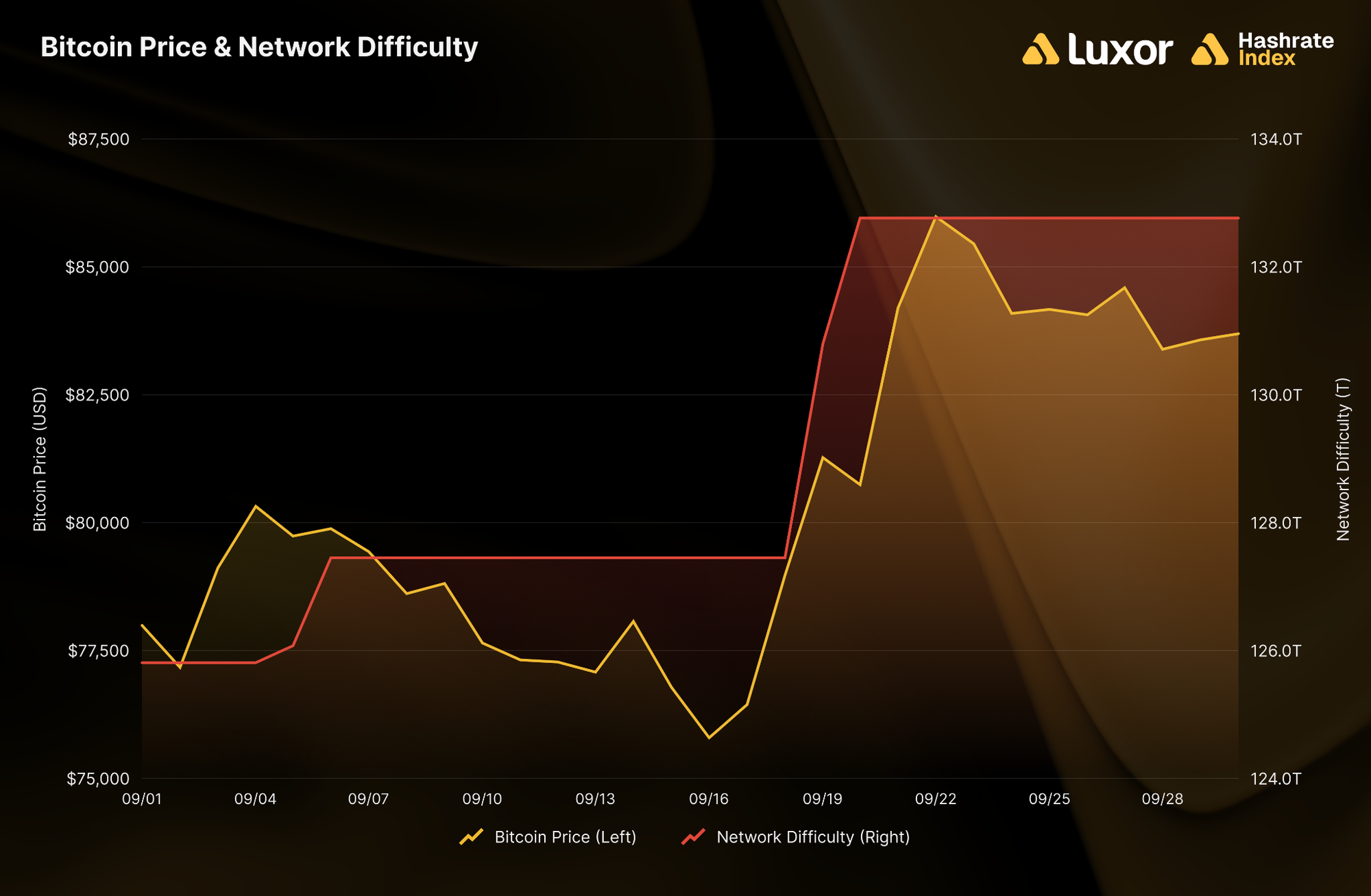
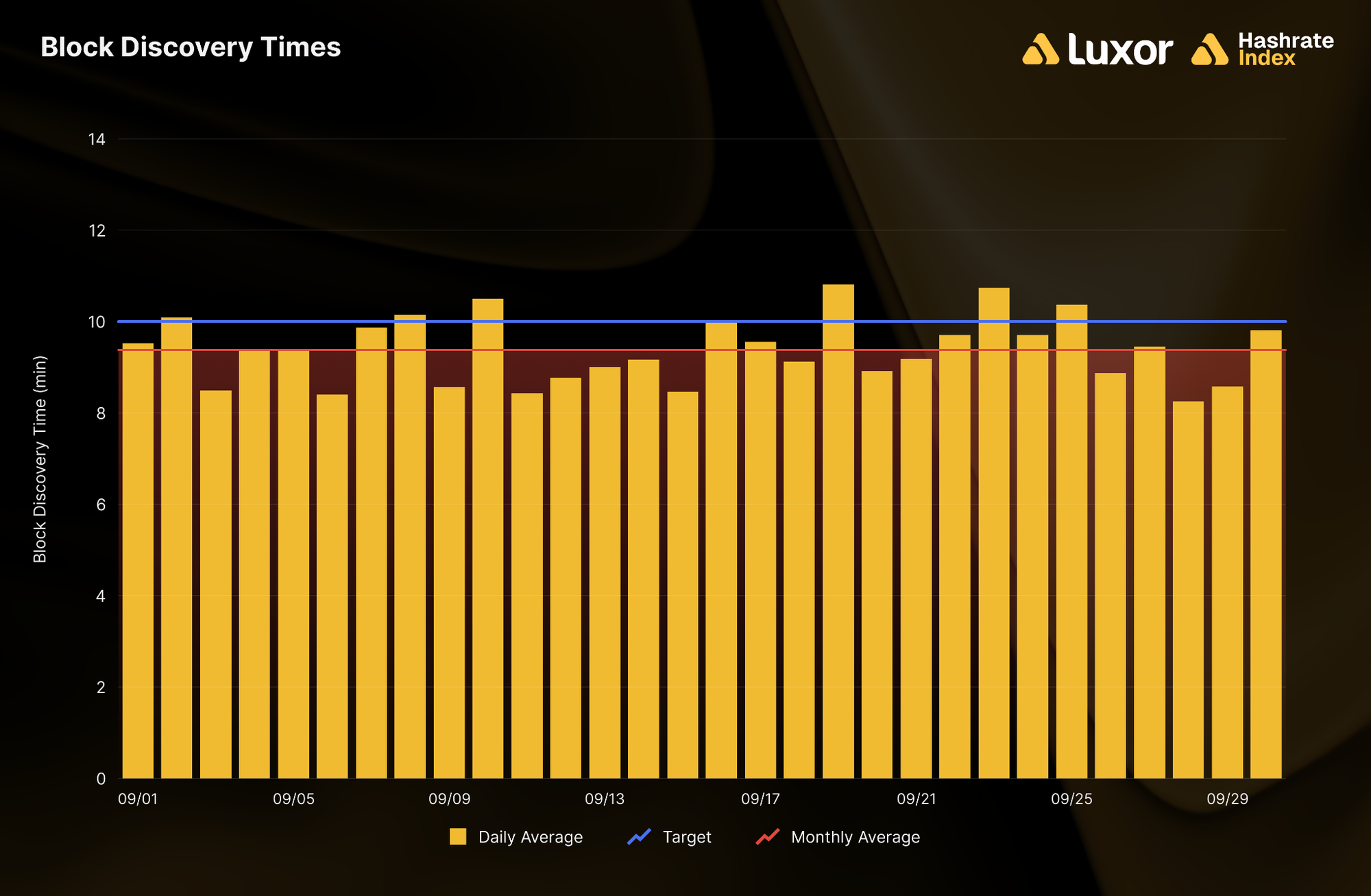
Block times averaged 9m23s, the fastest month since February, with 23 of 30 days under the 10-minute target. Hashrate that curtailed through the Texas summer came back as the 4CP season closed: the 7-day network hashrate average rose from 926 to 975 EH/s across the month.
In hindsight, ERCOT's four coincident peaks landed on June 18, July 22, August 24 and September 12. July's 90.96 GW set the season high; September's 86.49 GW, set at 4:30pm CT, was the last. One Luxor Energy flexible-load client dispatched curtailment at all four intervals, spending 120 hours of downtime across 47 dispatch days to do it (fewer than ten of them in September). At 2025 transmission rates, the avoided charge outweighs the mining margin given up by roughly 14 to 1. The +4.16% retarget landed one week after the final peak.
Transaction Fees — Lowest Since May
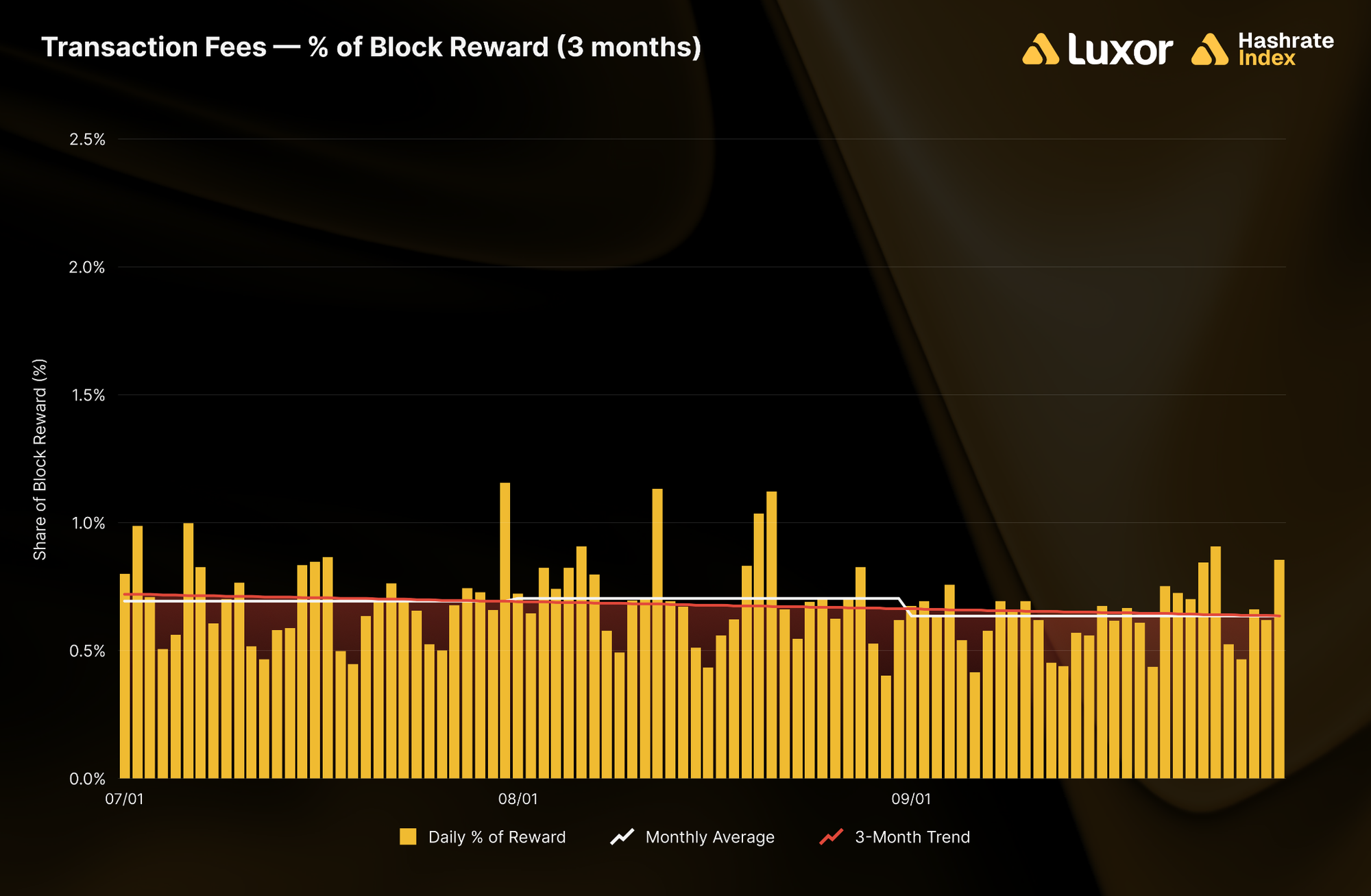
Average fee collection fell 10.1% to 0.0199 BTC per block, the lowest since May. Fees were 0.63% of total block rewards, a fifteenth consecutive month below 1%. Daily fee collection ran from 0.013 to 0.029 BTC per block. September had no outlier blocks.
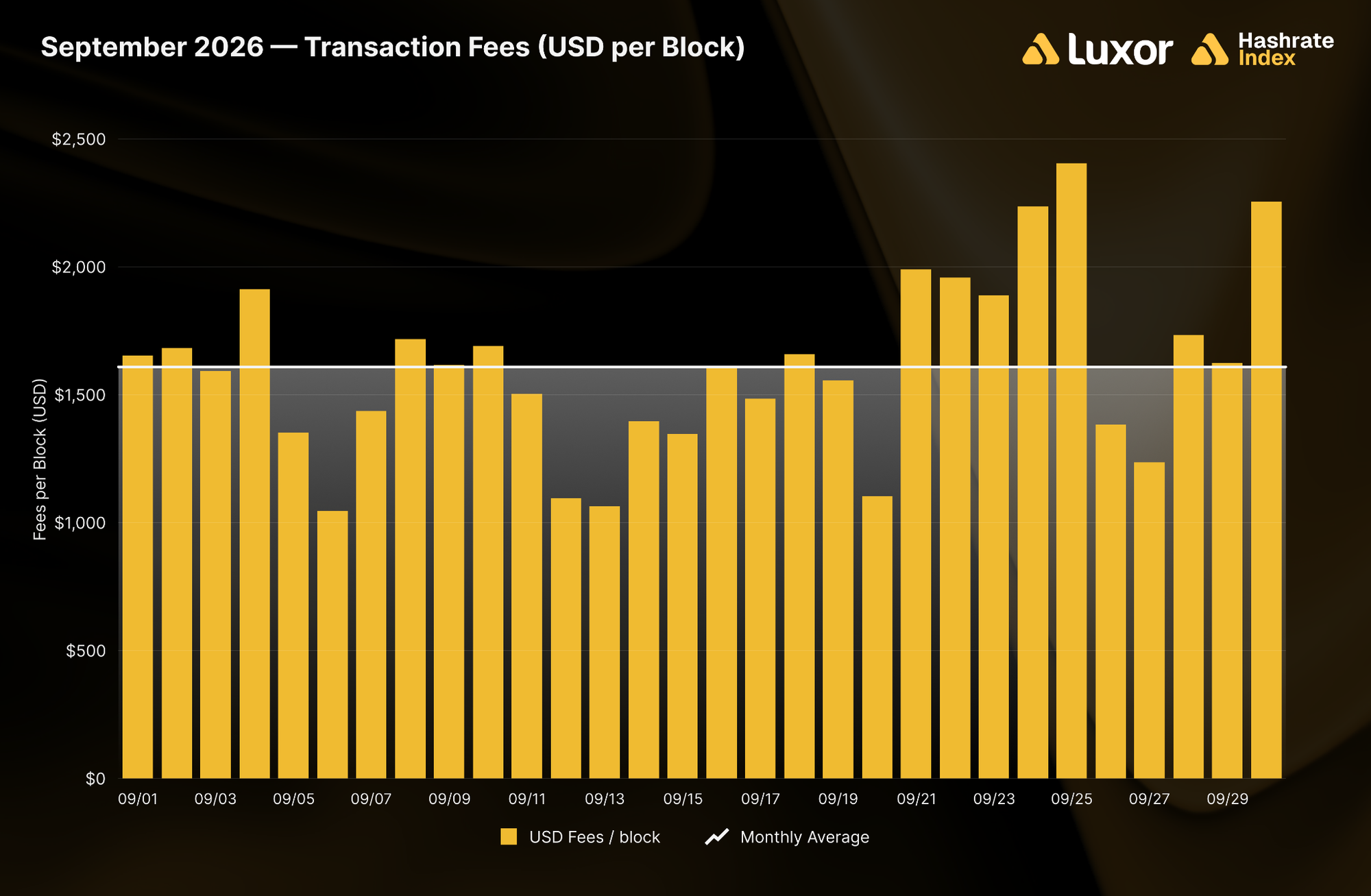
In USD terms, the average block earned ~$1,607 in fees (+4.8%), with Bitcoin's price doing the lifting.
BTC Hashprice — Difficulty Took Its Toll
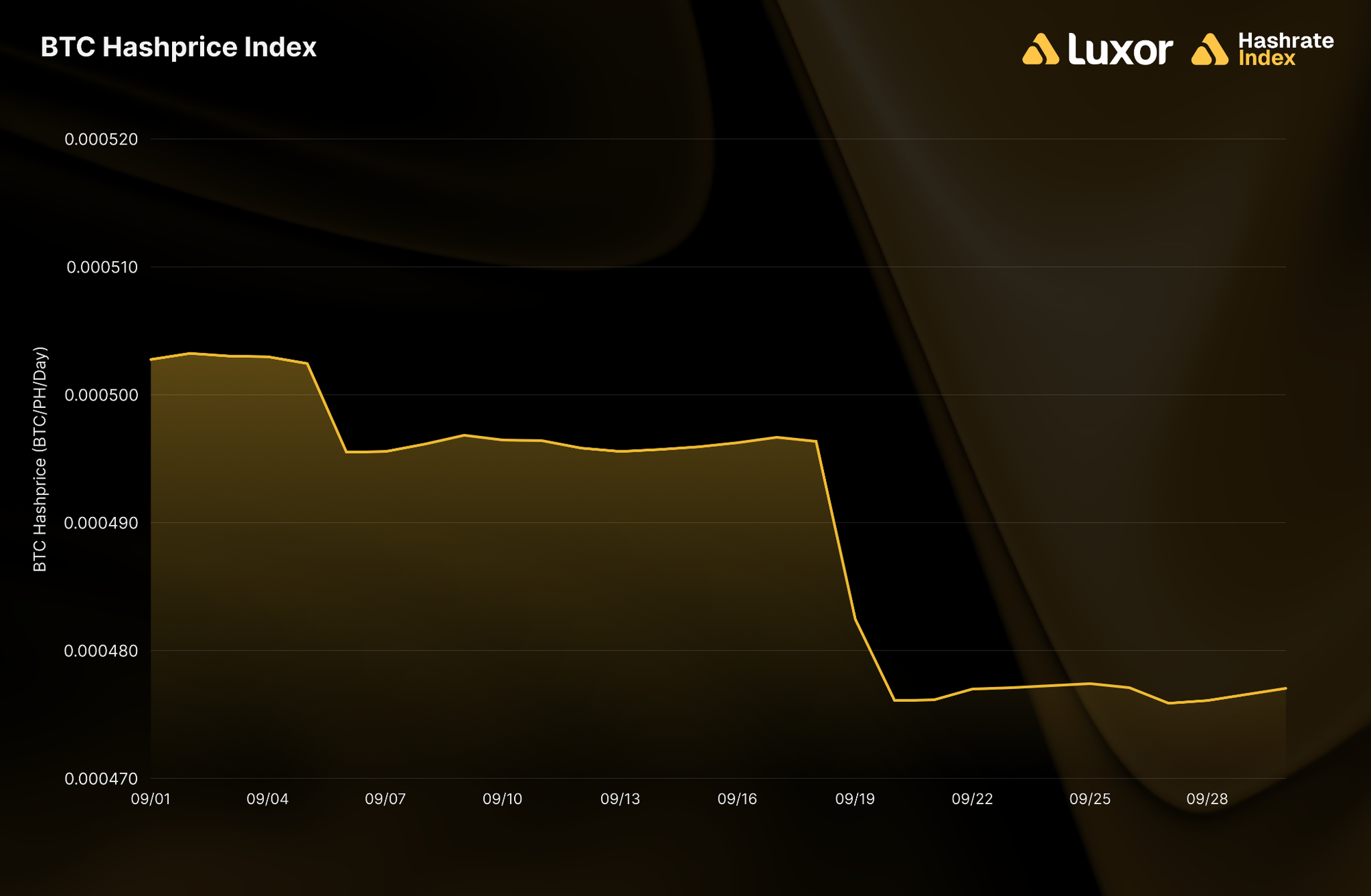
Monthly average BTC hashprice fell 2.0% to 0.00048965 BTC per PH/s/day. The month opened at 0.00050276 BTC and closed at 0.00047702 BTC (−5.1%), with each step down landing on a retarget day.
This is August in reverse: lower difficulty lifted BTC hashprice to a thirteen-month high then; in September the network saw hashrate growth come and take it back.
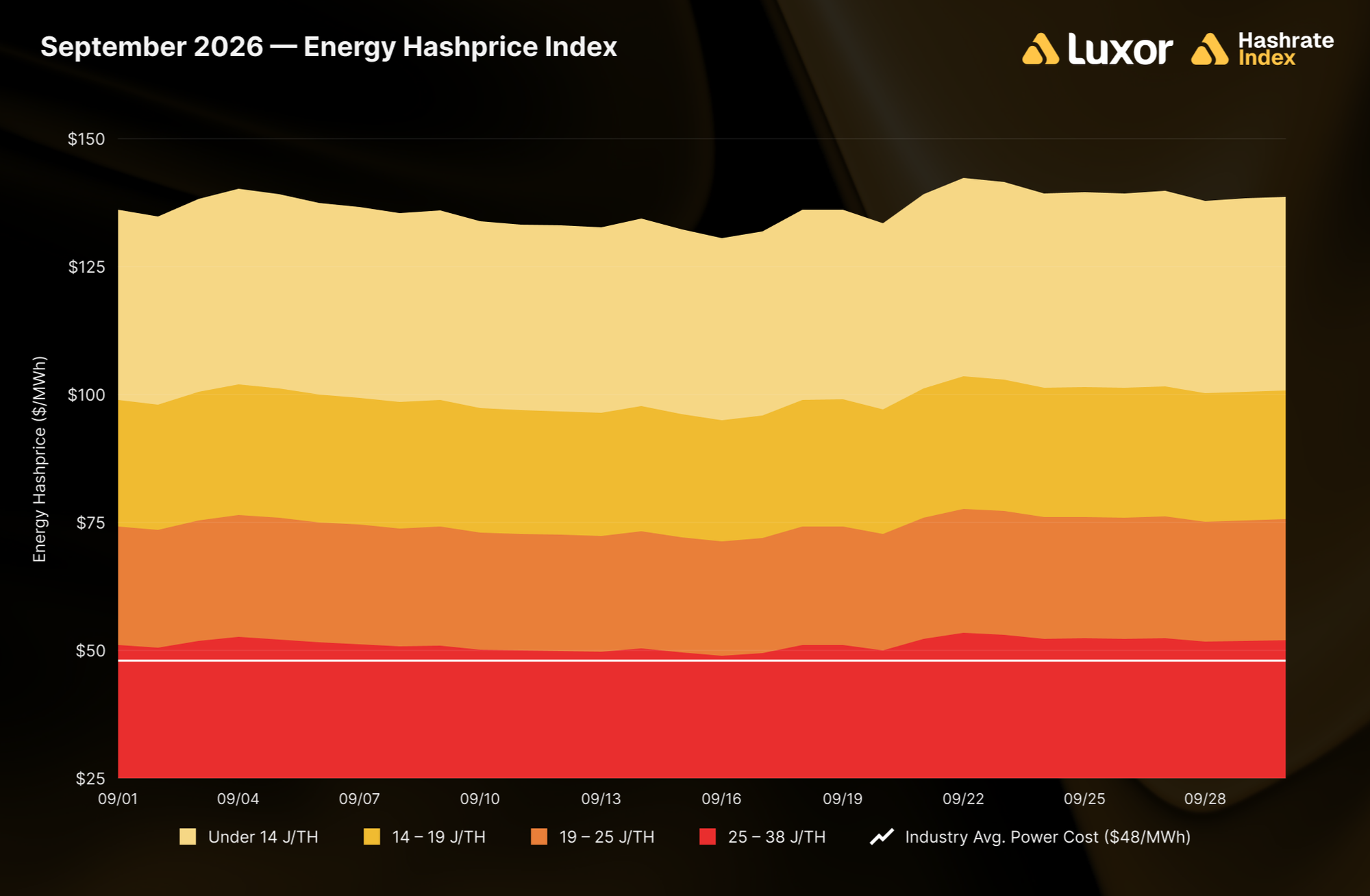
Energy Hashprice — Every Tier Lifted
September lifted every fleet tier in step. Based on fleet efficiency, Energy hashprice averaged:
- ~$137/MWh for under 14 J/TH
- ~$99/MWh for 14–19 J/TH
- ~$74/MWh for 19–25 J/TH
- ~$51/MWh for 25–38 J/TH
Each tier's monthly average rose roughly 13.6%, in step with average hashprice. Compared to an average industrial bitcoin mining power cost of $48/MWh, the marginal fleet bucket (25–38 J/TH tier) finished September above $51/MWh on every day of the final week.
September 2026 Hashrate Market Activity
Our analysis of the September 2026 hashrate market focuses on two key points: how the September 2026 hashrate contract traded in previous months and how the forward curve shifted in September, based on pricing for forward hashrate during the month.
The two tables below show the evolution of Luxor's USD and BTC-denominated hashrate forward markets from April 2026 to September 2026. Rows represent specific monthly contracts, columns represent each trading month. Cell values indicate the average monthly mid-market hashprice, except for the bold highlighted main diagonal, which shows actual spot hashprice settlement in each month.
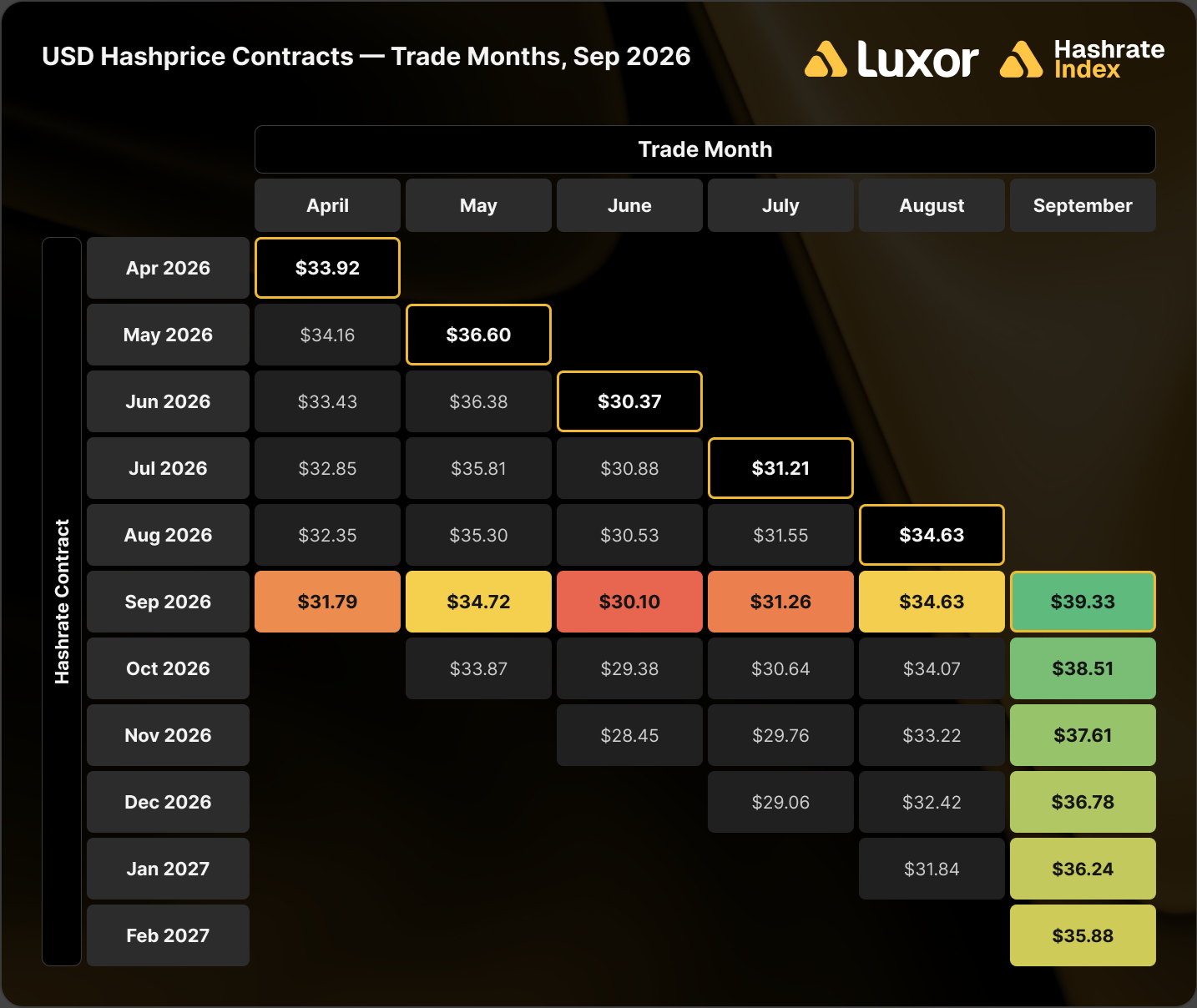
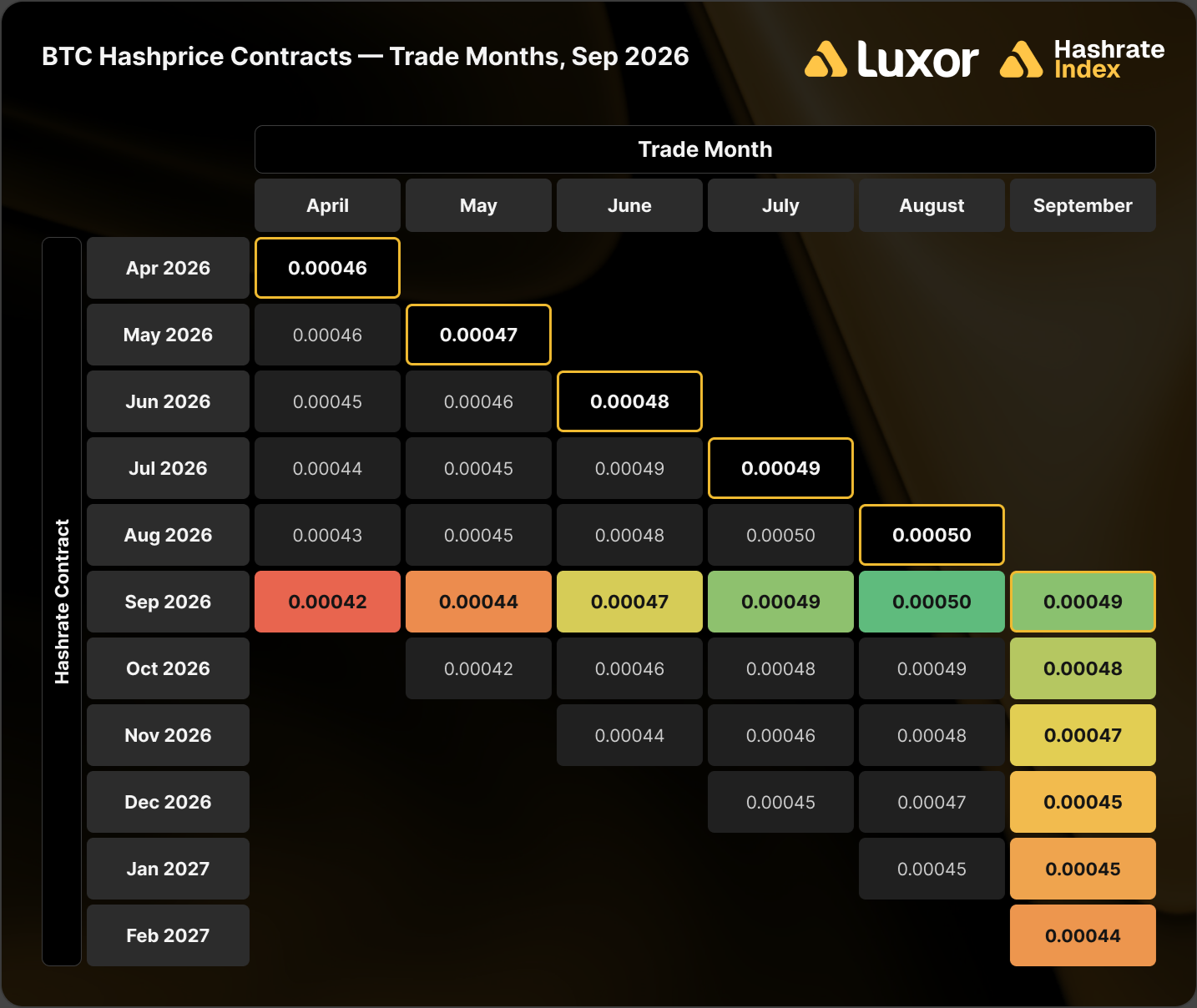
Note: all values (except for the bold highlighted main diagonal) shown in figures represent mid-market rates, the midpoint of the best bid and ask on Luxor's Non-Deliverable Hashrate Forward market. The bold highlighted main diagonal shows actual spot hashprice settlement in each month, measured by Luxor’s Bitcoin Hashprice Index.
The table below shows the type of market participants on the buy and sell side of Luxor’s deliverable (DF) and non-deliverable hashrate forward (NDF) market. In September, lenders were active on the buy side of the DF market, while public and private miners used the contract to sell forward, receive financing, and expand their fleet.
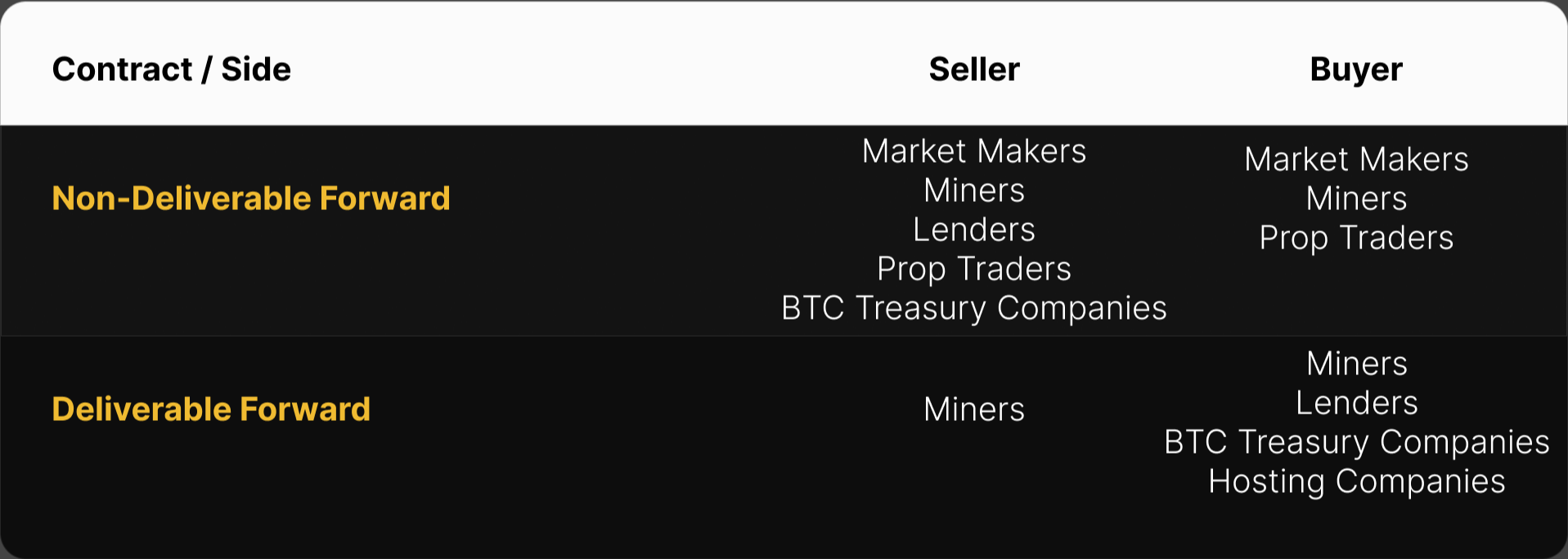
Because DFs are prepaid, they typically trade below NDFs to compensate buyers for credit risk and the cost of capital. Pairing a DF with an offsetting NDF can lock in that spread as a fixed BTC-denominated yield for lenders or a fixed financing cost for miners.
This strategy was used by lenders and Bitcoin treasury companies (buy DF & sell NDF) to earn a BTC-denominated return and by miners (sell DF & buy NDF) to obtain non-dilutive financing. In September 2026, that yield (cost of capital) was 6–13% annualized.
How September 2026 Hashrate Traded
September was the first month since July 2025 in which every dollar-denominated hedge lost. Sellers of the September USD contract locked in between $30.10 and $34.72 per PH/s/day against a $39.33 spot settlement.
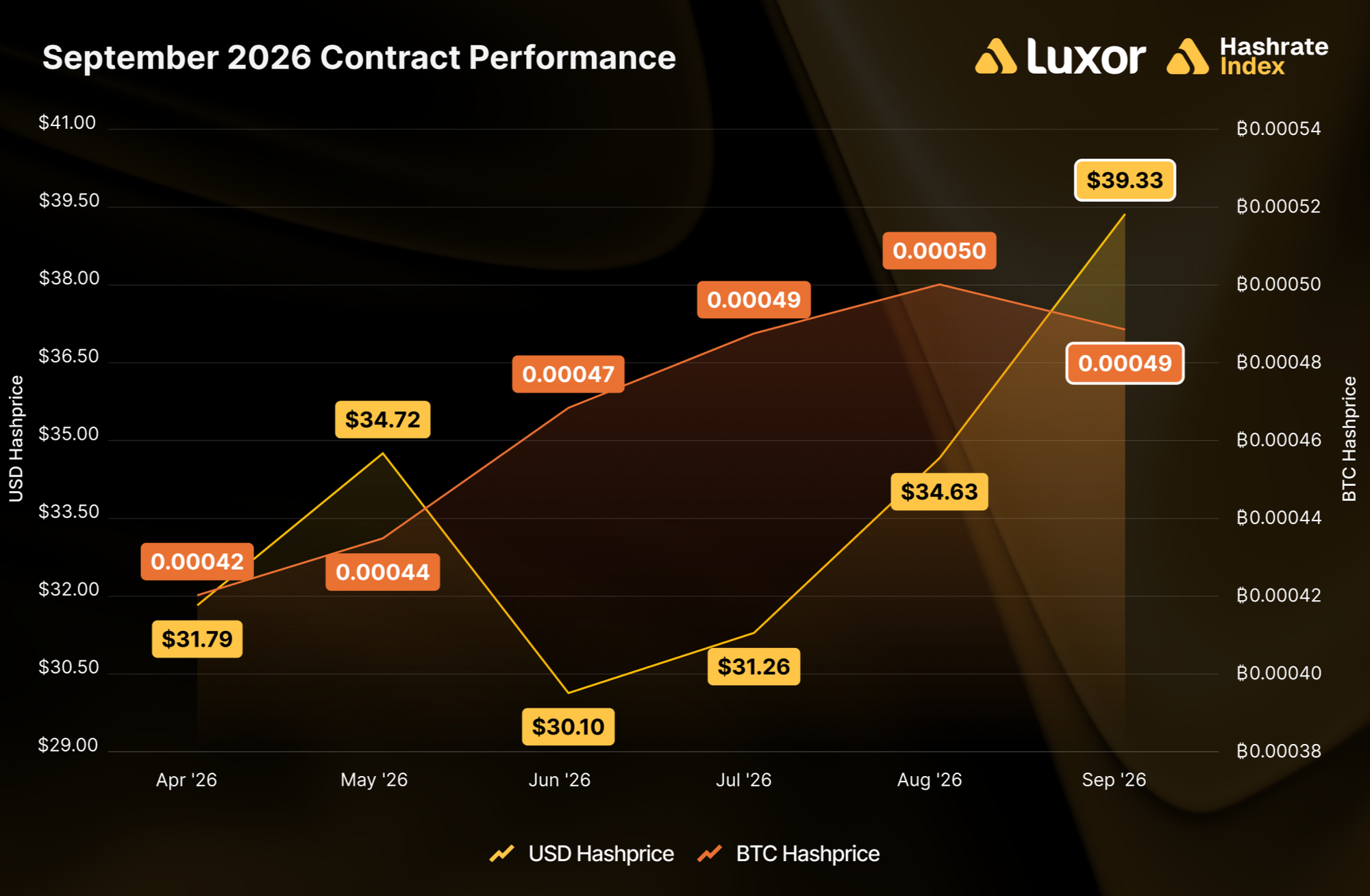
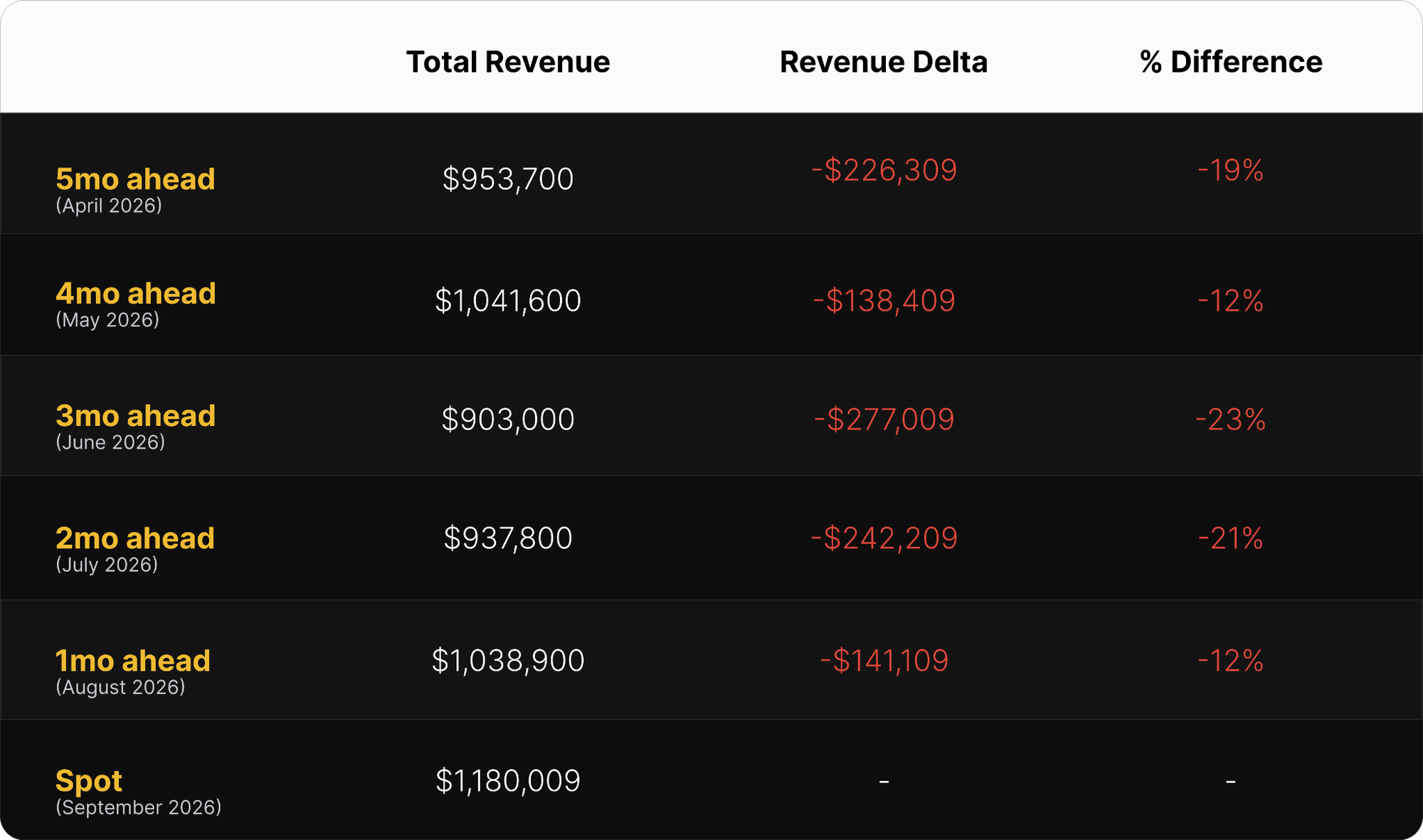
In BTC terms, a five-month streak broke: from April through August, every BTC-denominated hedge lost to spot. In September, August's one-month sale at 0.00050 BTC per PH/s/day beat the 0.00049 settlement by 2.4% (or +0.35 BTC on 1 EH/s). The two- to five-month horizons lost again, as they have every month since January.
Rolling Hedge Performance
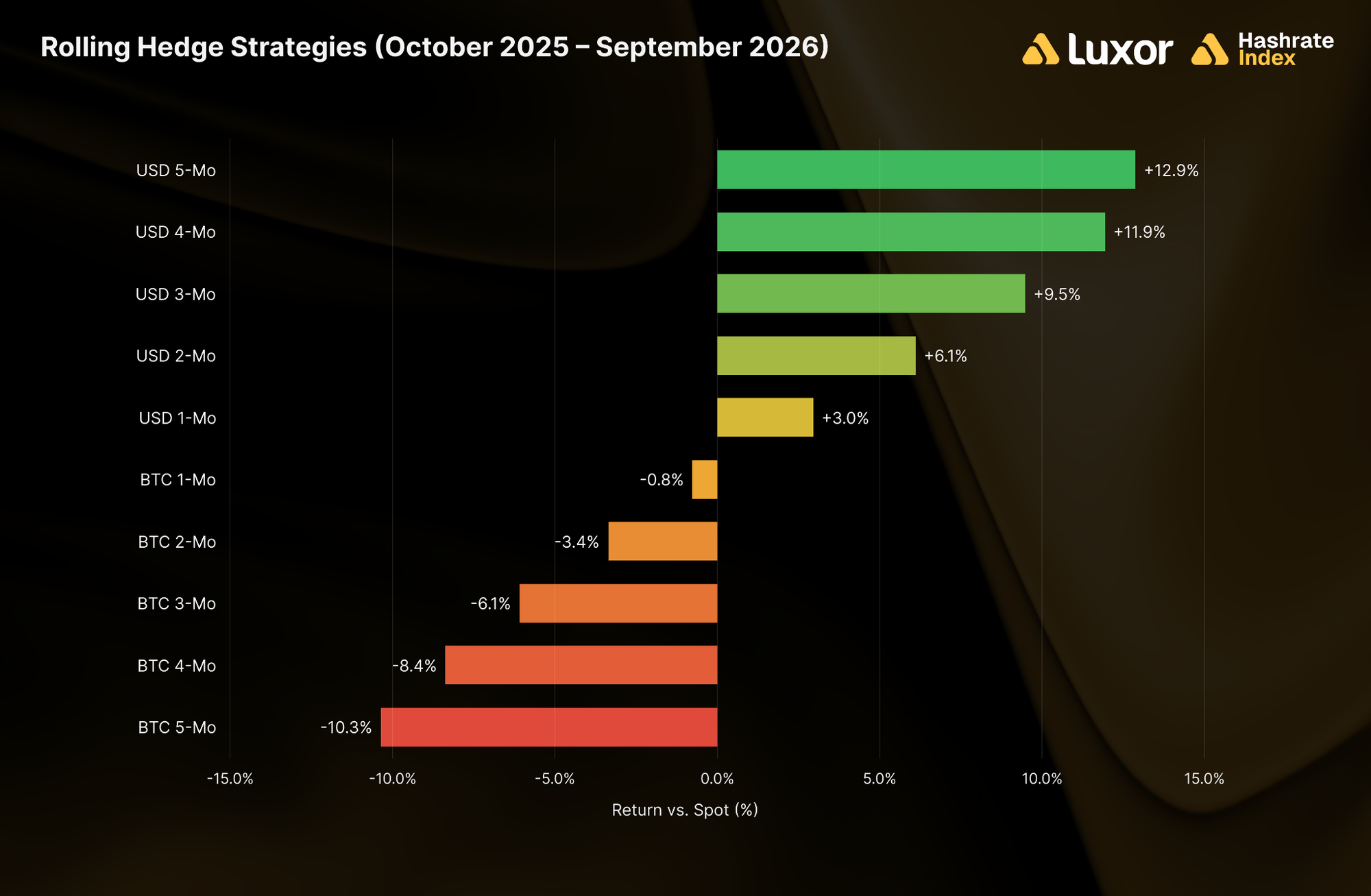
Across the trailing twelve months, rolling USD hashprice hedges beat spot mining (FPPS) at every horizon, +3.0% (1-month) to +12.9% (5-month), and rolling BTC hashprice hedges lost at every horizon, −0.8% to −10.3%. Both results trace to the same two moves over the trailing year: a falling Bitcoin price, which pulled USD hashprice below where it had been sold forward, and a falling network hashrate, which lifted BTC hashprice above where it had been sold forward.
Since the 2024 halving, all ten strategies remain ahead of spot and BTC hashprice hedges still lead, with the 5-month roll at +6.9% against USD hedges clustered between +1.1% and +1.7%. The BTC-denominated lead keeps narrowing over time as network difficulty growth has stalled: that same 5-month roll stood at +7.6% a month ago and +12.5% in March.
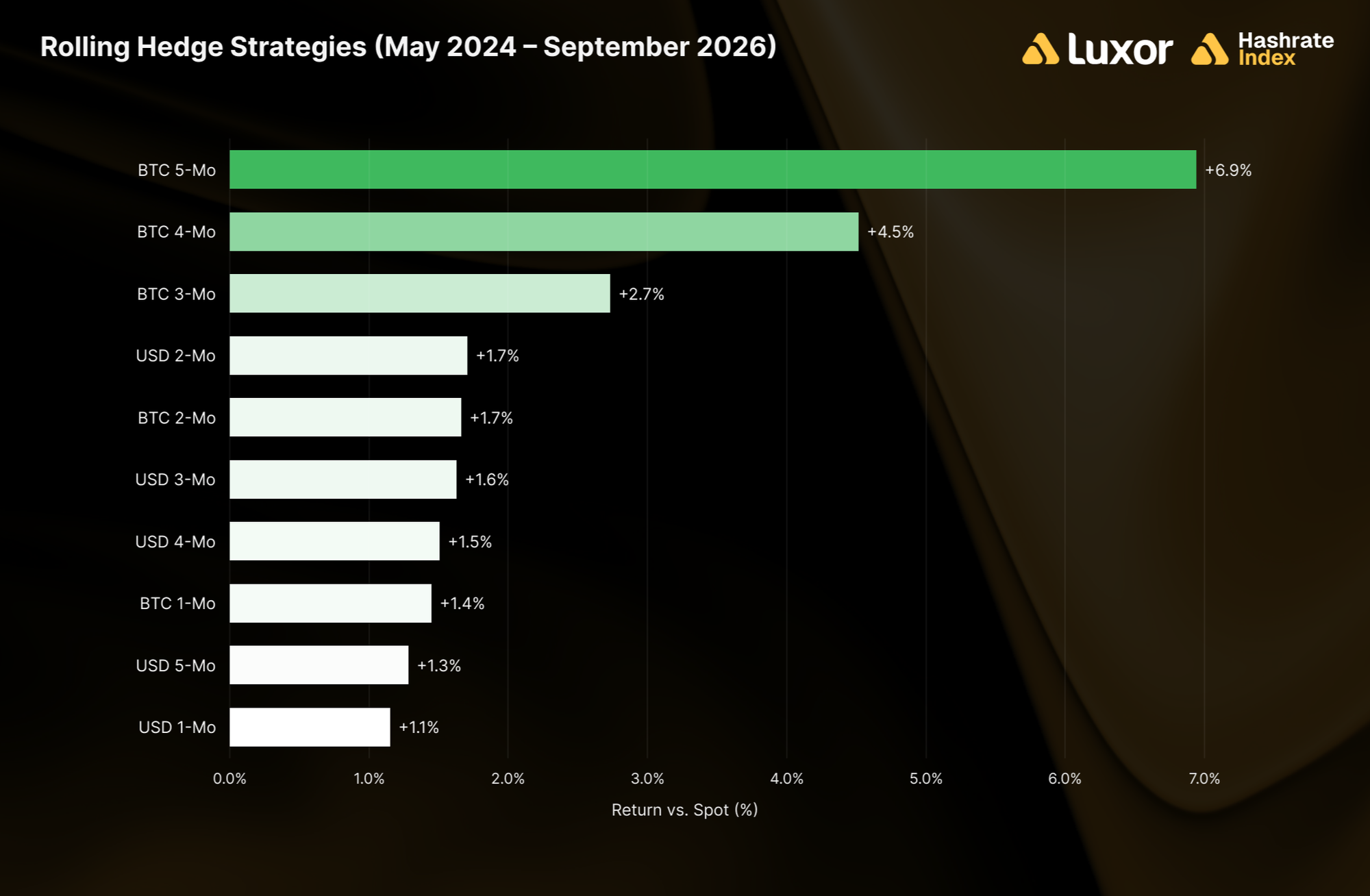
Which hedge wins comes down to which variable moved against the forward market's expectations: Bitcoin's price, or difficulty and fees. From the 2024 halving through late 2025, difficulty rose faster than the curve expected, so selling hashrate in BTC terms paid. Since late 2025, Bitcoin's price has run below the curve's expectations, so selling in USD terms has paid instead. September was the fourth month of this second regime in which most USD hedges lost, and the first in which they lost at every horizon. With only BTC's one-month forward sale beating spot, it was also the first month since September 2025 in which BTC hedges did better than USD hedges.
Note: figures exclude fees and bid/ask spreads, and hedging is a cost of business rather than a revenue generation strategy. Hedgers willingly buy the certainty of predictable cash flows, which increases valuations, reduces capital costs, and ultimately attracts investments.
How Future Hashrate Traded in September 2026
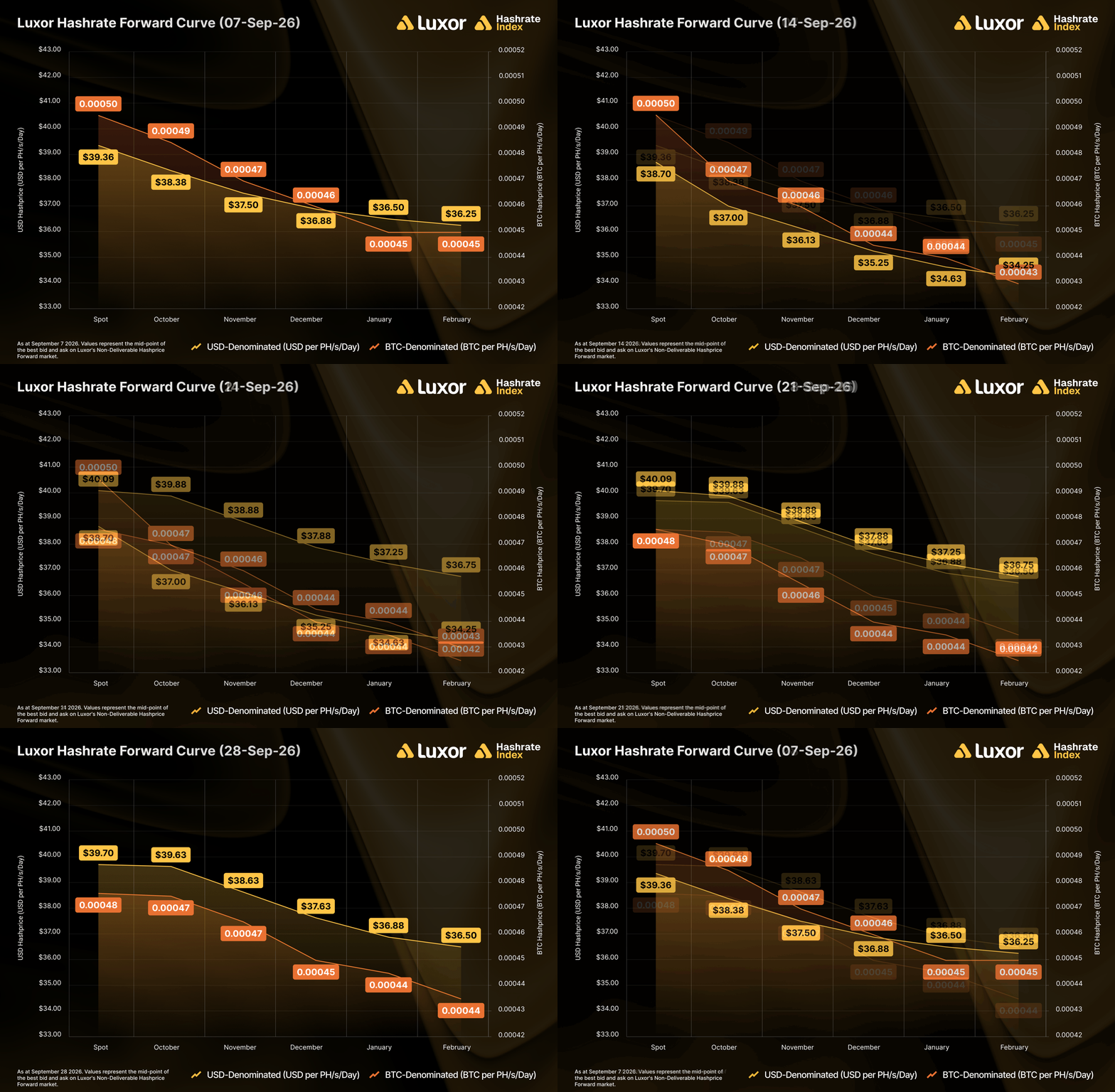
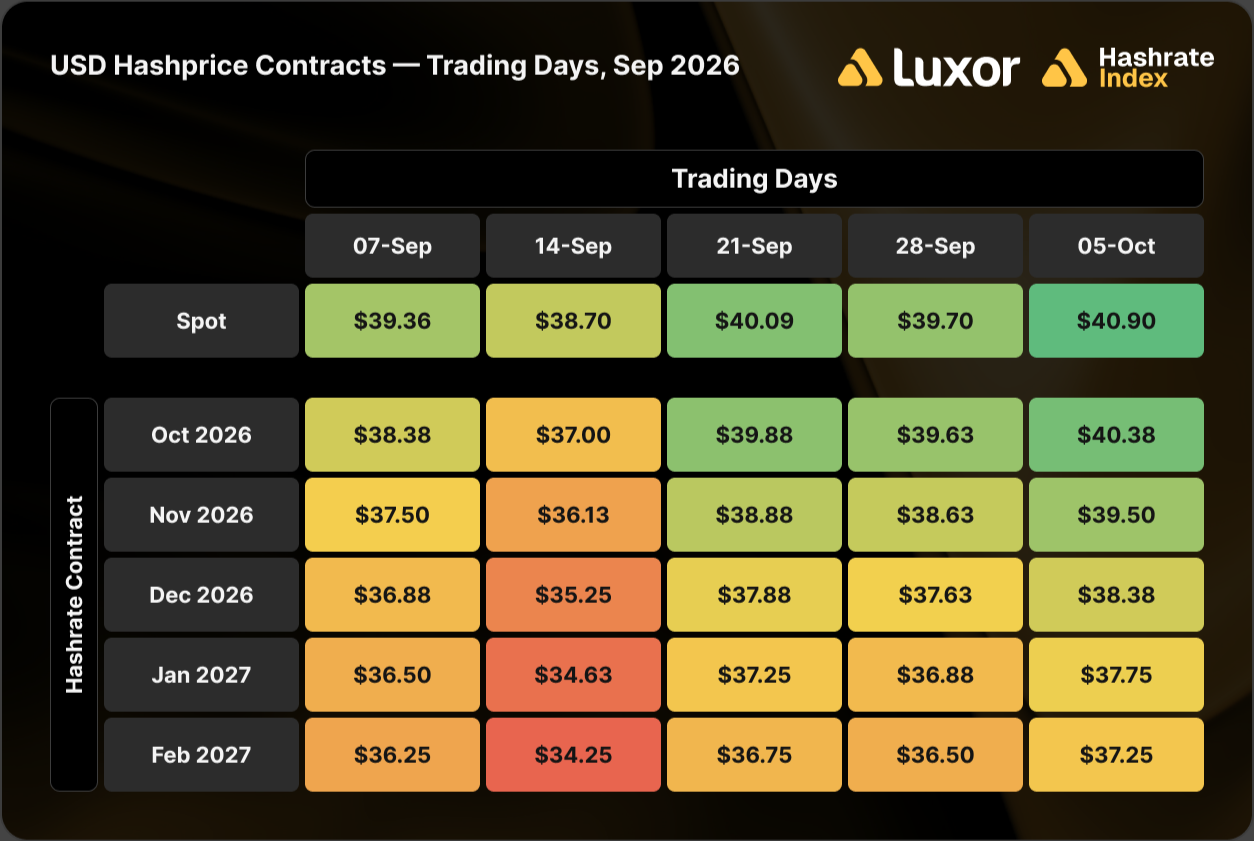
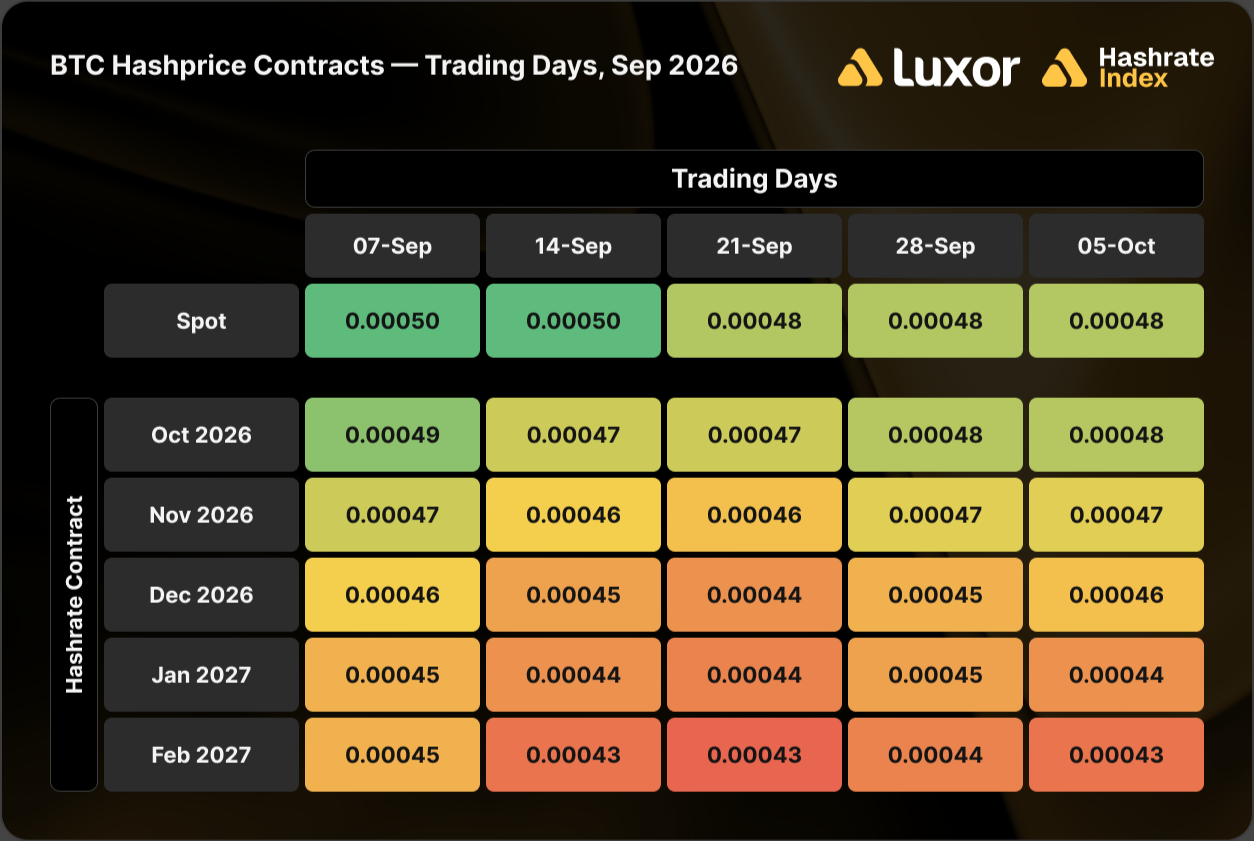
The tables below summarize the forward market during September 2026 for the five subsequent months, October 2026 to February 2027. Rows are monthly contracts; columns are weekly trading days. Cell values are the daily mid-market price, except for spot.
In September, the USD-denominated hashrate forward curve rose less than spot. Lock-in rates for October–February rose by +2.8–5.3% between September 7 and October 5 against +3.9% in spot hashprice, with the front of the curve moving most.
Over the same window, the BTC-denominated hashrate forward curve fell by 1–4% across the strip. Read together, the forward market repriced two things at once: a higher Bitcoin price and higher network difficulty (more hashrate).
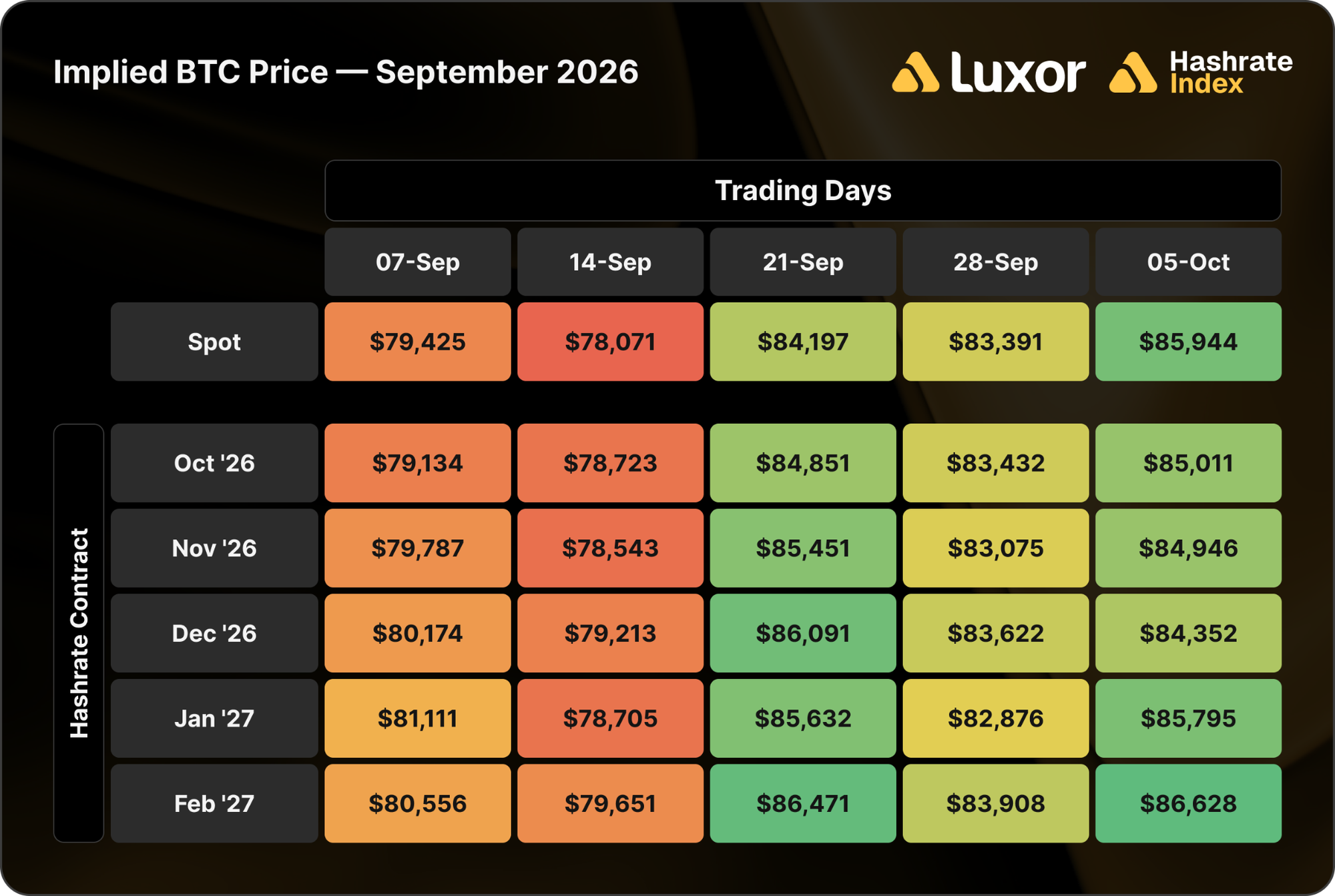
Dividing USD contract values by BTC contract values gives the implied BTC price embedded in the forward hashrate market. The October contract's implied BTC price moved from ~$79,100 to ~$85,000, and the curve sits at $84,400–$86,600 across all five months.
Assuming 0.0199 BTC per block in transaction fees (September's realized average), the same contracts imply the following forward-looking expectations on difficulty and network hashrate:
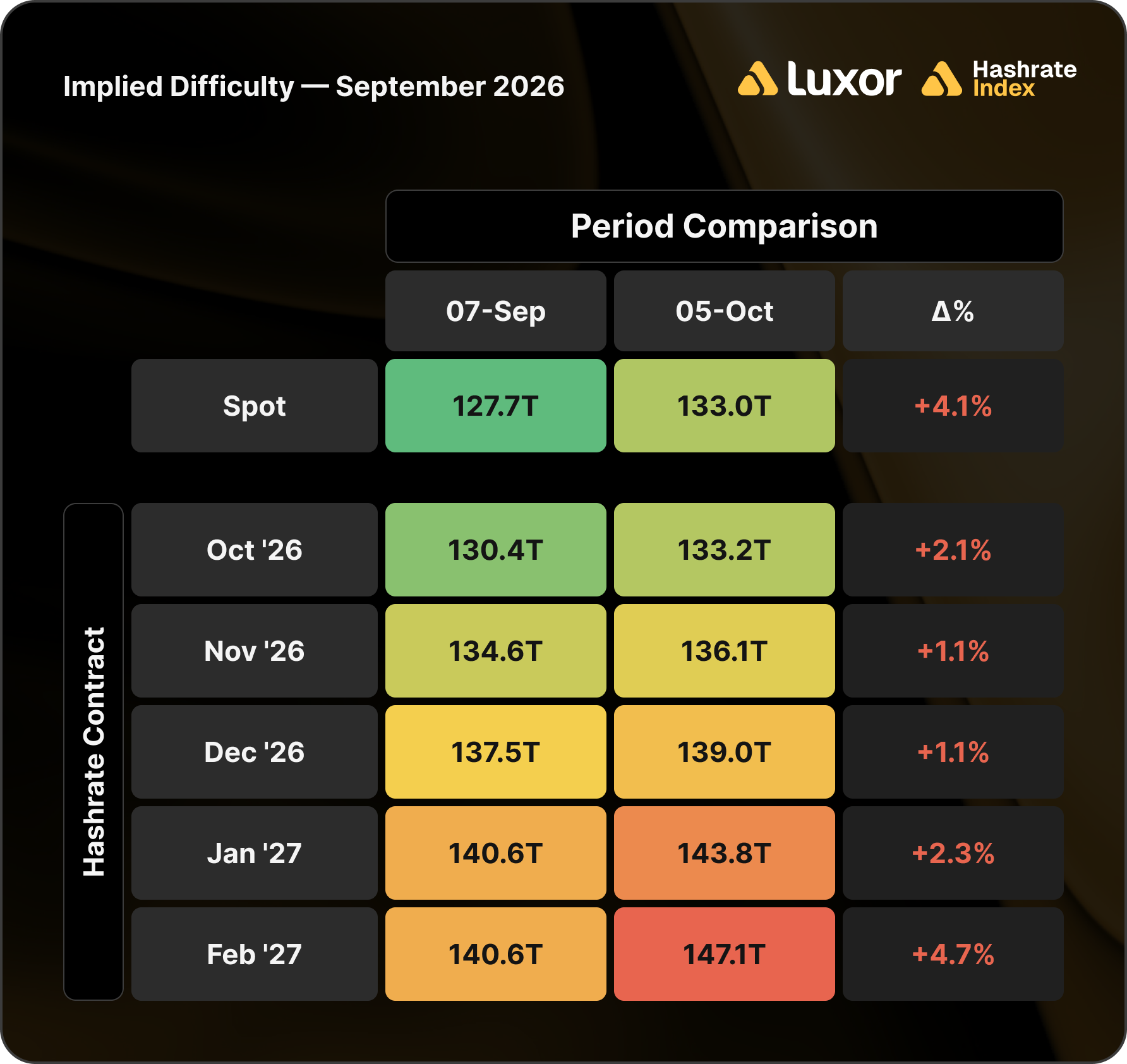
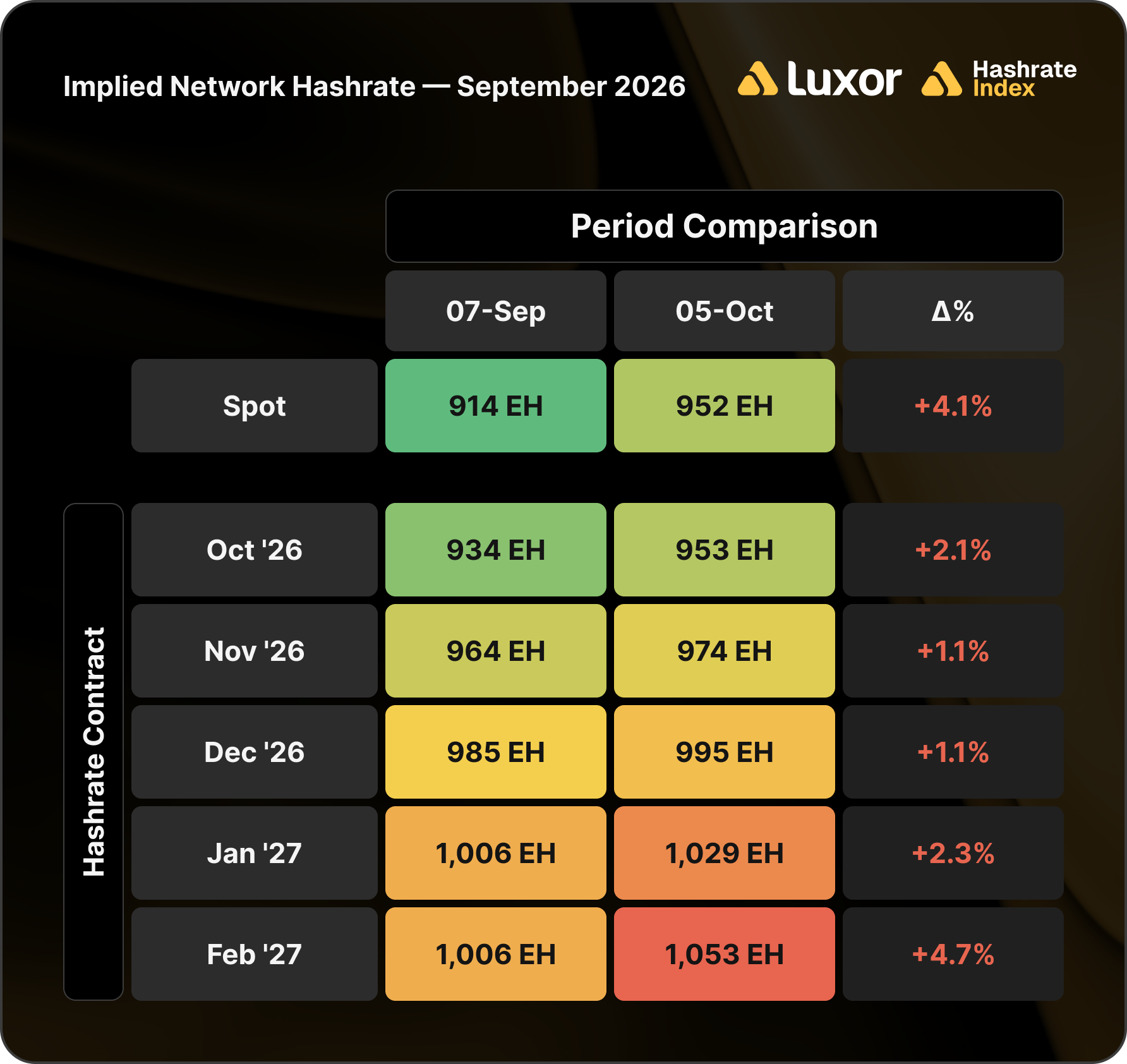
Note: figures assume 0.0199 BTC per block transaction fee collection.
The forward curve already expected network hashrate to grow; it now expects it to grow faster. Between the first and last snapshots, implied October difficulty rose 2.1% to 133.2T (current difficulty at 132.72T); implied February 2027 rose 4.7% to 147.1T. In hashrate terms the strip runs from 953 EH in October to 1,029 EH in January 2027 and 1,053 EH in February. August's curve had kept a path below 1 ZH/s through January. The hashrate forward market is now pricing it in.
Concluding Thoughts and Looking Ahead
October opened above September's close. Through October 8, hashprice has averaged $40.37 (0.00048 BTC) and Bitcoin $84,655.
The 4CP Season Is Over
Texas miners curtail through the summer to avoid 4CP transmission charges, and ERCOT's fourth and final coincident peak was set on September 12. The incentive to sit out peak-demand hours is gone until June 2027 — if 4CP survives in its current form. PUCT staff's March 2026 draft report on transmission cost recovery proposes charging large flexible loads as if they were online during the peak intervals, with a final rulebook due by year-end. September’s retargets show curtailed fleets already came back, and the 7-day hashrate average currently stands at 999 EH/s.
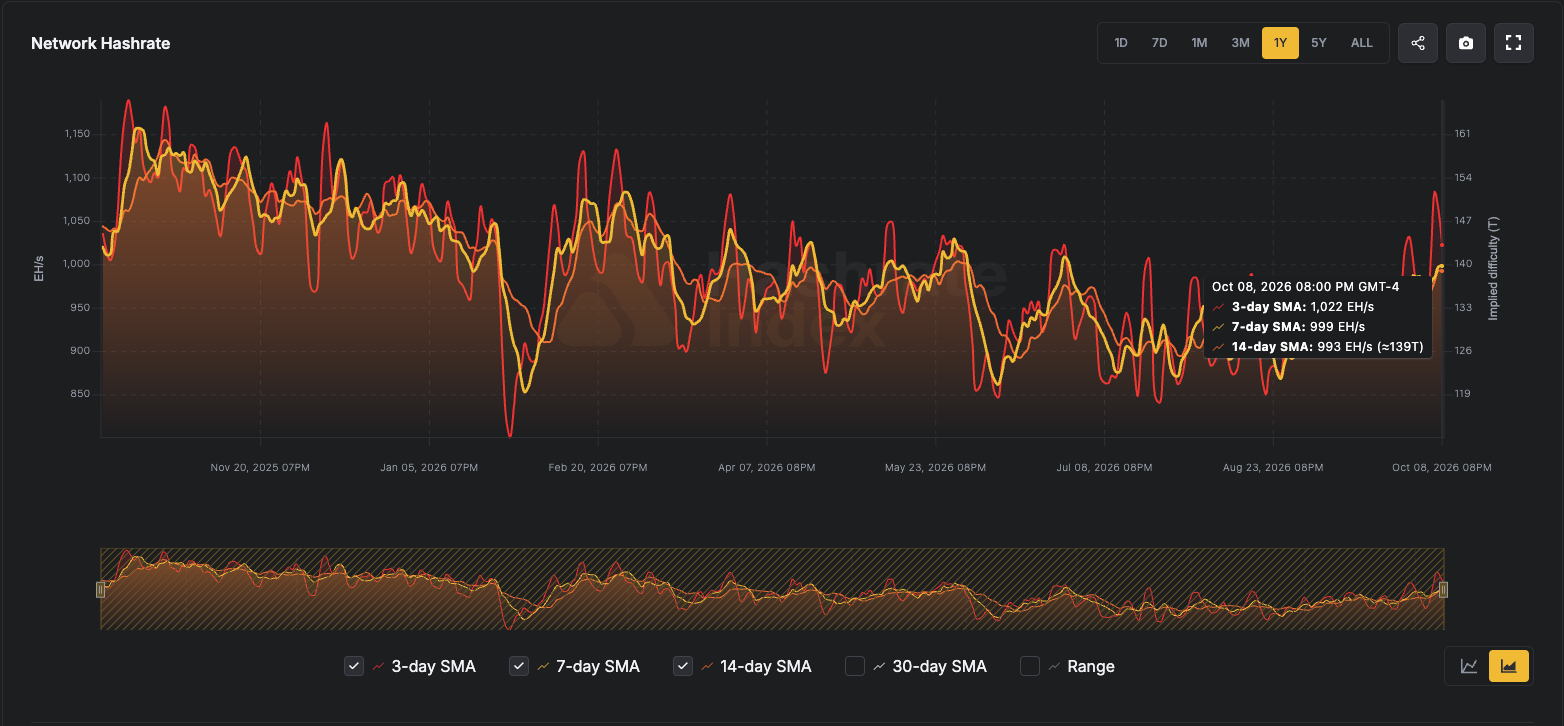
The seasonal pattern that follows: October has delivered positive difficulty growth in every year since 2022, averaging +4.38% per epoch and roughly +10% across the month (+16.4% in 2022, +8.1% in 2023, +7.1% in 2024, +9.1% in 2025). September has averaged +1.58% between 2022–2025, and September 2026 ran at +2.74%, beating its norm.
What October Decides
Two October retargets at the seasonal average would put difficulty near 145T by month-end, about 9% above where September closed, and the first is already pacing above that average. At $85,000 Bitcoin and current fees, that is a hashprice near $37.
Bitcoin's October calendar is lighter than September's. The next FOMC decision is October 27–28, with 16 of 18 participants' projections showing at least one more hike by year-end. Spot-ETF flows turned positive for 2026 in late September; whether they hold is the variable that matters most for the dollar side of hashprice.
The question from August still stands: will Bitcoin keep climbing or will difficulty take the rest of the hashprice raise back from miners? In September it did both, and the two cancelled each other out. October's seasonal pattern says difficulty moves first.
The forward market has priced in this path with an implied hashrate crossing 1 ZH/s in January 2027 at 1,029 EH. The current epoch is pacing blocks at 9m33s, which points to a retarget near +4.6% around October 16, to roughly 139T, within half a percent of the 139.7T that corresponds to 1 ZH/s. For a $40 hashprice to hold through year-end, Bitcoin's price has to keep outrunning difficulty, which is growing again.
Looking Ahead
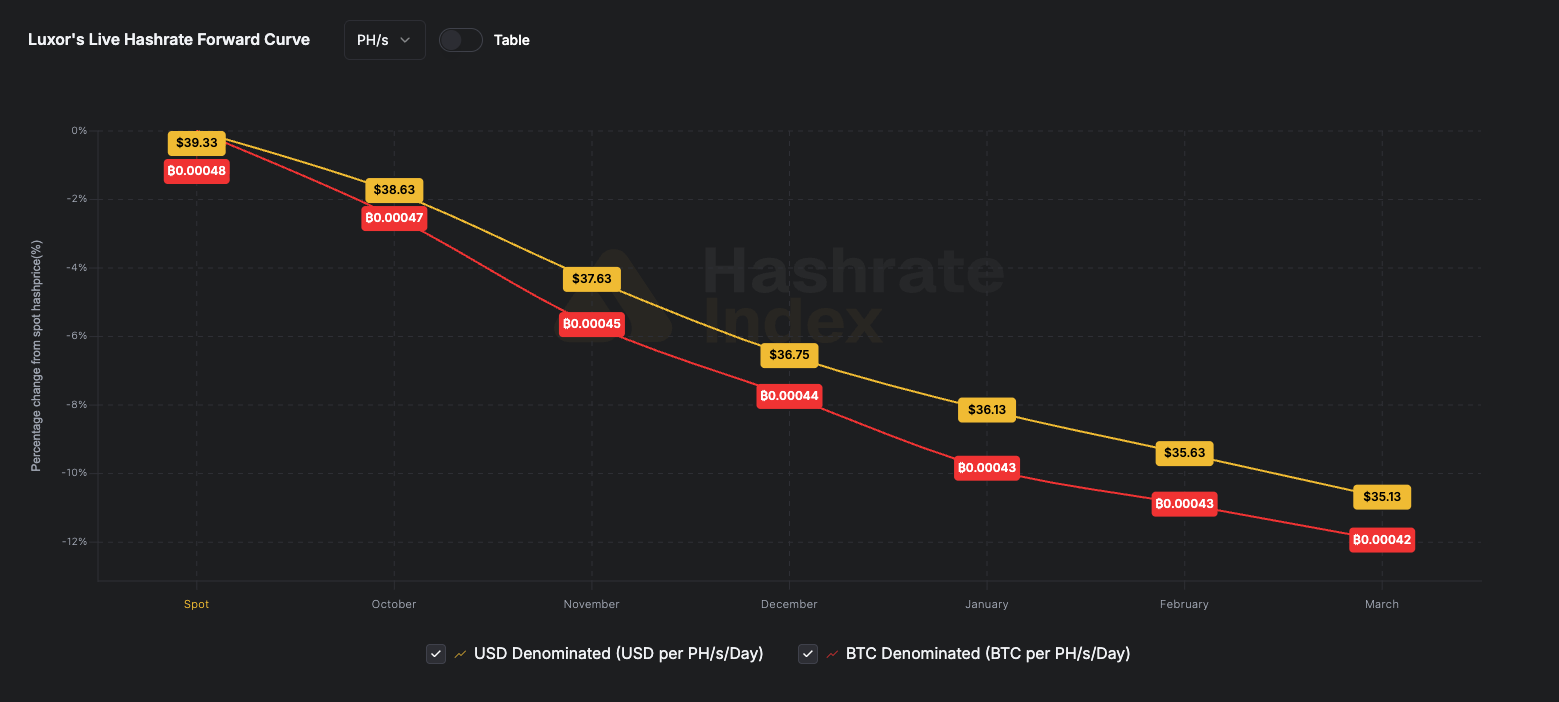
Luxor's Hashrate Forward Market is pricing an average hashprice of $36.65 or 0.00044 BTC per PH/s/day over the October 2026 – March 2027 window. Sellers can secure this hashprice while buyers have the opportunity to lock in the same hashcost over the next six months.
If you’d like to learn more about Luxor’s Bitcoin mining derivatives, please reach out to [email protected] or visit https://www.luxor.tech/derivatives.
About Luxor Technology Corporation
From Bitcoin mining to AI infrastructure, Luxor delivers the hardware, software, finance and energy tools that power the world's compute. Its Bitcoin product suite spans Mining Pools, ASIC Firmware, Hardware trading, Hashrate Derivatives, Energy services, a Miner Management software, Commander, and a bitcoin mining data platform, Hashrate Index; its AI product suite spans Hardware, Compute, and Tenki: cloud infrastructure for code and agents.
Disclaimer
This content is for informational purposes only, you should not construe any such information or other material as legal, investment, financial, or other advice. Nothing contained in our content constitutes a solicitation, recommendation, endorsement, or offer by Luxor or any of Luxor’s employees to buy or sell any derivatives or other financial instruments in this or in any other jurisdiction in which such solicitation or offer would be unlawful under the derivatives laws of such jurisdiction.
There are risks associated with trading derivatives. Trading in derivatives involves risk of loss, loss of principal is possible.




Hashrate Index Newsletter
Join the newsletter to receive the latest updates in your inbox.