Firmware Fundamentals – What is ASIC Firmware?
Every Bitcoin mining machine is two products under the hood: the hardware that hashes, and the software that decides how.

This post is part of Luxor's Firmware Features Series, which covers the core Bitcoin mining concepts behind the flexible firmware features that give operators custom control over performance and profitability.
Every Bitcoin mining machine is two products under the hood: the hardware that hashes, and the software that decides how. Most buyers obsess over the first, and never touch the second.
TLDR
- ASIC firmware is the software running on a mining machine's control board. It sets chip frequency and voltage, manages temperatures and fans, connects to mining pools, and exposes the machine's API.
- Stock (OEM) firmware covers the basics: power on and off, a few preset power modes, and pool configuration.
- Aftermarket firmware like LuxOS adds the dials: autotuning, custom performance profiles (overclocking and underclocking), advanced thermal management, fast curtailment, and fleetwide APIs.
- Firmware is the single biggest software lever on mining margin, because it directly controls power consumption and hashrate.
- Firmware is also a security decision, it has root-level control of every machine you own.
What Is ASIC Firmware?
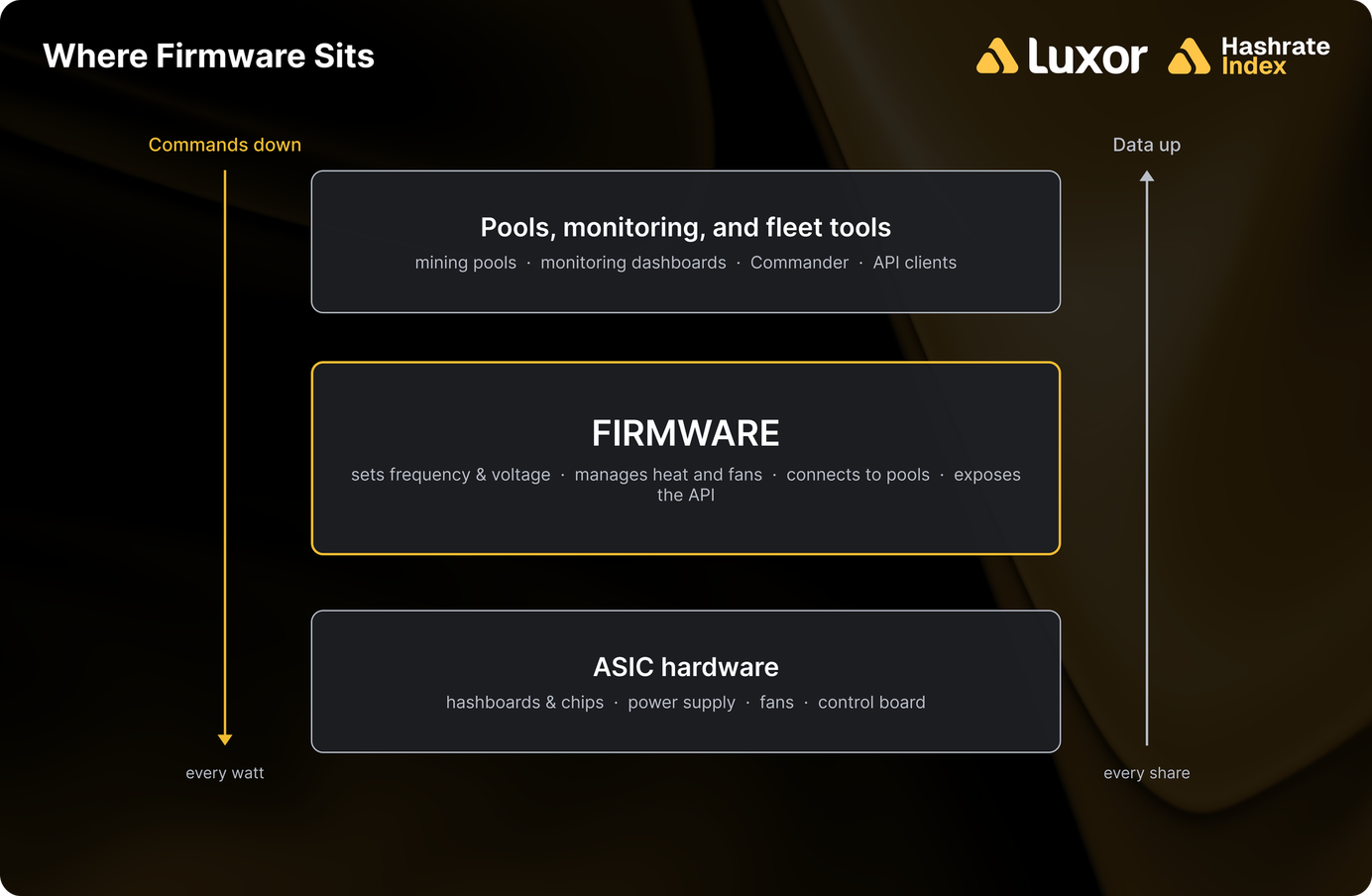
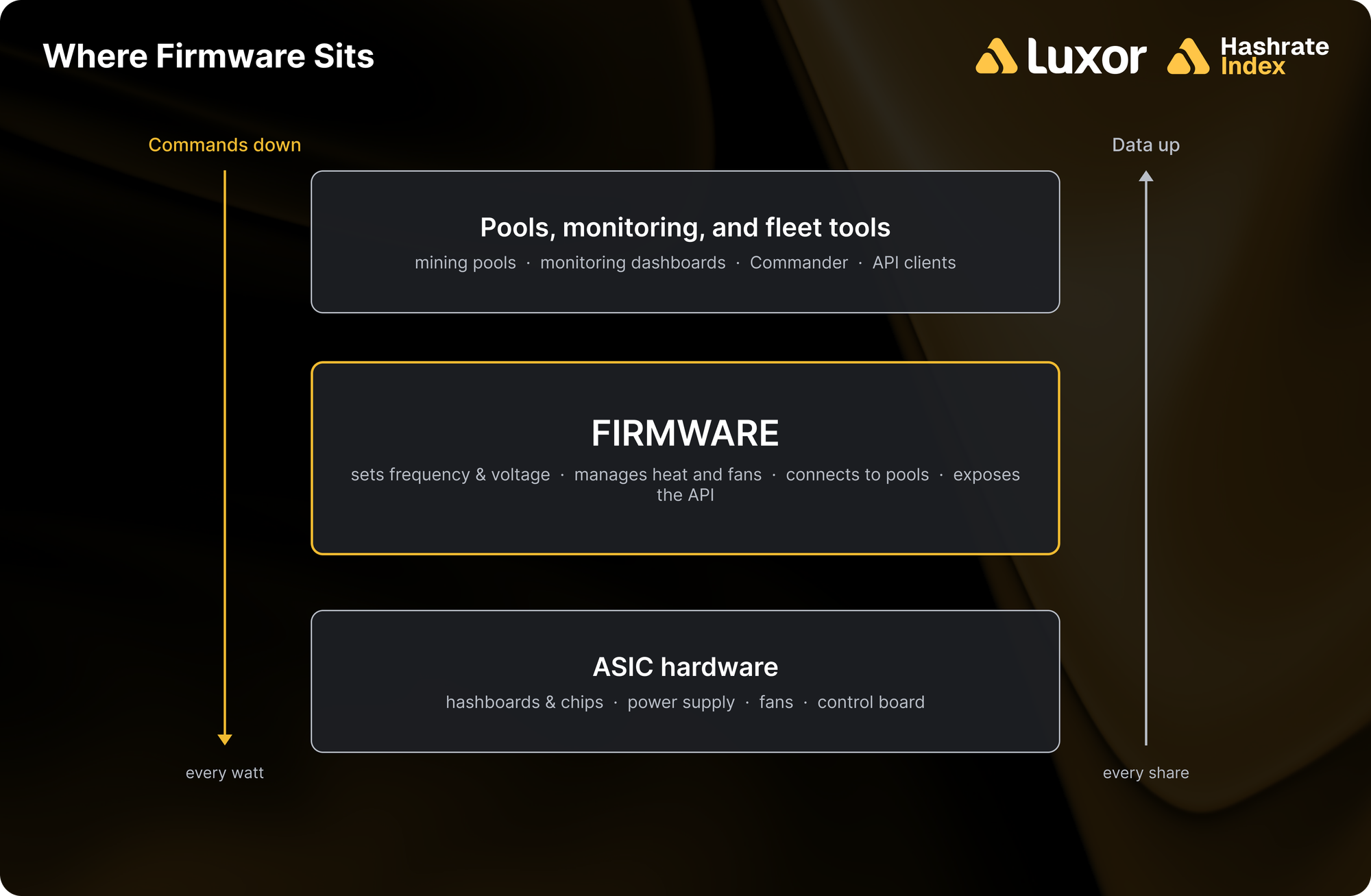
ASIC firmware is the operating software of a Bitcoin mining machine. It lives on the control board and governs everything the hardware does: how fast the chips run (frequency), how much electrical pressure they get (voltage), how the fans respond to heat, which pools receive shares, and what the machine reports to monitoring tools. When you change a power mode, point a miner at a pool, or read its dashboard, you are talking to firmware.
The useful mental model is a chokepoint. Commands travel down from your tools to the hardware, and data travels back up from the hardware to your dashboards. Every one of those messages passes through the firmware layer. That is why firmware sets the ceiling on both efficiency and control: nothing reaches the chips without going through it.
Stock vs. Aftermarket Firmware
OEM firmware ships with the machine and fulfils basic operational needs: powering on and off, selecting low, normal, or high power modes, and connecting to pools. It is deliberately conservative — built to run safely everywhere, optimized for nowhere. A single factory voltage has to keep every chip stable in every climate the machine might ship into, so the settings are chosen for the worst case rather than your specific case.
Aftermarket firmware replaces it to unlock what the hardware can actually do. On LuxOS that means an AutoTuner that finds each board's minimum stable voltage, custom performance profiles (from deep underclock to overclock), Advanced Thermal Management that prevents heat shutdowns, sub-five-second curtailment for participating in energy market programs, watt-level power targeting, and a full API for fleet automation.
Luxor's firmware — LuxOS — runs on more than 300,000 Bitcoin ASICs representing over 35 EH/s, across 30-plus supported models.
Why Firmware Matters
- Margin. Efficiency gains (J/TH) from tuning land straight into your financials — the cheapest improvement to your cost-per-hash available, as we've covered in Firmware Flexibility. When hashprice compresses, this is the difference between a machine that runs and one that doesn't, which is why underclocking with firmware is an intelligent move in low-hashprice environments.
- Uptime. Thermal management keeps machines hashing through heat that would otherwise shut stock firmware down. Proportional, temporary underclocks instead of a binary shutdown.
- Energy strategies. Demand response, curtailment, and energy trading all require firmware-level speed and precision that stock firmware doesn't offer. Power Targeting is the foundation those strategies are built on.
- Fleet control. One machine is a web UI; ten thousand machines is an API and a management layer. This is what Commander exists for.
- Choice. The aftermarket has real options. Our Top 5 Bitcoin Mining Firmware for 2026 compares the field.
What ASIC Firmware Controls
- Frequency and voltage. The two dials that set hashrate, stability, and efficiency.
- Thermals and fans. Fan curves, temperature thresholds, and what the machine does when it gets too hot.
- Pool configuration. Which pools receive shares, in what priority, and how failover behaves.
- Power draw. On supported models, an exact wattage the machine will hold regardless of conditions.
- Telemetry and API. What the machine reports, and how your monitoring and automation talk to it.
ASIC Firmware FAQ
Is aftermarket firmware safe to install? Provenance decides: who develops it, what independent examinations they hold, and whether they'll support your audits. LuxOS is developed, owned, and maintained by a US-based company and is SOC 2 Type II certified. Vet your vendors on the same axes.
Does firmware work on any miner? No, support is model-specific. LuxOS supports 30-plus select Bitmain Antminer and MicroBT Whatsminer models; check the compatibility list for your exact unit and hashboard.
What does aftermarket firmware cost? Pricing is a per-fleet conversation, and it should be weighed against the efficiency it returns rather than read as a line item. One concrete offset for Luxor Pool members: LuxOS users pay 0% pool fees.
Is firmware the same as a mining pool? No. The pool is where shares go; firmware is what runs the machine producing them. Firmware decides how efficiently those shares get made, and the two together result in mining revenues.
Can I go back to stock firmware? Yes. LuxOS includes an uninstall option, and Commander can manage firmware changes in bulk across a fleet.
Conclusion
Hardware sets the ceiling on what a miner can do; firmware decides how close you get to it. The machines in your racks almost certainly have headroom you haven't claimed. Factory settings are conservative by design, and reclaiming that margin is a software decision.
More From the Firmware Features Series
- What Is AutoTuner? LuxOS Autotuning Explained
- Bitcoin Mining Curtailment: How LuxOS Powers Down Fast
- Miner Thermal Management: Inside LuxOS ATM
- ASIC Overclocking & Underclocking: LuxOS Profiles
- Power Targeting: Watt-Level Fleet Control
Related Reading
- Go Further with Firmware
- Firmware Flexibility: Maximizing Mining Margins
- Top 5 Bitcoin Mining Firmware for 2026
- Introducing Commander: Luxor's Bitcoin Miner Management Software
- Power Targeting: A New Foundation for Luxor Firmware
- Bitcoin Mining Energy Consumption to Hashrate Guide
See what your own fleet is leaving on the table. Install LuxOS with Commander and enable AutoTuner in a few clicks.
If you'd like to learn more about Luxor's full-stack Bitcoin mining services, reach out to [email protected] or visit luxor.tech.
About Luxor Technology Corporation
Luxor delivers hardware, software, and financial services that power the global compute and energy industry. Its product suite spans Bitcoin Mining Pools, ASIC Firmware, Hardware trading, Hashrate Derivatives, Energy services, a Miner Management software, Commander, and a bitcoin mining data platform, Hashrate Index.
Disclaimer
This content is for informational purposes only, you should not construe any such information or other material as legal, investment, financial, or other advice.

Hashrate Index Newsletter
Join the newsletter to receive the latest updates in your inbox.