Firmware Features – When to Mine, When to Curtail: Power Breakevens
Every miner has a breakeven number: the power price above which hashing loses money. Most operators feel it intuitively. The ones who compute it get to act on it automatically.

This post is part of Luxor's Firmware Features Series, which covers the core Bitcoin mining concepts behind the flexible firmware features that give operators custom control over performance and profitability.
Every miner has a breakeven number: the power price above which hashing loses money. Most operators feel it intuitively. The ones who compute it get to act on it automatically.
TLDR
- Breakeven power price ($/kWh) = hashprice ($/PH/day) ÷ (24 × efficiency in J/TH).
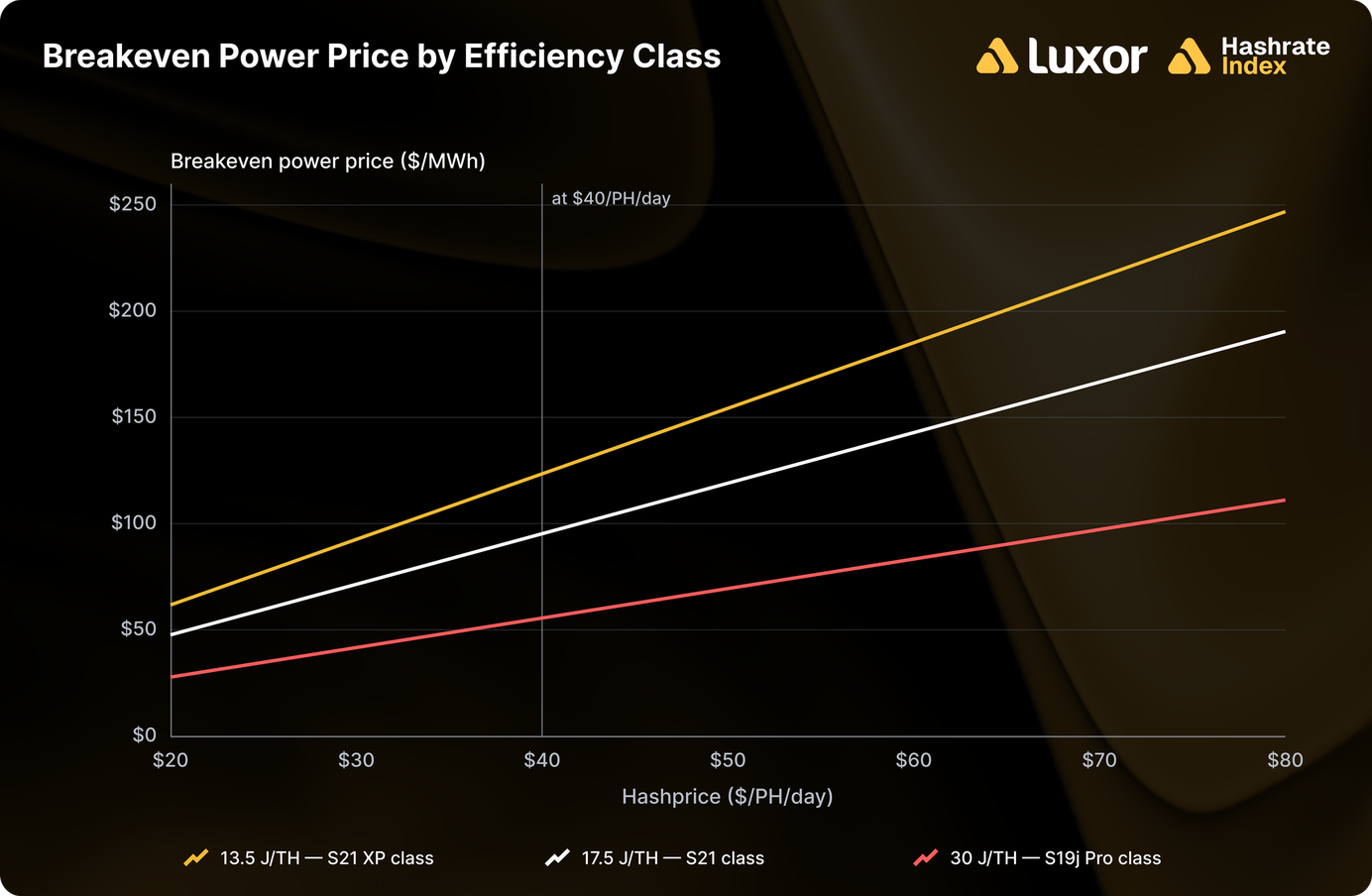
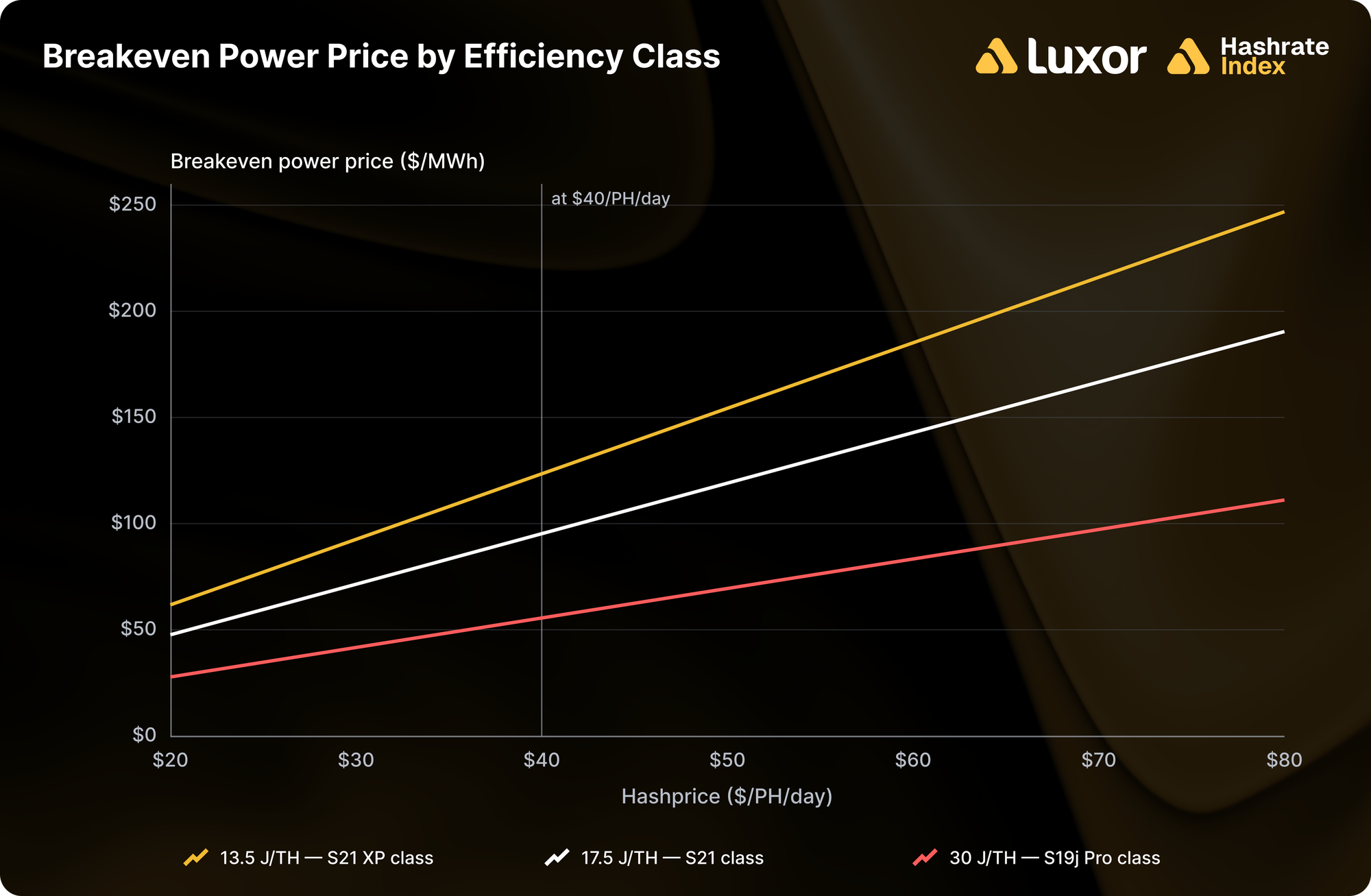
- At a hahsprice of $40 per PH/s/day, a 30 J/TH machine breaks even near $56/MWh; a 13.5 J/TH machine survives to roughly $123/MWh.
- Underclocking improves J/TH, which pushes the breakeven up — partial curtailment often beats binary off.
- The decision only earns money if it executes in real time — which makes it an automation problem.
- Your power contract shapes the answer — spot versus fixed power pricing determines whether the line is a live trigger or a planning benchmark.
The Formula
Mining revenue per machine is hashprice times hashrate; power cost is wattage times power price. Set them equal and the machine's wattage and hashrate collapse into a single term — its efficiency. What's left is a clean rule:
Breakeven $/kWh = hashprice ($/PH/day) ÷ (24 × J/TH)
Example – An S21-class machine (17.5 J/TH) at a $40 hashprice: 40 ÷ (24 × 17.5) ≈ $0.095/kWh, or about $95/MWh.
Below that power price, mine; above it, every megawatt-hour consumed loses money. Run the same arithmetic for a 30 J/TH machine and the line drops to roughly $56/MWh — the older fleet runs out of room first, which is the whole story of every hashprice drawdown.
Beyond the Simple Line
- Your real line is lower. The formula is a revenue-versus-power breakeven; hosting fees, labour, and pool fees all pull the practical curtailment threshold below it. Compute both (the gross line and your all-in line) because the gap between them is where partial responses live.
- Underclocking bends the curve. Efficiency improves at lower performance profiles, so a machine underwater at stock can be profitable when underclocked — the logic behind running fleets at reduced power in weak hashprice rather than switching them off. Partial curtailment is frequently the optimal response to moderately high power prices, with full curtailment reserved for significant spikes.
- Hashprice moves daily. A static threshold goes stale; the breakeven is a live calculation against current hashprice and your real-time power price. Framing revenue in energy-adjusted terms is a useful sanity check — it expresses what you earn per unit of energy rather than per unit of hashrate.
From Formula to Automation
- Compute your fleet's breakeven curve — per efficiency class, gross and all-in. Mixed fleets have several lines, not one.
- Wire in live inputs: your power price feed (spot or tariff) and hashprice. A curtailment strike-price API turns the threshold into something machines can read.
- Map price bands to actions: full power below the all-in line; step down profiles or power targets in the band between lines; curtail above the gross line.
- Let it run without you. LuxOS executes each tier via API — power targets for partial response, sub-five-second curtailment for spikes — and the same plumbing serves 4CP defense and demand response.
Breakeven FAQ
What is hashprice? Mining revenue per unit of hashrate per day — Hashrate Index's mining metric, quoted in USD or BTC per PH/s/day. It's the revenue side of every breakeven.
Should I curtail exactly at breakeven? At the gross line, hashing is exactly pointless; your all-in line (with non-power OpEx costs included) is the better trigger, which is below the gross line.
Does underclocking really change the breakeven? Yes — lower profiles run at better J/TH, so the breakeven price rises as you step down. That's why "slow down" often beats "shut off."
What about hosting contracts or fixed-price power? Fixed-price power simplifies the math but doesn't remove it. Your breakeven then decides whether the contract itself is in the money. Our spot vs. fixed piece covers this trade.
How do power prices actually behave? They're spikier than most models assume, and location matters enormously — see Power Prices and Bitcoin Mining Profitability and our energy arbitrage analysis.
Conclusion
One division tells you when to mine. The engineering is making the answer execute itself at machine speed, turning your breakeven number into an automated strategy.
More From the Firmware Features Series
- What Is AutoTuner? LuxOS Autotuning Explained
- Bitcoin Mining Curtailment: How LuxOS Powers Down Fast
- Miner Thermal Management: Inside LuxOS ATM
- ASIC Overclocking & Underclocking: LuxOS Profiles
- Power Targeting: Watt-Level Fleet Control
Related Reading: Power Prices & Profitability
- Four Strategies to Maximize Profitability in Low Hashprice Environments
- How Underclocking ASICs With LuxOS Can Help Hosts and Clients
- Energy Markets for Bitcoin Miners: Spot vs. Fixed Power Prices
- Power Prices and Bitcoin Mining Profitability in Bull and Bear Markets
- Energy Arbitrage: Analyzing Bitcoin Mining's Historical Revenue per kWh
- Energy-Adjusted Hashprice: Bitcoin Mining Revenue in Energy Terms
- Bitcoin Mining Energy Consumption to Hashrate Guide
- 4CP Defense Without an Operator in the Loop
Turn your cost curve into an automated dispatch rule with LuxOS.
If you'd like to learn more about Luxor's full-stack Bitcoin mining services, reach out to [email protected] or visit luxor.tech.
About Luxor Technology Corporation
Luxor delivers hardware, software, and financial services that power the global compute and energy industry. Its product suite spans Bitcoin Mining Pools, ASIC Firmware, Hardware trading, Hashrate Derivatives, Energy services, a Miner Management software, Commander, and a bitcoin mining data platform, Hashrate Index.
Disclaimer
This content is for informational purposes only, you should not construe any such information or other material as legal, investment, financial, or other advice.

Hashrate Index Newsletter
Join the newsletter to receive the latest updates in your inbox.