The Compute Competition
Zcash ASICs, Bitcoin ASICs and H100s are bidding for the same megawatts. What each earns per MWh, per machine and per dollar of capex in October 2026, and why the answer flips with the denominator.

At $0.08/kWh, an Antminer Z15 Pro mining Zcash earns about $770 of revenue per megawatt-hour. The best Bitcoin ASICs earn about $135. A rented H100 earns about $1,680, if it stays busy. Three kinds of compute now compete for the same power, and the winner depends on the denominator.
TLDR
- Per megawatt-hour, Zcash wins against Bitcoin by 6x to 8x. The Z15 Pro earns ~$773/MWh at today's ZEC price; the most efficient Bitcoin fleet earns ~$135 on Hashrate Index's Energy Hashprice.
- Against AI compute, it loses on energy and wins on capital. An H100 at the OCPI settlement earns ~$1,679/MWh when fully rented, but a megawatt of Z15 Pros costs $3-6M of hardware against $18-23M of new H100s, before the data center.
- Utilization is the swing factor. Below ~47% utilization at today's rental rate, or below ~$1.70/GPU-hr at 80%, the Zcash ASIC earns more per MWh than the GPU.
- Price outran hashrate. Zcash hashrate is up ~4x in a year; ZEC is up ~16.5x, even after a 30% pullback from its September 27 peak. The network already equals ~33,000 Z15 Pros, and new silicon does not arrive until Q2 2027.
- Firmware is the only new hashrate until then. LuxOS lifts a Z15 Pro's output by 5% at its most efficient profile and up to 18% at its fastest, at the cost of revenue per MWh.
Three Machines, One Megawatt
Energy is the one input all three machines share, so revenue per megawatt-hour is the cleanest first cut. We priced each on October 13 at $0.08/kWh, with ZEC at $1,185 and the Zcash network at 27.8 GSol/s.
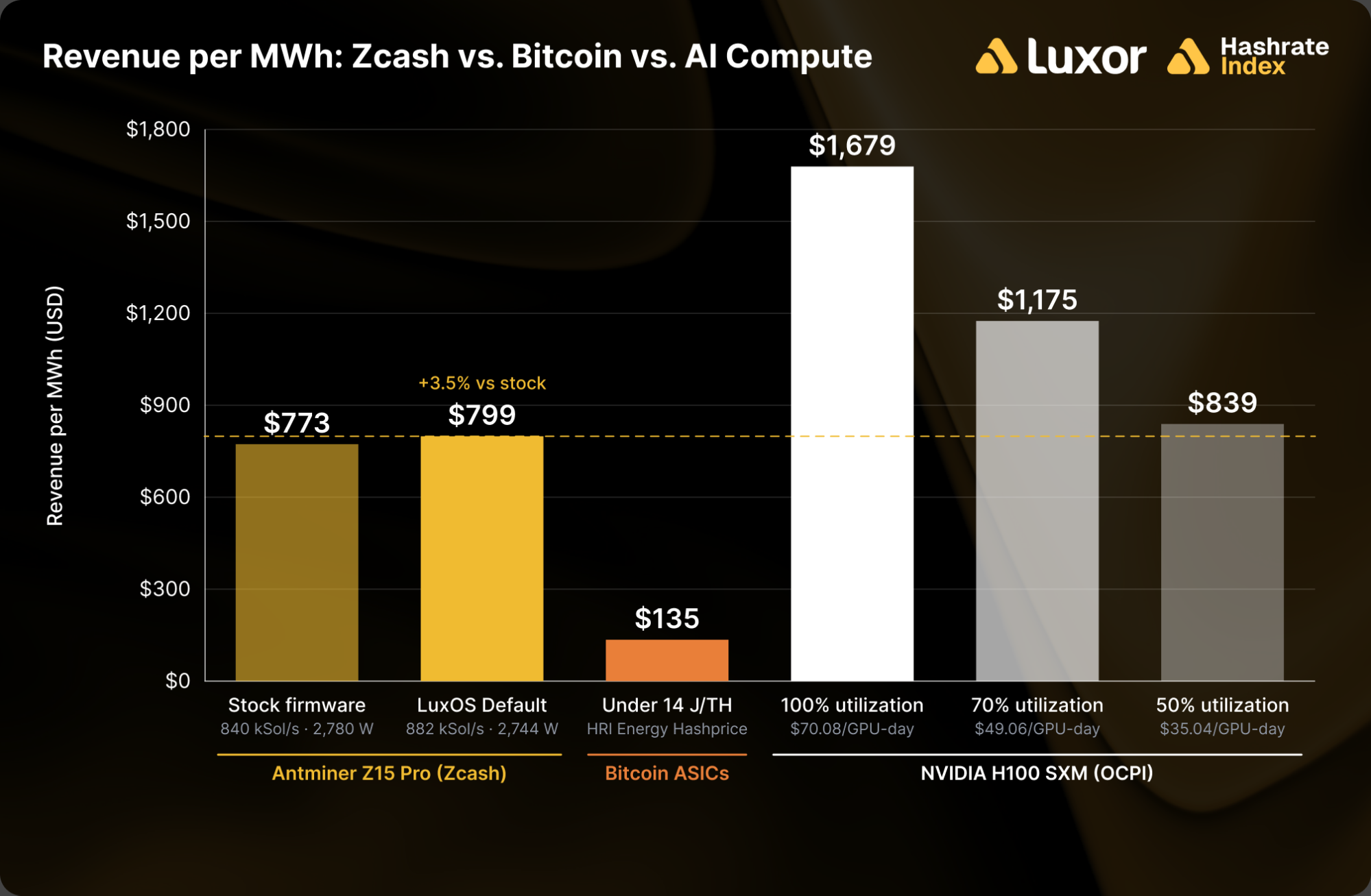
Miners receive 1,440 ZEC a day, so a stock Z15 Pro grosses $51.54, pays $5.34 for power and keeps $46.20. That is a 90% margin and a power break-even of $0.77/kWh, nearly ten times what most industrial miners pay. The best Bitcoin machines are not close: with hashprice at $39.71/PH/day, Energy Hashprice puts fleets under 14 J/TH at ~$135/MWh and S21-class hardware at ~$98. Grayscale's ~4x estimate from September is now conservative; ZEC kept rising for weeks after it.
The H100 is the twist. At the OCPI-H100 settlement of $2.92/GPU-hr it earns $70.08 a day, and on facility power of 1.74 kW per GPU that is ~$1,679/MWh, more than double the Z15 Pro. Quote the GPU's board power alone and the figure inflates to ~$4,170/MWh, which is why GPU-versus-ASIC comparisons need the same denominator. Facility power is the fair one; it is what the ASIC's wall draw already includes.
| Antminer Z15 Pro | NVIDIA H100 SXM | ||||
|---|---|---|---|---|---|
| Metric | Stock | LuxOS | 100% util. | 70% | 50% |
| Revenue / day | $51.54 | $52.63 | $70.08 | $49.06 | $35.04 |
| Gross profit / day | $46.20 | $47.36 | $66.74 | $45.72 | $31.70 |
| Revenue / MWh | $773 | $799 | $1,679 | $1,175 | $839 |
| Power break-even | $0.77/kWh | $0.80/kWh | $1.68/kWh | $1.18/kWh | $0.84/kWh |
| Units per MW | ~360 | ~364 | ~575 GPUs | ||
| Capex per MW | $3.2–5.8M | $18–23M new · ~$13M refurbished | |||
The H100 only holds its lead while it is rented. At 50% utilization it earns ~$839/MWh, level with the Z15 Pro; the crossover sits at ~46-48%.
Where the ASIC Wins: Capital, Not Energy
Per dollar of capex the order flips. A megawatt of Z15 Pros is ~360 machines at the $8,800-$16,000 that in-stock units list for this month, in a shell that costs a few hundred thousand dollars per megawatt. A megawatt of H100s is ~575 GPUs. Our AI Hardware Price Index has tracked new 8-GPU H100 nodes at $31,000-$40,500 per GPU since launch, so the hardware alone runs $18-23M (about $13M refurbished), and it sits inside a Tier-3 facility that can cost more than the GPUs. The Z15 Pro pays itself back in about 6 to 11 months on $46 a day of gross profit.
That is the honest version of the "Zcash mining beats AI" line that Grayscale and Cypherpunk have both used. It holds on capital intensity and build speed, the same edge we found when we modeled neocloud unit economics from a miner's position. It does not hold on revenue per unit of energy at index rental rates.
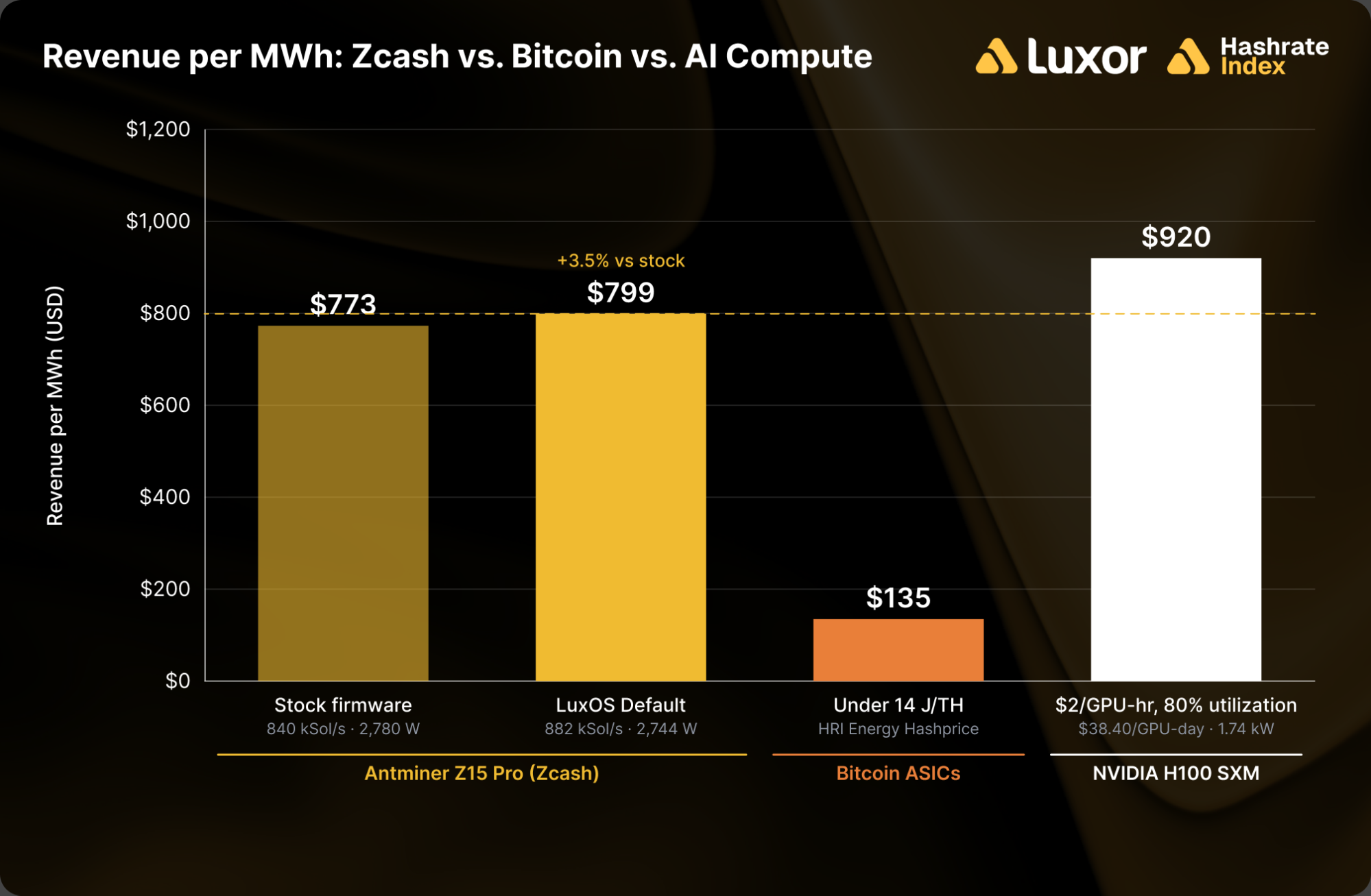
Lower rental rates close the gap fast. At $2.00/GPU-hr and 80% utilization the H100 earns ~$920/MWh, 15% more than a Z15 Pro on LuxOS. Push utilization under ~70% at that rate, or the rate under ~$1.70 at that utilization, and the ASIC earns more per megawatt-hour before counting its capex advantage. Moving from ASICs to GPUs is a bet on keeping both numbers high.
Price Outran Hashrate
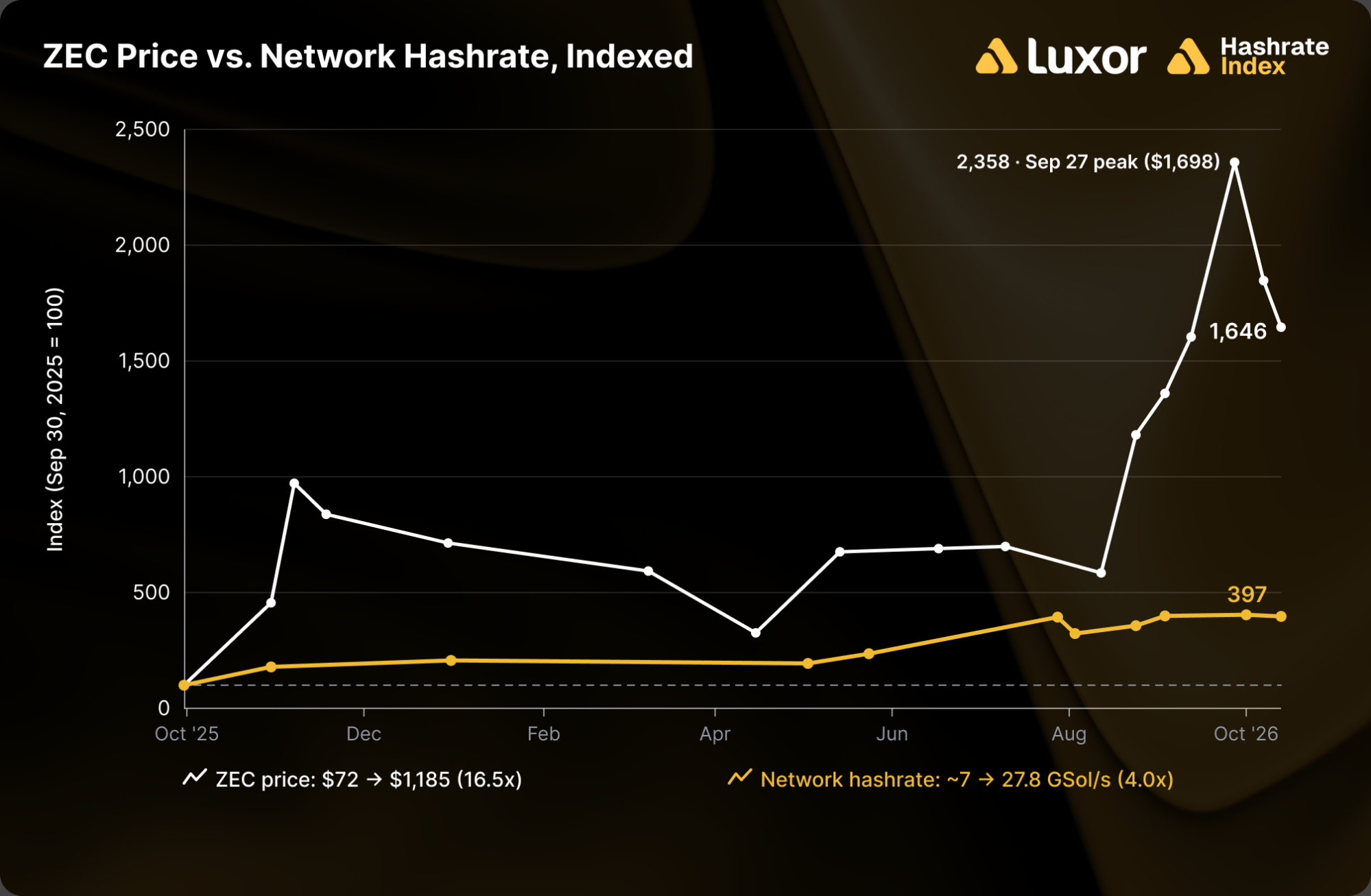
Zcash's hashrate has grown ~4x in twelve months, from ~7 GSol/s before the September 2025 rally to 27.8 GSol/s. ZEC went from $72 to a peak of ~$1,698 on September 27, a 23.6x move, and has given back about 30% since. Hashrate lagged price through both legs of the rally and barely moved through the spring drawdown to ~$235. Per-machine revenue held near $0.06/kSol/day the whole way because price kept outrunning the machines chasing it.
The miner pot is fixed at ~1,440 ZEC a day, ~$1.7M, and every new machine dilutes every existing one. The network already equals ~33,000 Z15 Pros drawing ~90 MW, yet at today's price the machine stays cash-positive until hashrate rises another ~10x. The binding constraint is supply, not power: in-stock Z15 Pros are scarce, their price has risen 2.4-4.3x since April, and Bitmain's next-generation Equihash ASIC is not expected before Q2 2027, with Fortitude Mining already holding a priority allocation of up to ~$100M. For Bitcoin ASICs the same picture runs the other way; see our weekly ASIC closing prices.
Who Mines Zcash
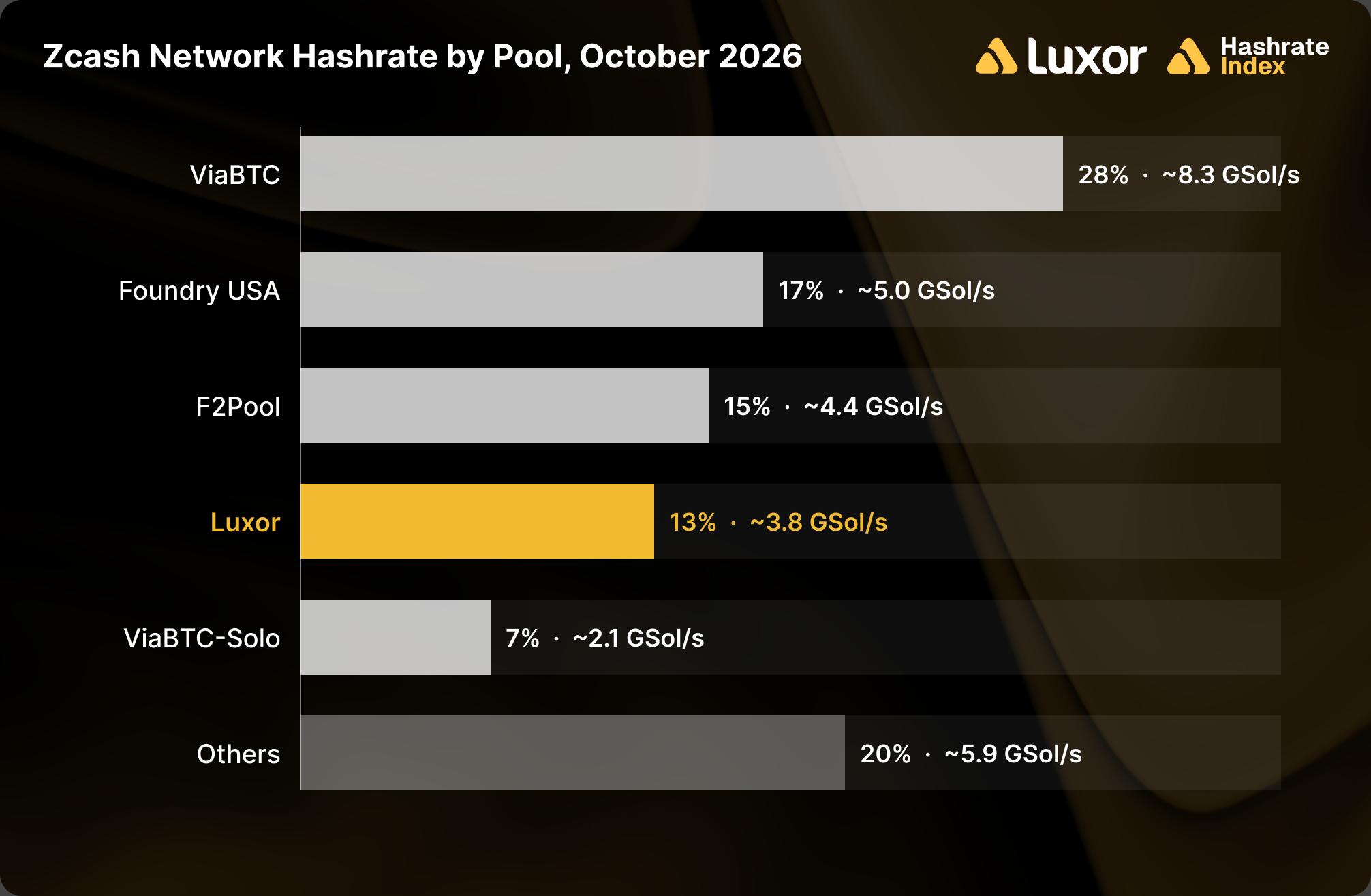
Six pools carry about 80% of the network, led by ViaBTC at 28%, with Luxor fourth at 13%. Tracker readings differ by a few points. The largest disclosed operator is Cypherpunk Technologies, whose 4.2 GSol/s Z15 Pro fleet was 18% of the network at its August launch and is ~15% today. That dilution in eight weeks is the hashrate story in one number: the fleet did not shrink, the network grew around it.
Firmware Is the Only New Hashrate Until 2027
With no new silicon until the second quarter of 2027, the only way to add Equihash hashrate from machines already deployed is firmware. LuxOS added Z15 Pro support on October 1, its first Equihash machine, with the same tuning profiles Bitcoin fleets already run. Luxor's bench testing measured four overclock profiles against Bitmain's stock 840 kSol/s at 3.31 J/kSol.
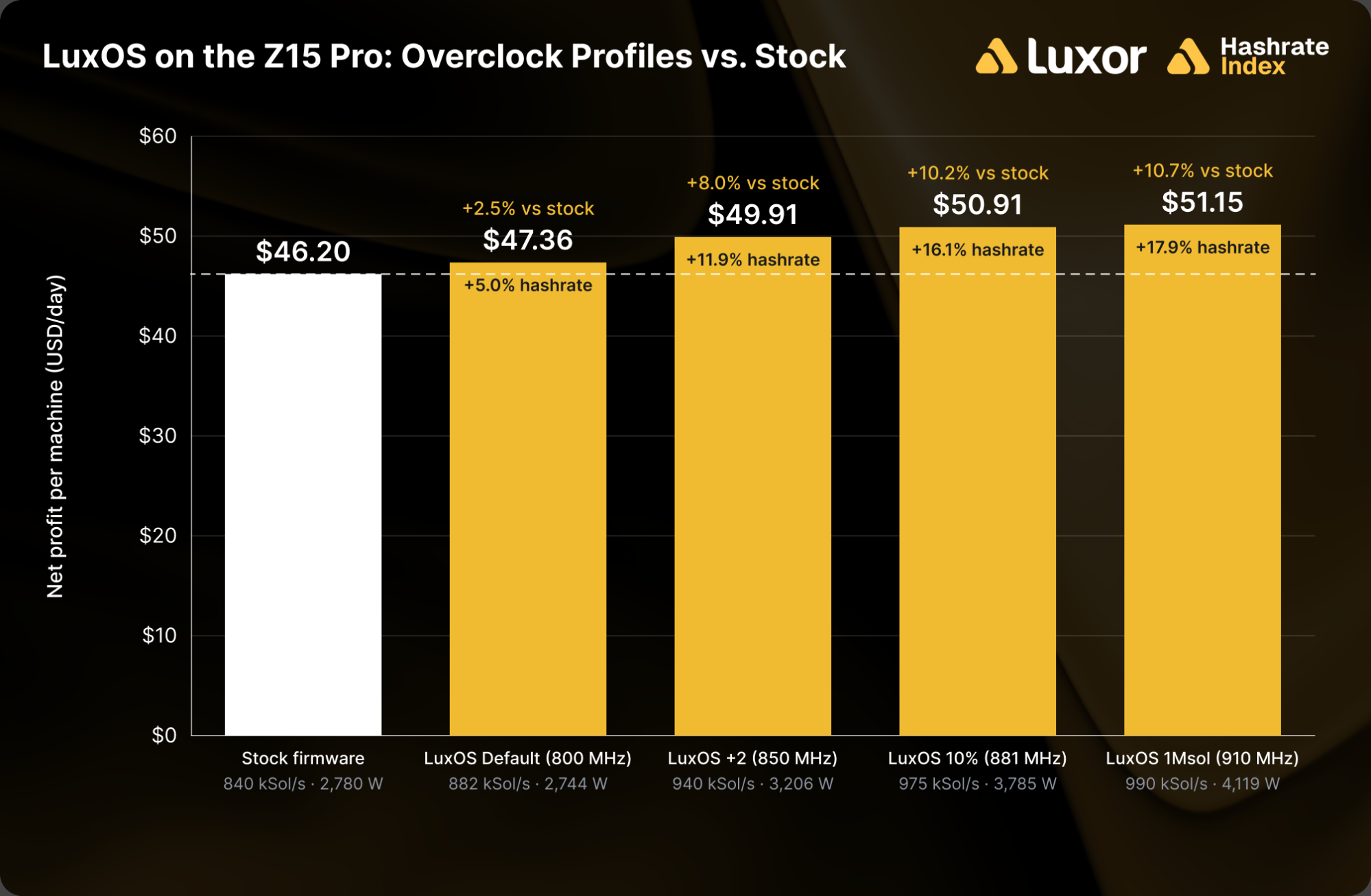
Only the Default profile beats stock on both axes: 5% more hashrate from 1% less power, and $799/MWh against $773. Every step beyond it trades energy efficiency for absolute dollars, down to ~$600/MWh at the 1Msol profile, which adds 18% hashrate on the bench and 14% sustained across a day. That is the right trade at $0.08/kWh and a 90% margin, and the wrong one at $0.15 or on a power-constrained site; our power break-even framework applies unchanged. The network effect is modest: each 10% of the Z15 Pro base moved to the top profile adds ~0.5 GSol/s, about 1.8% of the network, without a new machine.
FAQ
Why does an H100 earn more per MWh but lose on capital? Because its revenue is high per unit of energy and its cost is high per unit of revenue. A GPU rents for ~$2.92/hr against a $31,000-40,500 price tag and a Tier-3 shell; an ASIC earns $52/day against a $9,000-16,000 price tag and a warehouse. Energy favors the GPU, payback favors the ASIC.
Does overclocking improve revenue per MWh? Only the Default profile does (+3.5%). Every overclock above it raises dollars per machine and lowers dollars per MWh, because power rises faster than hashrate.
What happens to the Z15 Pro if ZEC halves again? At ~$590 and today's hashrate, revenue per MWh falls to ~$390, still ~3x the best Bitcoin ASICs, and power break-even drops to ~$0.39/kWh. The machine keeps running; the payback stretches to roughly 14-26 months at current hardware prices.
Conclusion
The compute competition is not one race. Per megawatt-hour, a busy H100 beats a Zcash ASIC, and a Zcash ASIC beats a Bitcoin ASIC by six to eight times. Per dollar of capital, the ASIC wins outright and pays itself back inside a year. What all three share is that the lead belongs to whoever keeps the hardware running: an idle GPU and a stock-firmware ASIC both leave revenue on the table, which is the case for running more than one kind of compute on the same site. In Zcash's case, the supply constraint means firmware is the only lever until 2027.
If you'd like to learn more about Luxor's Bitcoin Mining Hardware services or LuxOS firmware, please reach out to [email protected] or visit https://luxor.tech.
— Happy Hashing!
About Luxor Technology Corporation
From Bitcoin mining to AI infrastructure, Luxor delivers the hardware, software, finance and energy tools that power the world's compute. Its Bitcoin product suite spans Mining Pools, ASIC Firmware, Hardware trading, Hashrate Derivatives, Energy services, a Miner Management software, Commander, and a bitcoin mining data platform, Hashrate Index; its AI product suite spans Hardware, Compute, and Tenki: cloud infrastructure for code and agents.
Disclaimer
This content is for informational purposes only, you should not construe any such information or other material as legal, investment, financial, or other advice.

Hashrate Index Newsletter
Join the newsletter to receive the latest updates in your inbox.