A $5M Put Option on B200 Rental Prices: Inside the First OTC Compute Option
Hyperbolic bought a price floor on a year of B200 rental revenue. Here is what was traded, how the put option payoff works, and why it is familiar to anyone who has hedged hashprice.


On Nov 17, Luxor, Architect and Hyperbolic announced the first over-the-counter (OTC) option trade on GPU rental prices: a one-year put option that hedges about $5 million of Hyperbolic's future NVIDIA B200 rental revenue. It is cash-settled and non-deliverable, so no GPUs change hands, and it pays only when a rental price index settles below an agreed strike. Bitcoin miners have used similar contracts on hashprice for years.
What Was Traded
Three companies are on the trade. Hyperbolic, an AI infrastructure platform that rents out GPU capacity, is the hedger. Architect designed the hedge with Hyperbolic through its CFTC-registered introducing broker affiliate, and Luxor, as swap counterparty, priced and executed the option.
The option references the Silicon Data B200 Rental Price Index (SDB200RT), a daily benchmark of what neocloud providers quote for an NVIDIA B200, in dollars per GPU-hour. The contract settles monthly in cash, and the index, start date and settlement schedule were set around Hyperbolic's own exposure.
"With Architect and Luxor, we turned a year of B200 rental revenue into something we can plan around, and that's what lets compute be run like the commodity it is becoming."
— Jasper Zhang, Co-founder and CEO, Hyperbolic
The B200 index opened 2026 at $4.40 and reached $7.10 on Nov 17, up 61% for the year and 19% in the last five weeks alone.
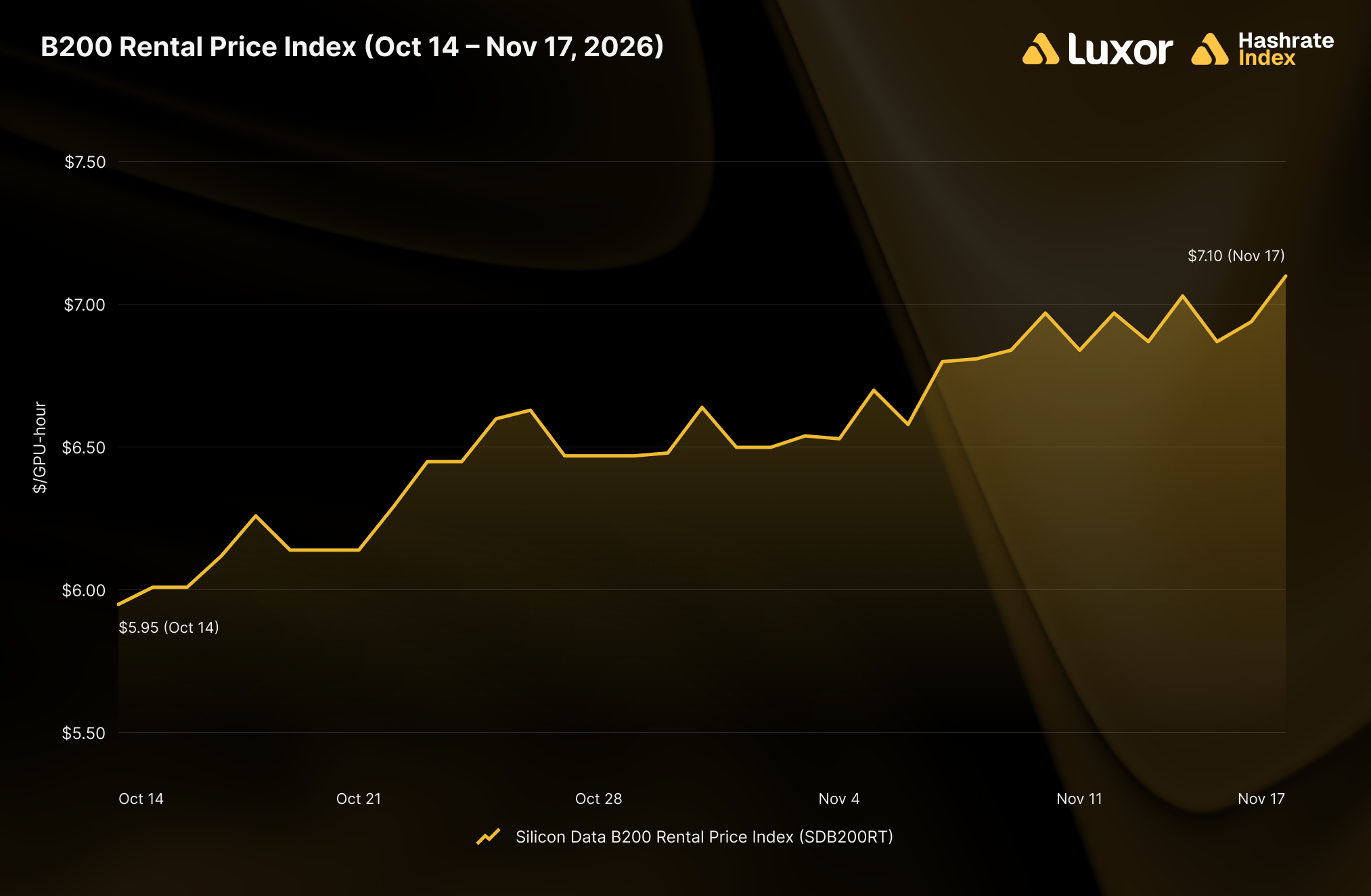
Bought into a rising market, the put option sets the floor a GPU-hour will earn if on-demand rental prices turn, and leaves the upside with Hyperbolic.
How a GPU Rental Put Pays
A put option has a strike, a price per GPU-hour. In any settlement period where the rental price index comes in below it, the seller pays the buyer the difference on the hedged GPU-hours. Above the strike, the option pays nothing and the operator keeps what the market pays.
Take a hypothetical $4.50 strike. If the index averages $3.00 for a month, the put option pays $1.50 per GPU-hour, or $1,080 per GPU over a 30-day month, and index-linked revenue is back at $4.50. At $6.00, the put option pays nothing and the operator earns $6.00.
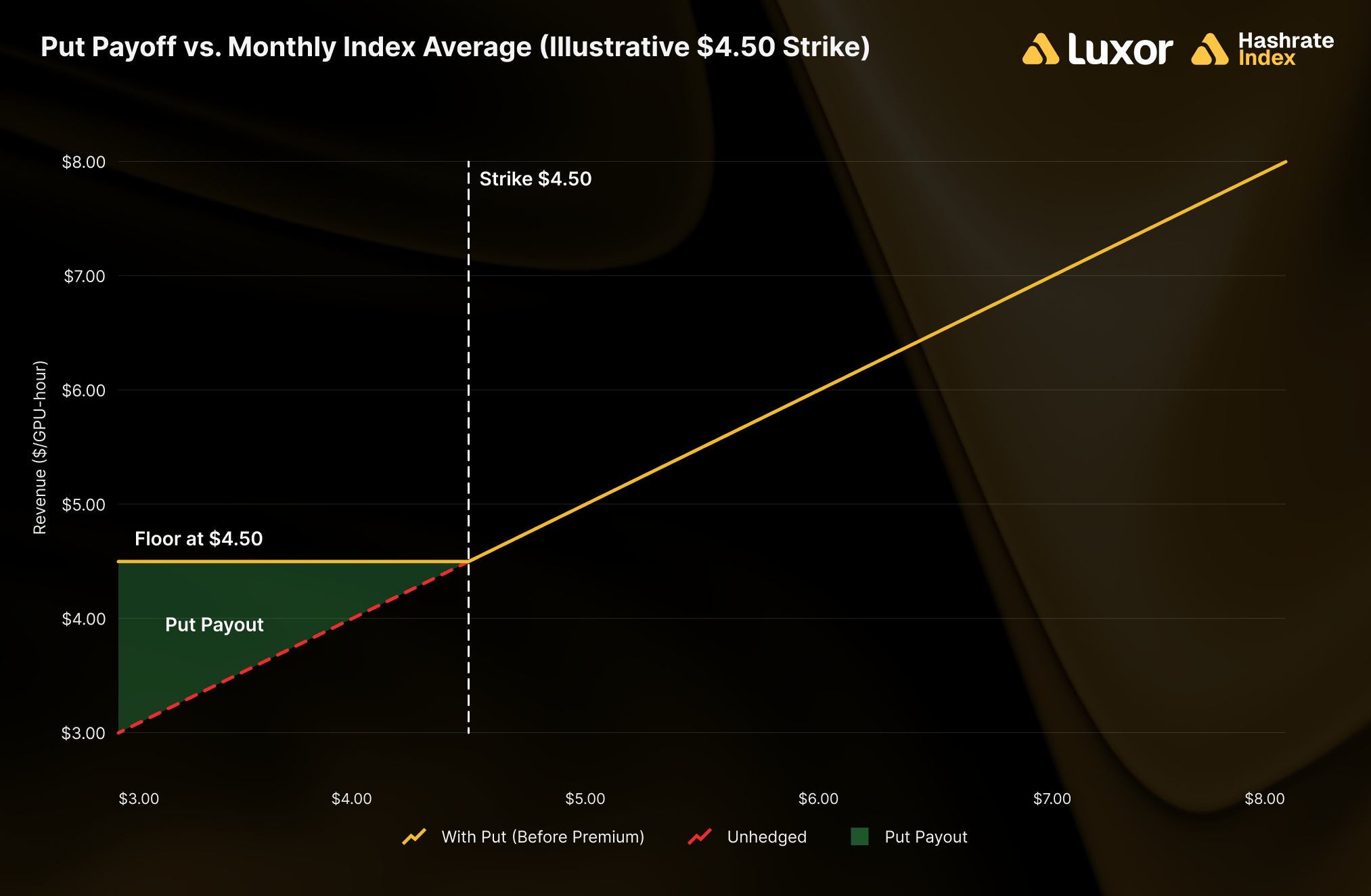
Buying the put costs a premium, paid whether or not the option pays out. A forward avoids the premium by fixing a rate per GPU-hour in both directions: if the index rises, the operator pays the excess and gives up the upside. Other structures like collars and spreads sit between the two, giving up some upside for a lower or zero premium. An operator who expects B200 rates to keep climbing, but wants to lock in a floor price for downside protection, buys the put option.
Labs and inference platforms that rent compute can do the reverse: buying a call to cap their index-linked rental cost or a forward contract to fix it.
The hedge leaves some risks in place. It floors the index, not the operator's own rental prices (basis risk), and an idle GPU earns the put payout but not the rent. It also adds counterparty credit risk, limited ability to exit early, and exposure to changes in the index methodology.
Miners Know This Trade
A GPU operator pays for hardware upfront and finds out later what it earns. So does a Bitcoin miner. Hashprice, the daily revenue of 1 PH/s, fell 33% from $41.64 on Jan 15 to $27.74 on Jun 6, was back above $40 in September, and sat at $30.22 on Nov 17.
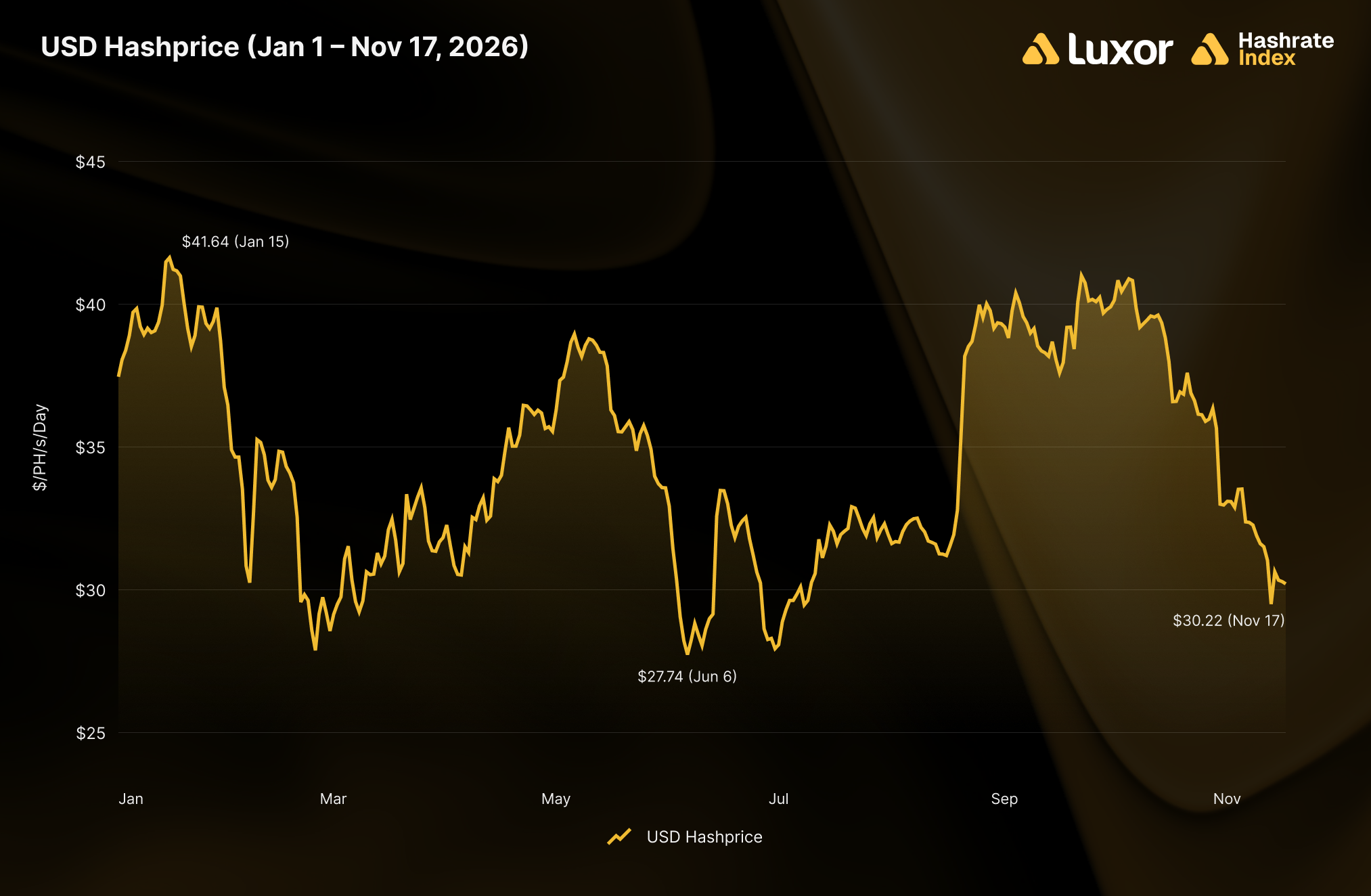
Miners answered with derivative contracts on hashprice. Luxor's derivatives desk started with hashrate forwards in 2022, saw the first hashrate futures list on a CFTC-regulated exchange, and has traded more than $500 million of notional with over 130 institutional counterparties. The Hyperbolic put option applies the same approach to a different index.
Listed compute futures are not here yet. CME Group's planned contracts on Silicon Data's H100 and B200 indexes are still with the CFTC, and NYMEX has agreed to extend that review through Jan 8, 2027. We covered the index questions behind that delay in our Yotta 2026 recap. Exchange-listed and bilateral contracts do different jobs: a futures contract is one size and one calendar month, which makes it liquid, while a bilateral contract is tailor-made.
"Operators don't run their businesses on standard contract months. They need hedges that match the hardware they own and the period they need covered."
— Matt Williams, Head of Financial Services, Luxor
Matt walked through the trade on Blockspace, including why it settles on each month's average index price.
Hedging Compute With Luxor
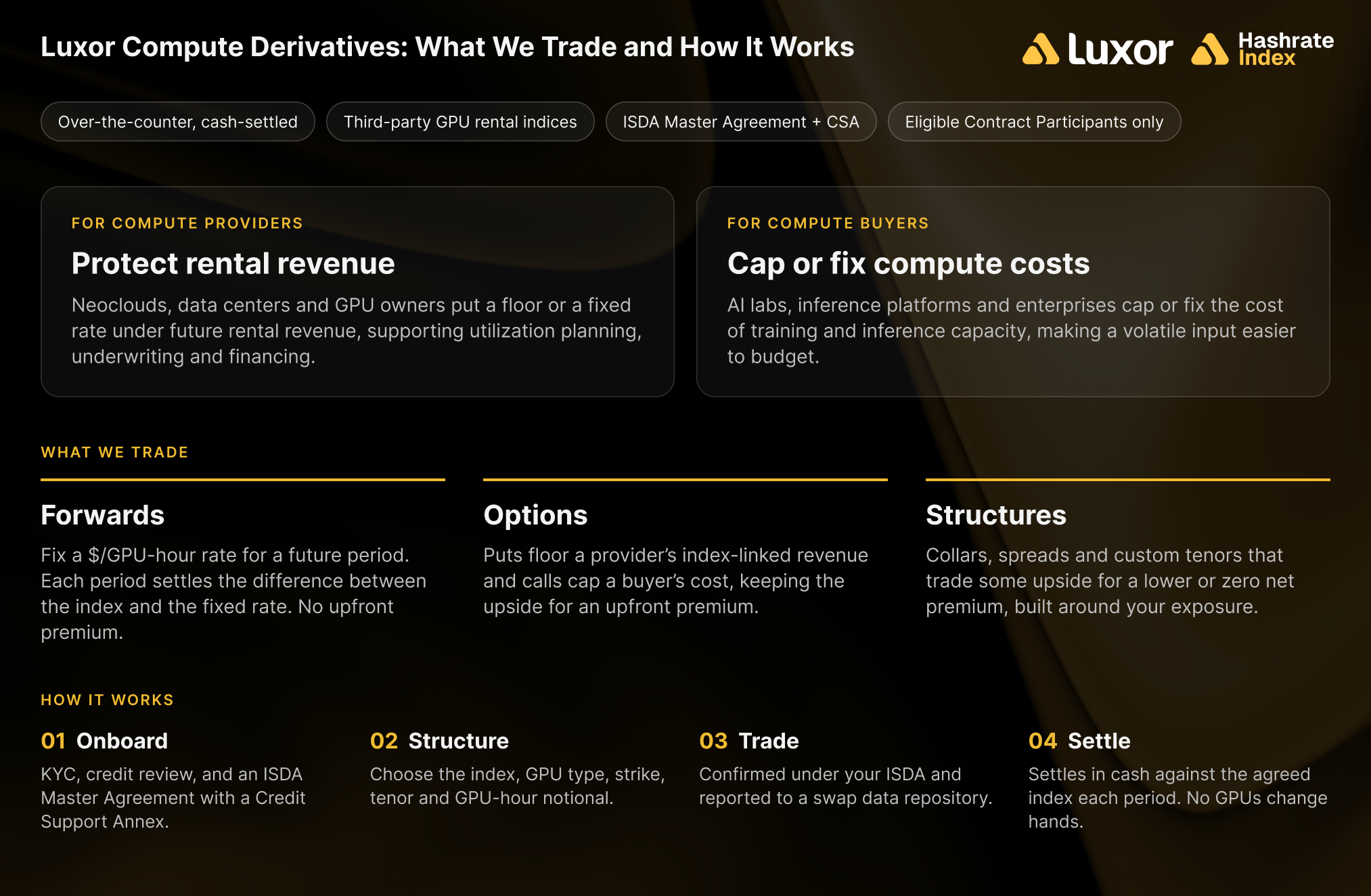
One trade is a starting point. A deeper market needs hedgers on both sides: GPU owners (compute producers) looking to floor or lock in their rental revenue, and labs and inference platforms (compute consumers) looking to cap or fix their compute costs, with traders willing to carry the risk in between.
"Every company building on GPUs is exposed to the price of compute, and until now there has been no practical way to manage that risk."
— Brett Harrison, Founder and CEO, Architect
Luxor's compute derivatives desk is built for both sides of that market. It trades over-the-counter forwards, options and custom structures on GPU-hour prices, cash-settled against third-party GPU rental indices, with each hedge set around the client's own GPUs, tenor and index.
If you'd like to learn more about Luxor's compute derivatives, please reach out to [email protected] or visit luxor.tech/ai/derivatives.
About Luxor Technology Corporation
From Bitcoin mining to AI infrastructure, Luxor delivers the hardware, software, finance and energy tools that power the world's compute. Its Bitcoin product suite spans Mining Pools, ASIC Firmware, Hardware trading, Hashrate Derivatives, Energy services, a Miner Management software, Commander, and a bitcoin mining data platform, Hashrate Index; its AI product suite spans Hardware, Compute, and Luxor AI: cloud infrastructure for code and agents.
Disclaimer
This content is for informational purposes only; you should not construe any such information or other material as legal, investment, financial, or other advice. Nothing contained in our content constitutes a solicitation, recommendation, endorsement, or offer by Luxor or any of Luxor's employees to buy or sell any derivatives or other financial instruments in this or in any other jurisdiction in which such solicitation or offer would be unlawful under the derivatives laws of such jurisdiction.
There are risks associated with trading derivatives. Trading in derivatives involves risk of loss; loss of principal is possible.



Hashrate Index Newsletter
Join the newsletter to receive the latest updates in your inbox.