Firmware Fundamentals – Measuring Bitcoin Mining Efficiency: J/TH Explained
Hashrate tells you how big your compute capacity is. Efficiency (J/TH) tells you how well you run from a performance-per-watt perspective.

This post is part of Luxor's Firmware Features Series, which covers the core Bitcoin mining concepts behind the flexible firmware features that give operators custom control over performance and profitability.
Hashrate (TH/s) tells you how big a bitcoin mining machine's compute production capacity (SHA-256) is. Efficiency (J/TH) tells you how well it runs from a performance-per-watt perspective.
TLDR
- Joules per terahash (J/TH) measures how much energy an ASIC consumes to produce one terahash of work. Lower is better.
- The math is simple: powerr consumption (watts) divided by hashrate (TH/s). A 3,000 W mining machine producing 100 TH/s runs at 30 J/TH.
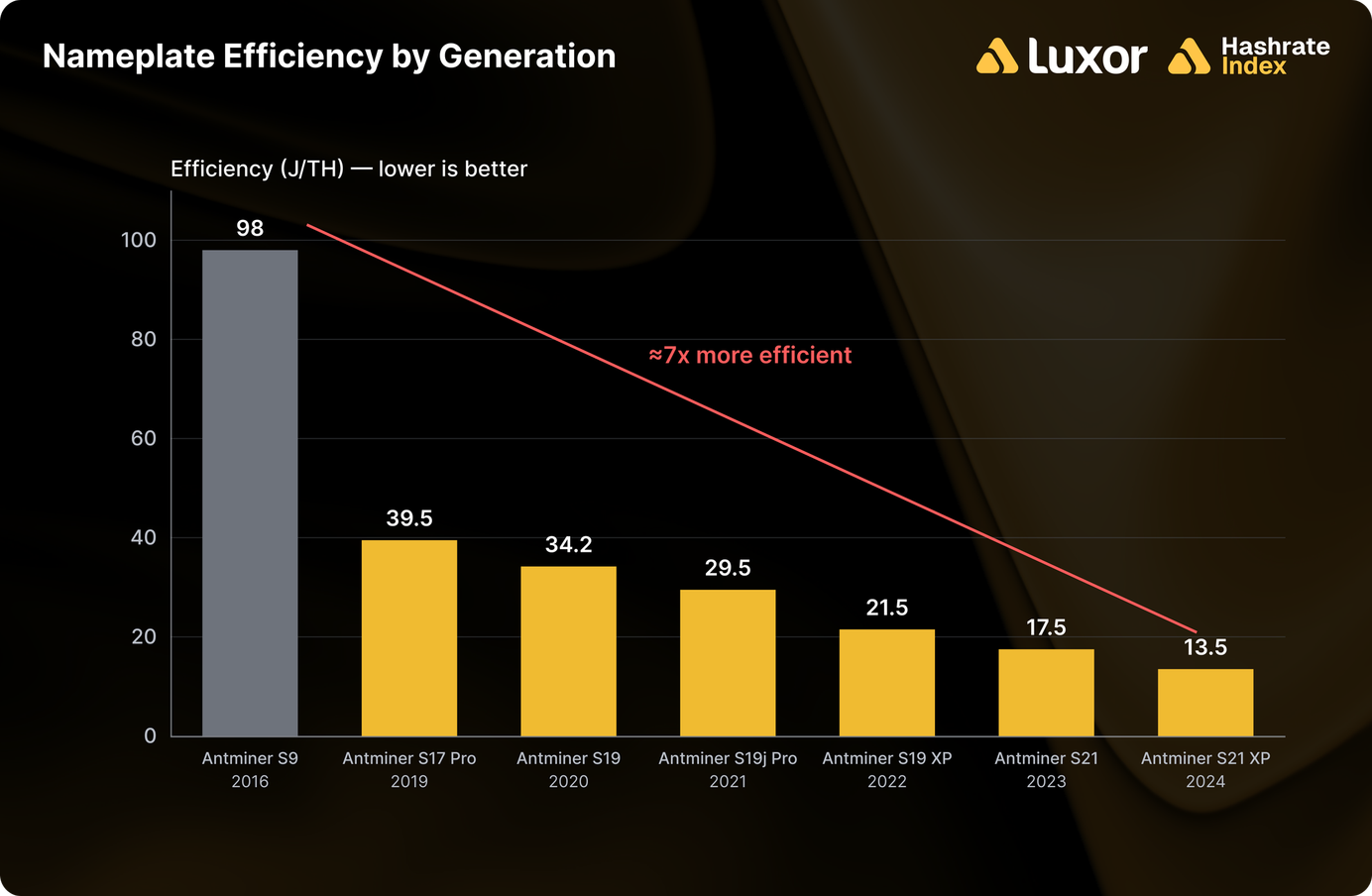
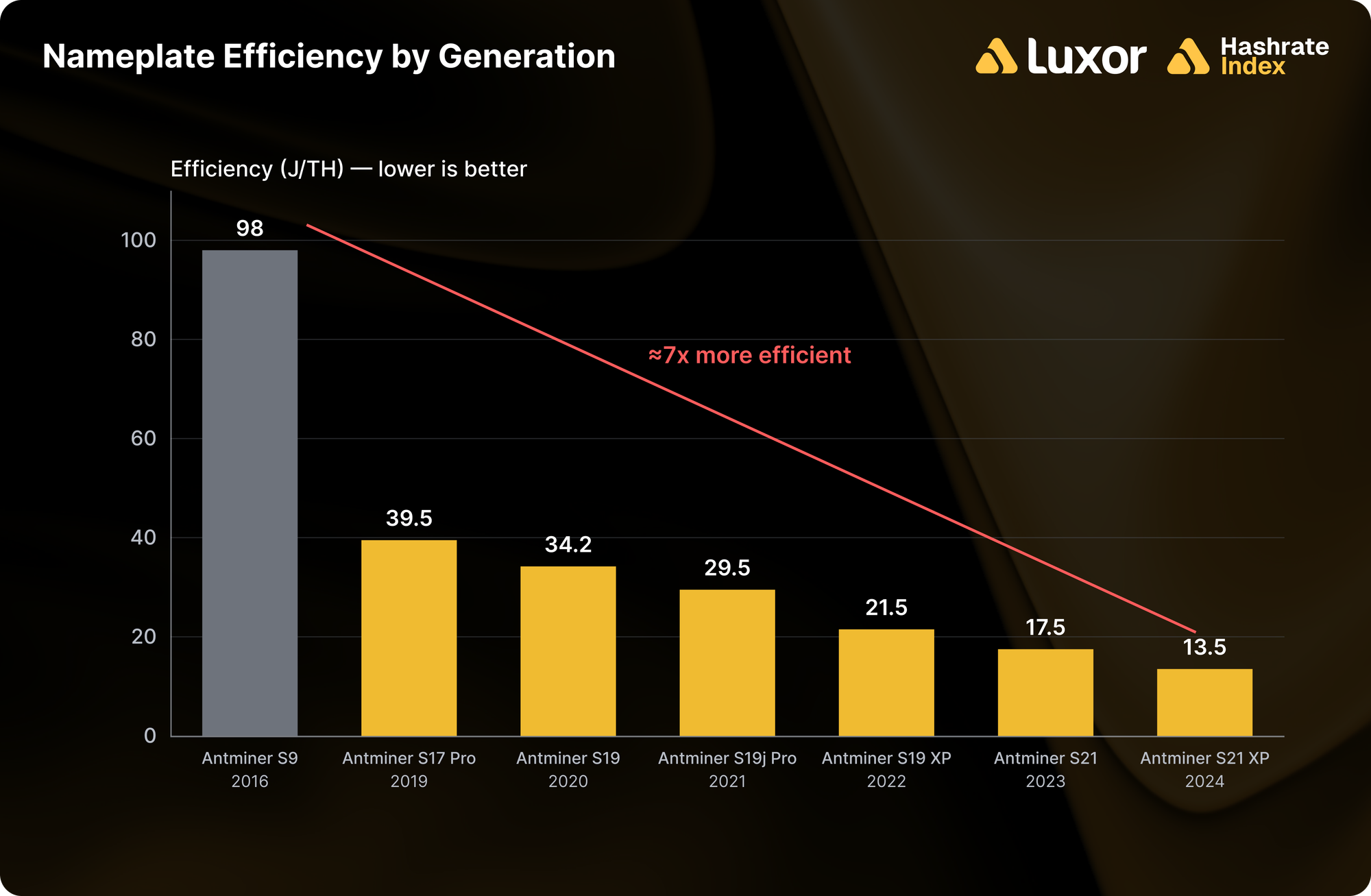
- Efficiency has improved roughly 7x from the S9 era (~98 J/TH) to the S21 XP class (~13.5 J/TH).
- J/TH sets your breakeven power price: the lower your J/TH, the higher a power price you can justify.
- Hardware sets your starting efficiency; firmware decides where it ends up. Tuning moves J/TH away from nameplate specs in both directions.
What Is J/TH?
J/TH is joules of energy per terahash of computation — the standard efficiency metric for Bitcoin mining hardware. Because one watt is one joule per second and hashrate is measured per second, the units collapse conveniently: a miner's J/TH equals its wattage divided by its hashrate in TH/s.
Two worked examples. An Antminer S19j Pro drawing roughly 2,950 W at 100 TH/s runs at about 29.5 J/TH. An S21 XP at roughly 3,645 W and 270 TH/s runs at about 13.5 J/TH. Same arithmetic, but two very different machines. This gap is the entire story of the last several ASIC hardware generations.
Why J/TH Is the Metric That Matters
Revenue per terahash — hashprice — is the same for every miner on the network. Cost per terahash is not: it is your specific power price multiplied by your specific J/TH. This asymmetry, where you lie on the cost curve, is the whole game. Two operators earning identical revenue can sit on opposite sides of profitability purely because one runs at 30 J/TH and the other at 15 J/TH.
When hashprice compresses, the least efficient (high J/TH) portion of the network goes underwater first, which is why every halving and every difficulty epoch is, underneath, an efficiency story. The same logic governs your own fleet: a machine's J/TH decides the power price at which it stops making sense to run.
It also shapes what hardware is worth paying for. Efficiency commands a price premium, so the buying decision is never J/TH alone but J/TH per dollar of CapEx — the thinking behind our efficiency-adjusted ASIC price.
How to Improve Your J/TH
- Tune the voltage. Factory settings carry a stability margin sized for the worst case. LuxOS' Autotuner reclaims it, cutting watts at constant hashrate — a direct J/TH improvement with no hashrate trade-off.
- Underclock when economics favour it. Efficiency improves at lower frequencies, so stepping down profiles lowers J/TH while it lowers output — often the right trade during low hashprice periods.
- Manage heat. Hot chips need more voltage to stay stable, so cooler operation is more efficient operation — one reason thermal management shows up in the efficiency conversation.
- Mind the denominator. Nameplate specs assume nameplate conditions. For converting between consumption and hashrate at fleet scale, see our energy-consumption-to-hashrate guide.
J/TH FAQ
Is J/TH the same as W/TH? Numerically yes — watts per terahash-per-second and joules per terahash are the same figure. J/TH is the conventional notation.
What's a good J/TH in 2026? Latest-generation hardware runs in the low-to-mid teens, and the modern fleet broadly sits under about 20. Anything north of 25 is living on cheap power.
Does my real J/TH match the spec sheet? Rarely exactly — chip quality, temperature, and tuning all move it. Tuned machines typically beat nameplate; hot or untuned ones miss it.
Does a lower J/TH always win? Per kilowatt-hour, yes. Per dollar of CapEx, not necessarily — efficiency carries a price premium, which is its own separate analysis.
How does J/TH relate to my breakeven power price? Directly. Breakeven in dollars per kWh is roughly hashprice in $/PH/day divided by 24 times your J/TH — so halving your J/TH roughly doubles the power price you can survive.
Conclusion
Hashrate is what you sell; J/TH is what it costs you to produce it. Hardware sets your starting efficiency, firmware decides where it ends up. Most fleets are running above their best available efficiency for no reason other than that nobody has tuned them.
More From the Firmware Features Series
- What Is AutoTuner? LuxOS Autotuning Explained
- Bitcoin Mining Curtailment: How LuxOS Powers Down Fast
- Miner Thermal Management: Inside LuxOS ATM
- ASIC Overclocking & Underclocking: LuxOS Profiles
- Power Targeting: Watt-Level Fleet Control
Related Reading
- Four Strategies to Maximize Profitability in Low Hashprice Environments
- How Underclocking ASICs With LuxOS Can Help Hosts and Clients
- The Efficiency-Adjusted ASIC Price
- Bitcoin Mining Energy Consumption to Hashrate Guide
- Firmware Flexibility: Maximizing Mining Margins
- Top 5 Bitcoin Mining Firmware for 2026
Your machines are probably running above their achievable J/TH. Install LuxOS with Commander and tune your fleet down to its best efficiency.
If you'd like to learn more about Luxor's full-stack Bitcoin mining services, reach out to [email protected] or visit luxor.tech.
About Luxor Technology Corporation
Luxor delivers hardware, software, and financial services that power the global compute and energy industry. Its product suite spans Bitcoin Mining Pools, ASIC Firmware, Hardware trading, Hashrate Derivatives, Energy services, a Miner Management software, Commander, and a bitcoin mining data platform, Hashrate Index.
Disclaimer
This content is for informational purposes only, you should not construe any such information or other material as legal, investment, financial, or other advice.

Hashrate Index Newsletter
Join the newsletter to receive the latest updates in your inbox.