Firmware Features – Bitcoin Mining Heat Recycling: Turning Watts Into BTUs
A Bitcoin miner is a resistive heater that happens to get paid. Heat recycling is the act of tapping into that treasure.

This post is part of Luxor's Firmware Features Series, which covers the core Bitcoin mining concepts behind the flexible firmware features that give operators custom control over performance and profitability.
A Bitcoin miner is a resistive heater that happens to get paid. Heat recycling is the act of tapping into that treasure.
TLDR
- Essentially all of a miner's electrical input becomes heat — the conversion runs at 1 kW = 3,412 BTU/hr.
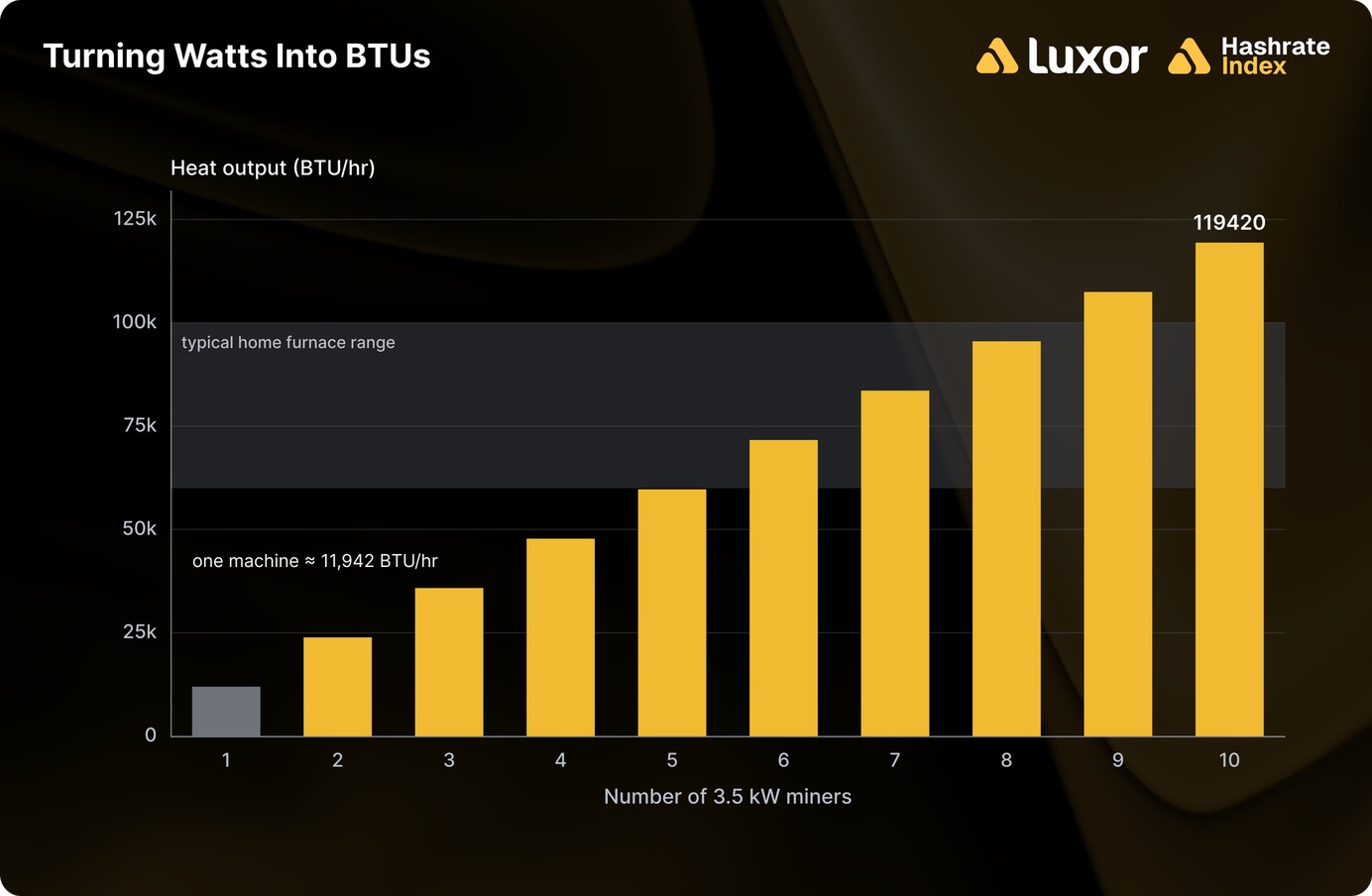
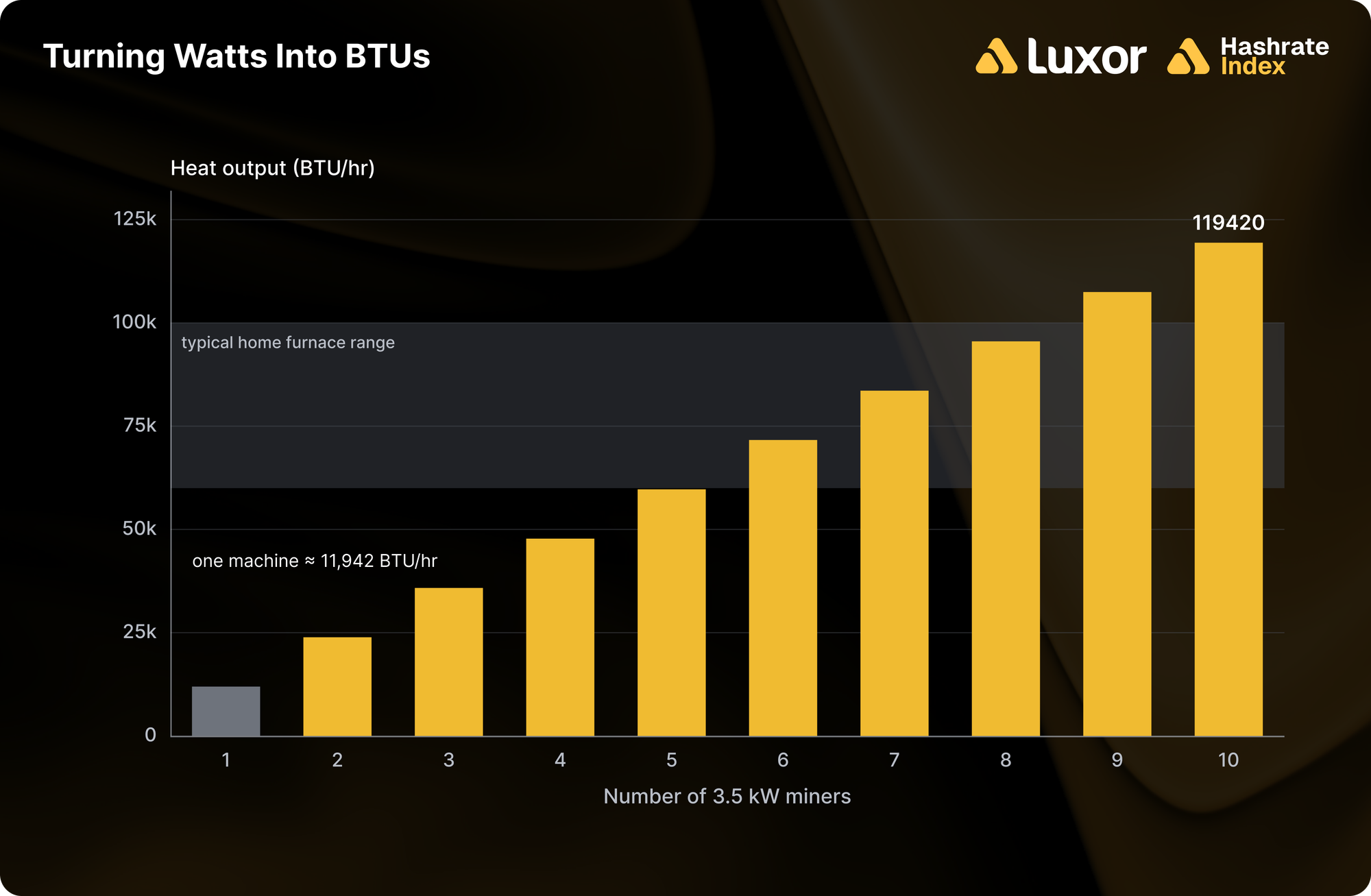
- A single 3.5 kW machine emits roughly 12,000 BTU/hr: genuine space-heater territory. Ten of them reach furnace-class output.
- Power Targeting turns heat output into a setpoint — BTUs are proportional to watts, and watts become whatever number you type.
- Captured heat is revenue-equivalent: every BTU that offsets a heating bill subsidizes the hashrate that produced it.
- Delivery method decides the application — air for zones and workshops, hydro and immersion for water loops and quiet spaces.
The Physics and the Math
A miner does no mechanical work and stores nothing; apart from a trivial amount leaving as network signals, every joule in becomes heat out. That makes the accounting unusually clean: kilowatts of draw times 3,412 gives BTU/hr of heating.
The interesting consequence is that a miner is, thermodynamically, a 100%-efficient electric heater that also produces hashrate. Anywhere electric resistance heating already makes sense, mining heat is strictly better economics — you were going to pay for those watts and get heat; now you get heat and BTC. The comparison that does not hold is against a heat pump, which moves several units of heat per unit of electricity and will beat resistance heating on pure efficiency.
Where the Heat Goes
- Space and water heating. Single-machine setups heat workshops, garages, and zones; hydro and immersion machines move heat into water loops for domestic hot water and hydronic systems.
- Home and hobby heating. Purpose-built small units have made this a real category — Canaan's Avalon Nano 3, the Nano 3S, and the Avalon Mini 3 are designed for a living space.
- Agriculture and aquaculture. Greenhouses and grow operations buy heat year-round, and steady-state mining heat fits their load profile well. Purpose-built hydro systems like the HeatCore HS20 exist for exactly this application.
- District and industrial heat. At scale, immersion and hydro facilities export to heat networks — the heat becomes a second product line rather than a disposal problem.
Why Firmware Enables Planning for Heat Recyling
Heat reuse has a control problem: the building wants a heat schedule, the miner wants to run flat out, and stock firmware can't negotiate between them. LuxOS' Power Targeting resolves it because BTU output is proportional to watt input, so setting a power target is like setting a thermostat.
Need 8,500 BTU/hr? That's roughly a 2,500 W target, held continuously regardless of conditions. Ramp targets up on cold nights and down on mild days, by API, on a schedule. Advanced Thermal Management keeps the machine safe inside whatever envelope the heating design imposes, so the thermal plan never fights the hardware's own protection.
This is also what separates heat reuse from heat disposal. A site that can only run flat out produces heat on the machine's schedule; a site that can dial watts produces heat on the building's schedule, and only the second one can sell it.
Heat Recycling FAQ
How much heat does a Bitcoin miner produce? Its full power draw, converted at 3,412 BTU/hr per kW — a 3.5 kW machine is roughly a 12,000 BTU/hr heater.
Can a miner heat a whole house? One machine heats a zone; whole-home heating wants several machines or a hydro unit feeding a hydronic loop, plus real heating design.
Does reusing the heat reduce mining performance? No — heat is the byproduct either way. Capture design (airflow, water loops) is what varies, and well-cooled machines can even run more efficiently.
What about noise in living spaces? Air-cooled units belong in utility spaces; hydro and immersion move the heat without the noise, which is why they dominate residential heat-reuse builds.
Is it cheaper than a heat pump? Not on efficiency alone. A heat pump delivers several units of heat per unit of electricity. Mining heat wins when you value the hashrate revenue alongside the warmth, or where resistance heating is the realistic alternative.
Conclusion
Mining's waste product is a commodity everyone already buys. Capture it and the same kilowatt gets sold twice — once as hashrate, once as heat. The engineering question is never whether the heat exists; it's whether you can deliver it where it's wanted, on the schedule it's wanted, which is a firmware problem as much as a plumbing one.
More From the Firmware Features Series
- What Is AutoTuner? LuxOS Autotuning Explained
- Bitcoin Mining Curtailment: How LuxOS Powers Down Fast
- Miner Thermal Management: Inside LuxOS ATM
- ASIC Overclocking & Underclocking: LuxOS Profiles
- Power Targeting: Watt-Level Fleet Control
Related Reading: Heat, Hydro & Immersion
- Power Targeting: A New Foundation for Luxor Firmware
- A Deep Dive into the HeatCore HS20 Hydro Mining System and Whatsminer M63S
- A Look Inside an Immersion and Hydro Bitcoin Mine
- What Is Immersion ASIC Cooling? Immersion Bitcoin Mining 101
- Canaan Avalon Nano 3: Your Humble Heater for Home Mining
- Canaan Avalon Mini 3: Your Home Base for Hash Heating
- Bitcoin Mining Energy Consumption to Hashrate Guide
Planning a heat-reuse deployment? LuxOS can help you size the thermal output and wire the controls.
If you'd like to learn more about Luxor's full-stack Bitcoin mining services, reach out to [email protected] or visit luxor.tech.
About Luxor Technology Corporation
Luxor delivers hardware, software, and financial services that power the global compute and energy industry. Its product suite spans Bitcoin Mining Pools, ASIC Firmware, Hardware trading, Hashrate Derivatives, Energy services, a Miner Management software, Commander, and a bitcoin mining data platform, Hashrate Index.
Disclaimer
This content is for informational purposes only, you should not construe any such information or other material as legal, investment, financial, or other advice.

Hashrate Index Newsletter
Join the newsletter to receive the latest updates in your inbox.