
Luxor Hashrate Lookback Series — August 2026
August 2026’s hashrate and hashprice trends, forward market participation, trading activity and contract performance.




Luxor’s Monthly Lookback Series is a deep dive into Bitcoin hashrate market activity. In this post, we cover August 2026’s hashrate market and hashprice trends, forward market participation, trading activity and contract performance.
Summary
- Hashprice +24% in Twelve Days: USD hashprice opened August at $31.63 per PH/s/day and closed at $39.33 (+24.4%), the 18th-largest monthly gain since 2017 and the biggest since November 2024. August 27 saw the first $40 reading in 220 days. The monthly average rose to its highest since May.
- BTC +25%, Two Days Did It: Bitcoin opened at $62,889 and closed at $78,312 (+24.5%), the 22nd-largest monthly gain since 2017 and the biggest since November 2024. An SEC rulemaking, a Treasury buyback expansion and a White House push on the Clarity Act landed inside 72 hours. Spot ETFs took in $3.52B, their best month of 2026.
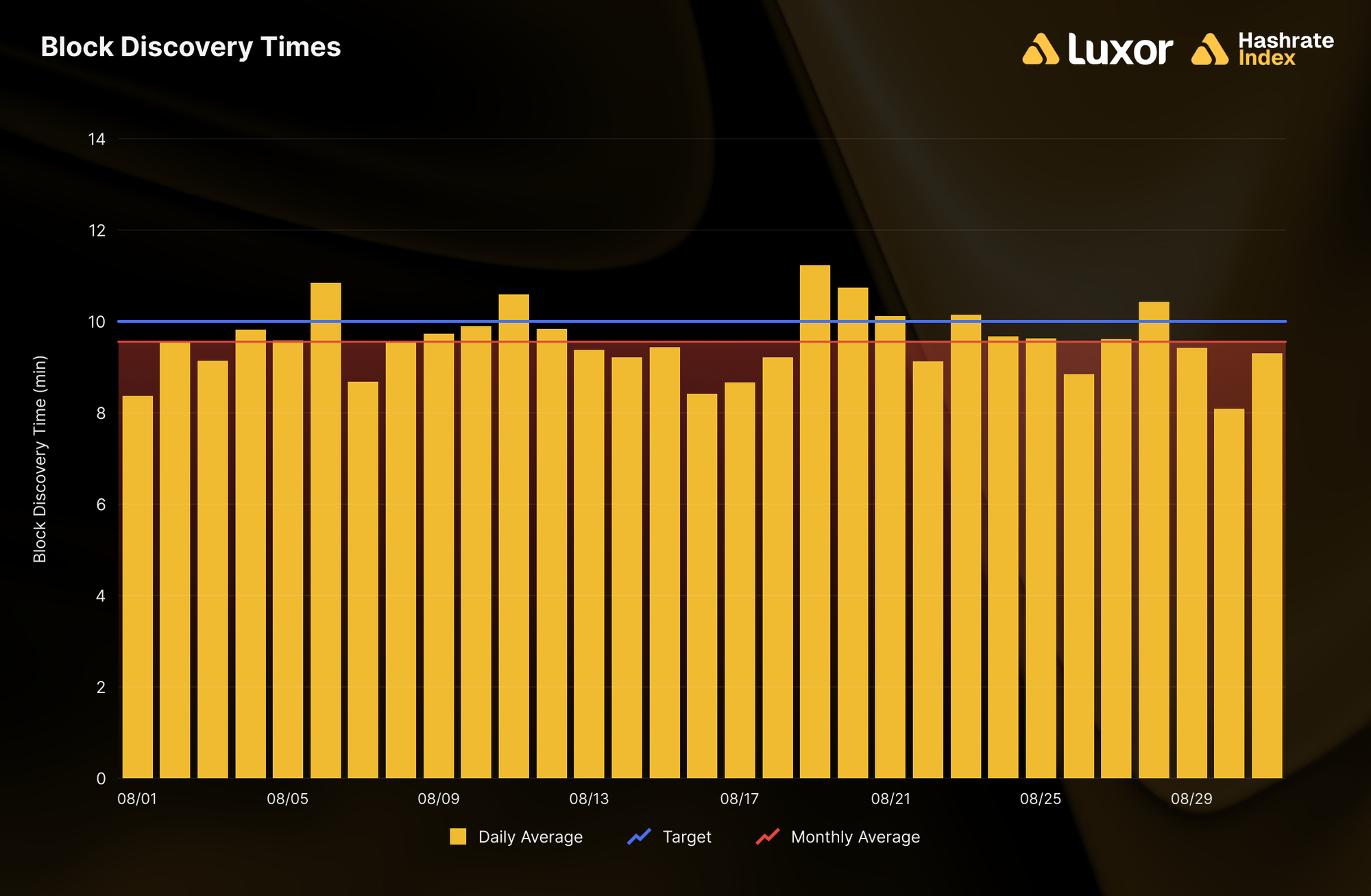
- Network Flat, Hashrate Returning: Difficulty adjusted +0.99% on August 8 and −1.31% on August 23, net −0.34%. Blocks averaged 9m34s, with 24 of 31 days below target. BTC hashprice averaged 0.00049980 BTC per PH/s/day, its highest since July 2025.
- Hedgers Paid for the Rally: One of five USD forward sales beat spot settlement at $34.63, May's $35.30 (+1.9%). BTC-denominated sellers lost at every horizon for a fifth consecutive month.
- The Forward Curve Followed Price, Not Difficulty: USD forwards for September–January rose +23.8% against +24.2% in spot. BTC forwards rose +1.3%. The forward hashrate market repriced Bitcoin and maintained its view of mining economics as is.
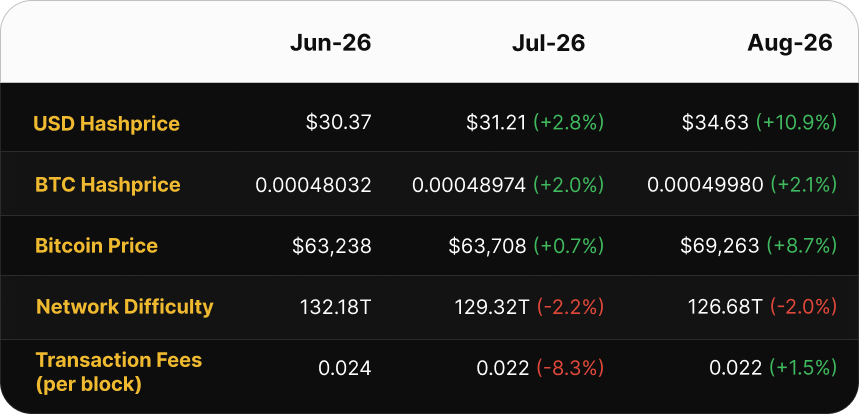
August 2026 Spot Hashprice & Its Constituents
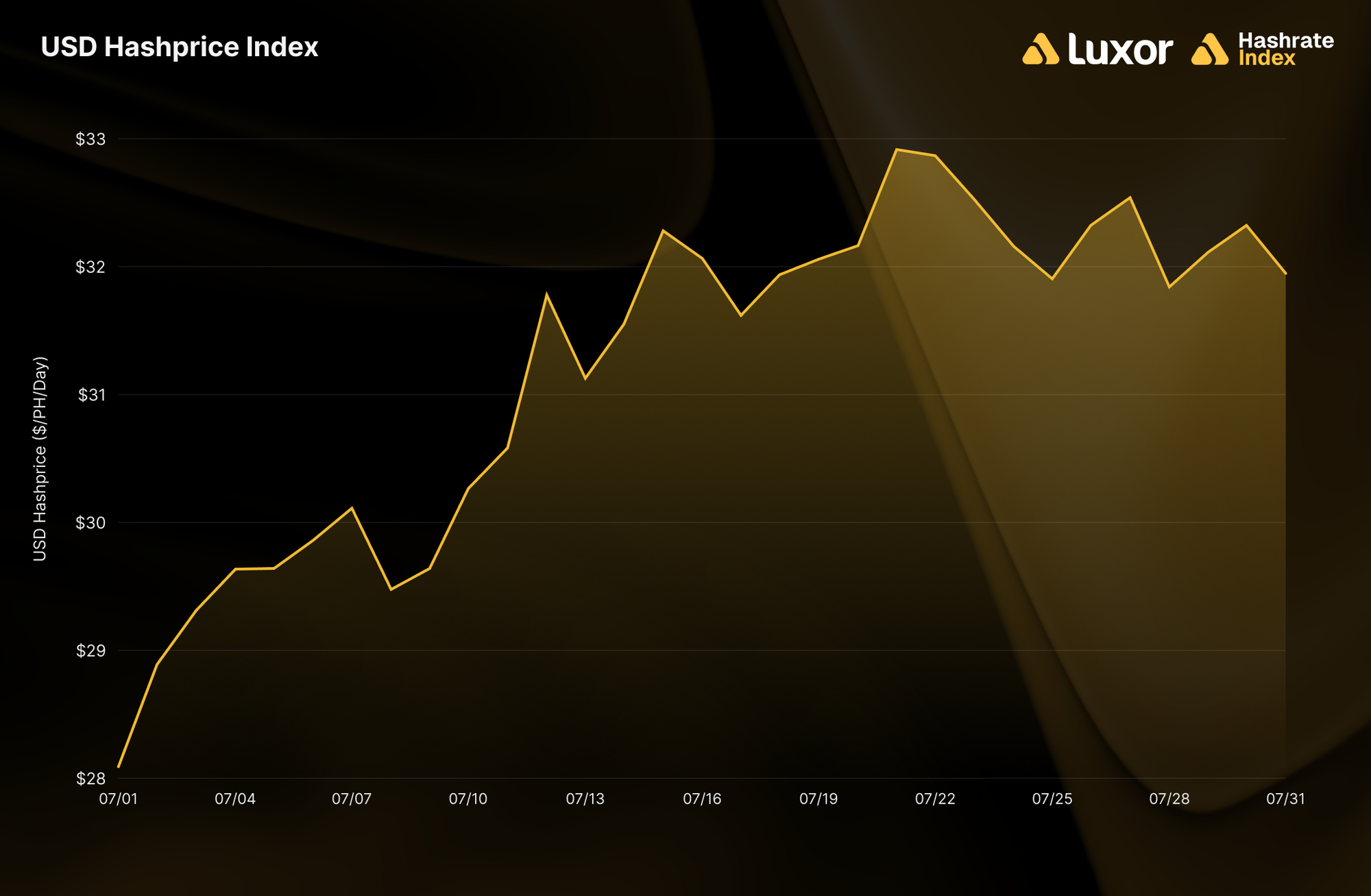
August was a two-in-one month. The first nineteen days extended July’s trend: hashprice in a $31–33 band, Bitcoin in the low $60,000s. Then BTC repriced. It gained 19.0% in three days, and hashprice followed.
USD Hashprice — Nineteen Days of July, Twelve Days of Something Else
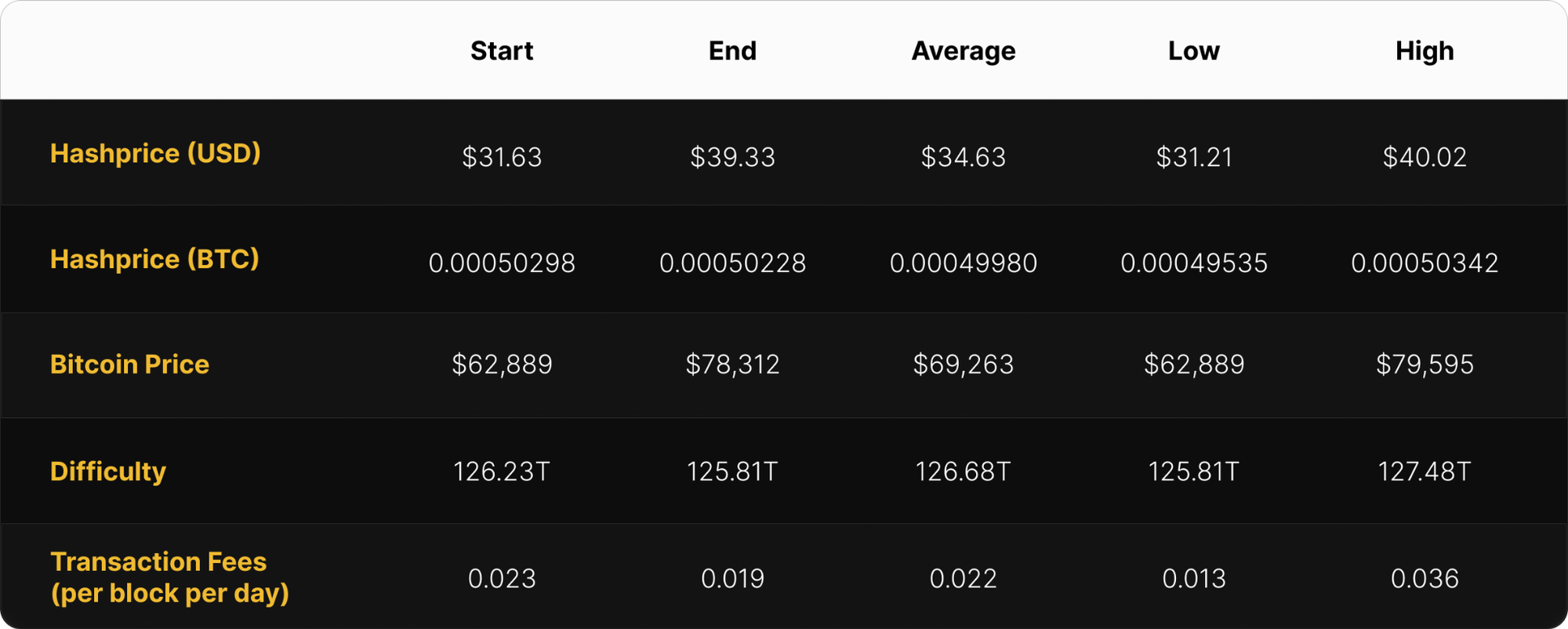
Monthly average USD hashprice rose from $31.21 to $34.63 per PH/s/day (+10.9%), the highest since May ($36.60). The month opened at $31.63 and drifted to a $31.21 low on August 16, closing at $39.33, +24.4% on the open. August 1–19 averaged $31.90. August 20–31 averaged $38.95. Eleven of the last twelve days settled above $38, a level last seen on May 15.
The +24.4% open-to-close move ranks 18th of 116 months since 2017 and is the largest since November 2024 (+30.6%). August 27's $40.02 was the first $40 hashprice recorded since January 19, 220 days earlier. It lasted one day. 2025's monthly averages ran between $37.89–$59.38 with a mean of $50.68; August 2026 sits 32% below that.
BTC Price — Significant Gains
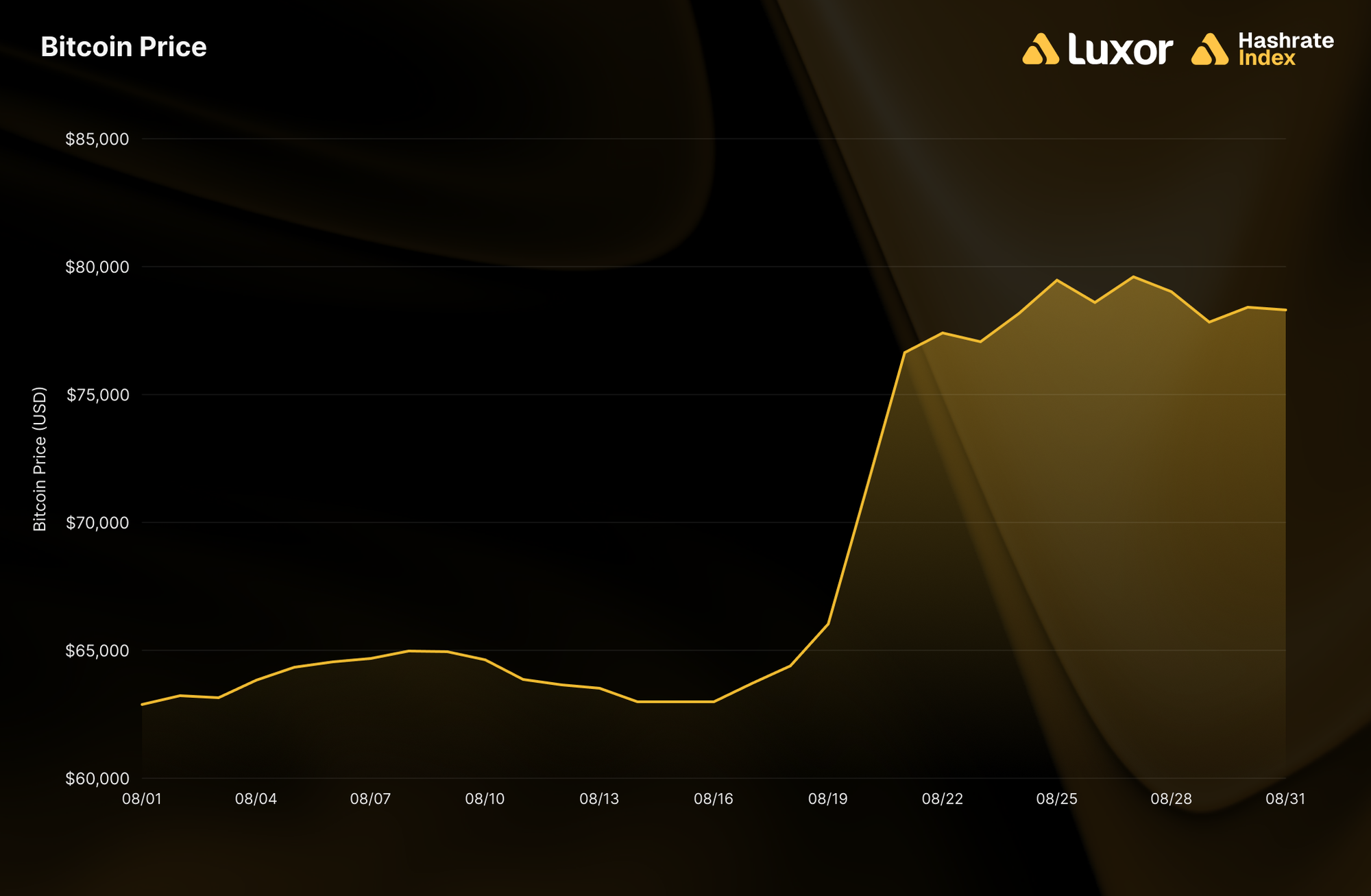
BTC opened August at $62,889 and closed at $78,312 (+24.5%), averaging $69,263 (+8.7%) month-over-month. The high was $79,595 on August 27. The month ranks 22nd of 116 since 2017 and is the largest gain since November 2024 (+38.8%).
Two days did the work. Bitcoin averaged $66,032 on August 19, $71,280 on August 20 and $76,635 on August 21. August 20's +7.9% is the largest single-day gain since the April 2024 halving; August 21's +7.5% is the third-largest. Together they are the largest two-day move (+16.1%) and three-day move (+19.0%) since the halving, and the 19th- and 20th-largest since 2017.
The catalysts came from a confluence of factors. On August 18 the SEC proposed Regulation Crypto Assets, its first rulemaking dedicated to crypto offerings, exempting raises of up to $5M and $75M from Securities Act registration. On August 19 the Treasury said it would at least double its long-end buyback operations from $2B to $4B, effective September 9, and 30-year yields fell almost 10bps from a 19-year high. On August 20 President Trump pressed the Senate to pass the Clarity Act. Across the same window a record ~$2.7B of crypto shorts were liquidated. Spot Bitcoin ETFs confirmed rather than led: $3.52B of August inflows against $172M in July, positive on 16 of 21 sessions, assets under management (AUM) up from $76.3B to $99.6B.
The first crack came on August 28. Fed Chair Kevin Warsh used his Jackson Hole keynote to call summer inflation readings insufficient, and CME FedWatch odds of a September hike rose from 33–40% to 57–66%. Bitcoin gave back 1.5% the next day.
At $78,312, BTC ended August 37.1% below its October 6, 2025 peak of $124,485, versus −48.9% at the end of July and −52.6% at June's trough. It remains 18.7% below the 2026 high of $96,278 (January 15).
Network Difficulty — Two Adjustments That Cancelled
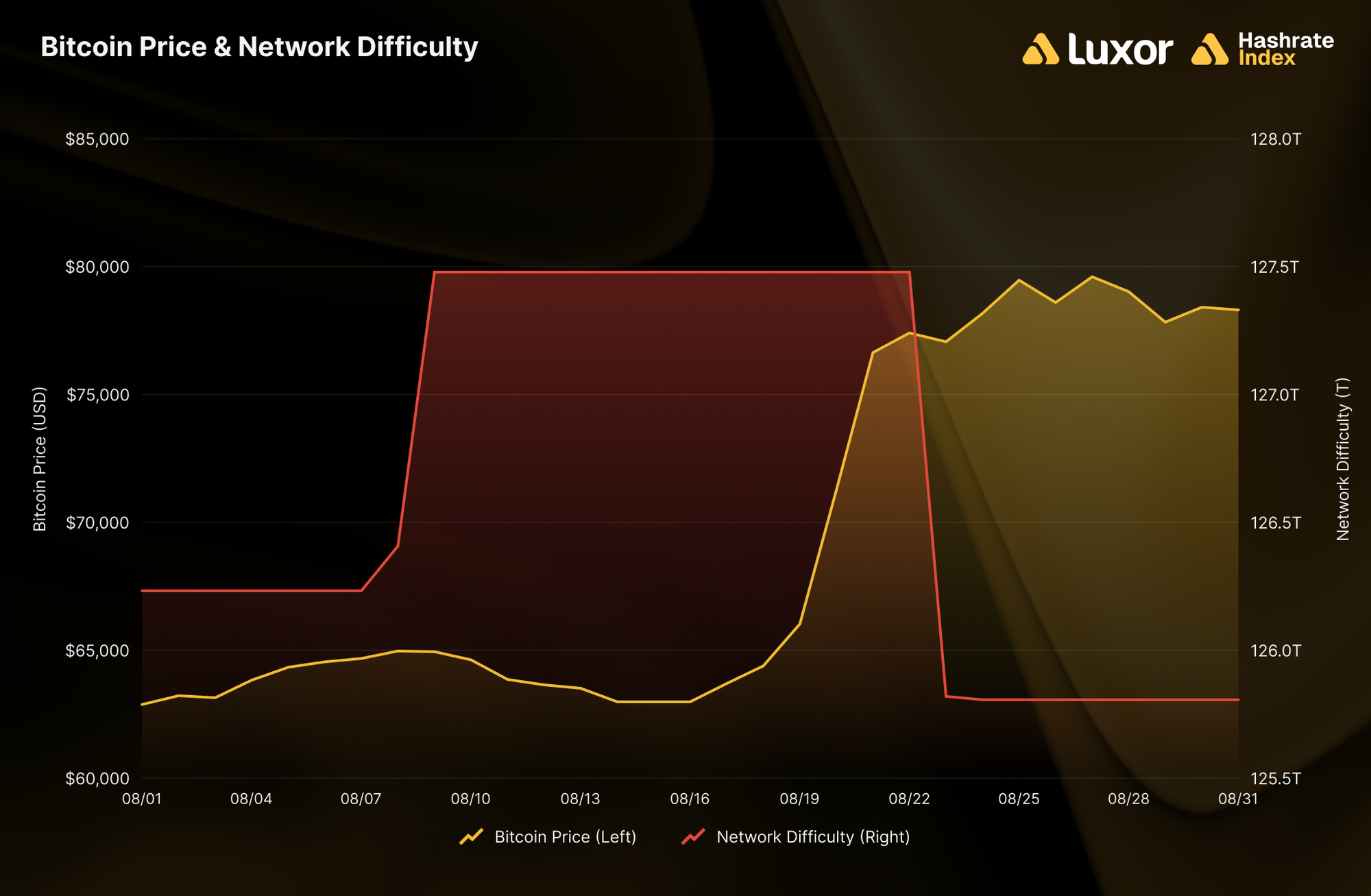
Difficulty averaged 126.68T, −2.0% from July. Two adjustments: +0.99% on August 8 (126.23T to 127.48T) and −1.31% on August 23 (127.48T to 125.81T). Net: −0.34%. After July's −5.71%, August was a flatline.
Block times averaged 9m34s against July's 9m55s, with 24 of 31 days below the 10-minute target and a fastest day of 8m06s on August 30. The network produced blocks 4.6% faster than the prevailing difficulty implied. Marginal hashrate which had left in June and July is coming back. The latest adjustment (September 5) has already come in at +1.31%.
August 23’s difficulty drop was the twelfth consecutive adjustment below 139.70T, the 1 ZH/s equivalent, a streak running since March 20. The 4CP drag maintained: August's two adjustments averaged −0.16% against a historical 2022–2025 August norm of +2.04%.
Transaction Fees — Flat in BTC, Up in USD, One Very Expensive Mistake
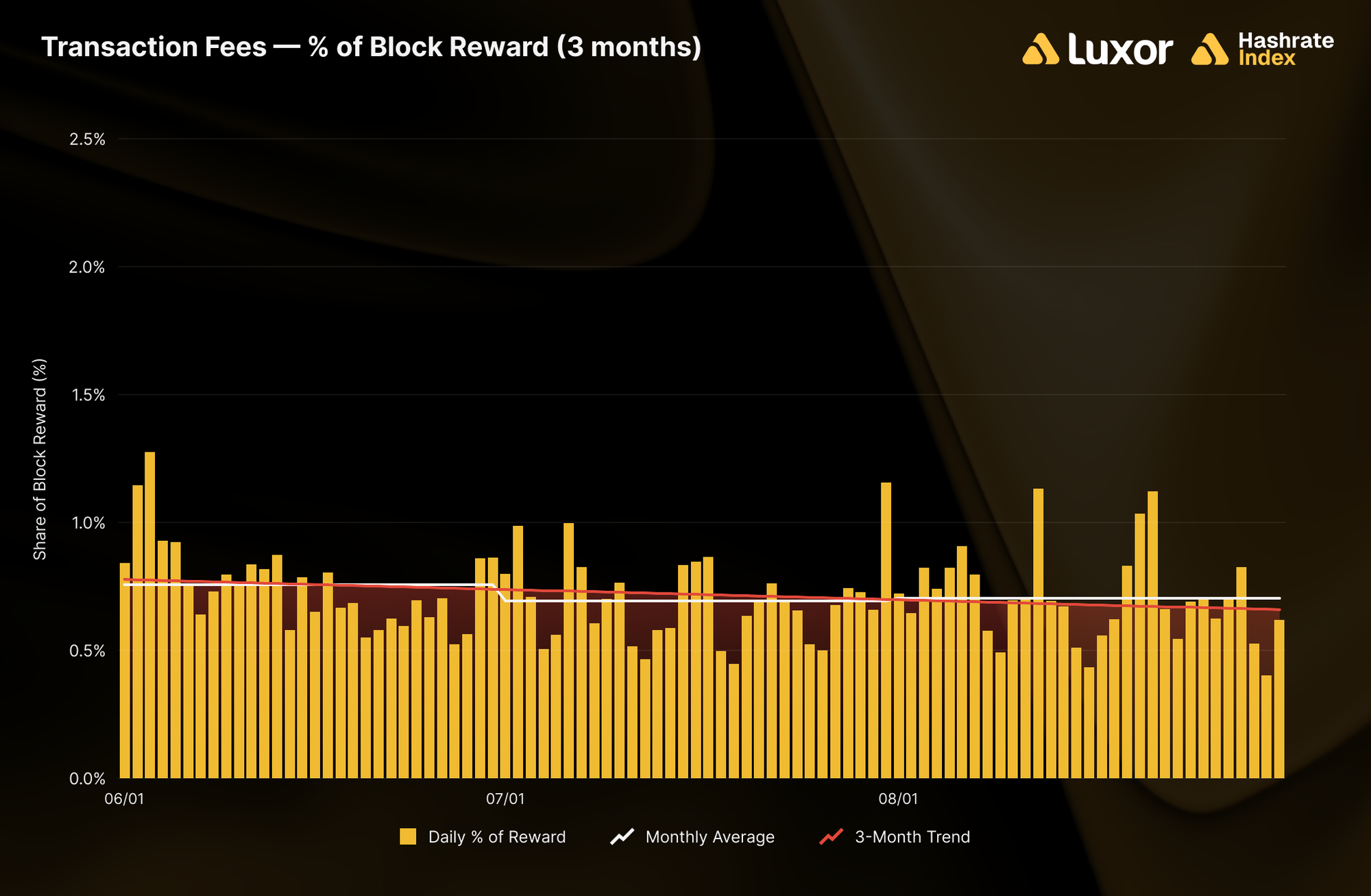
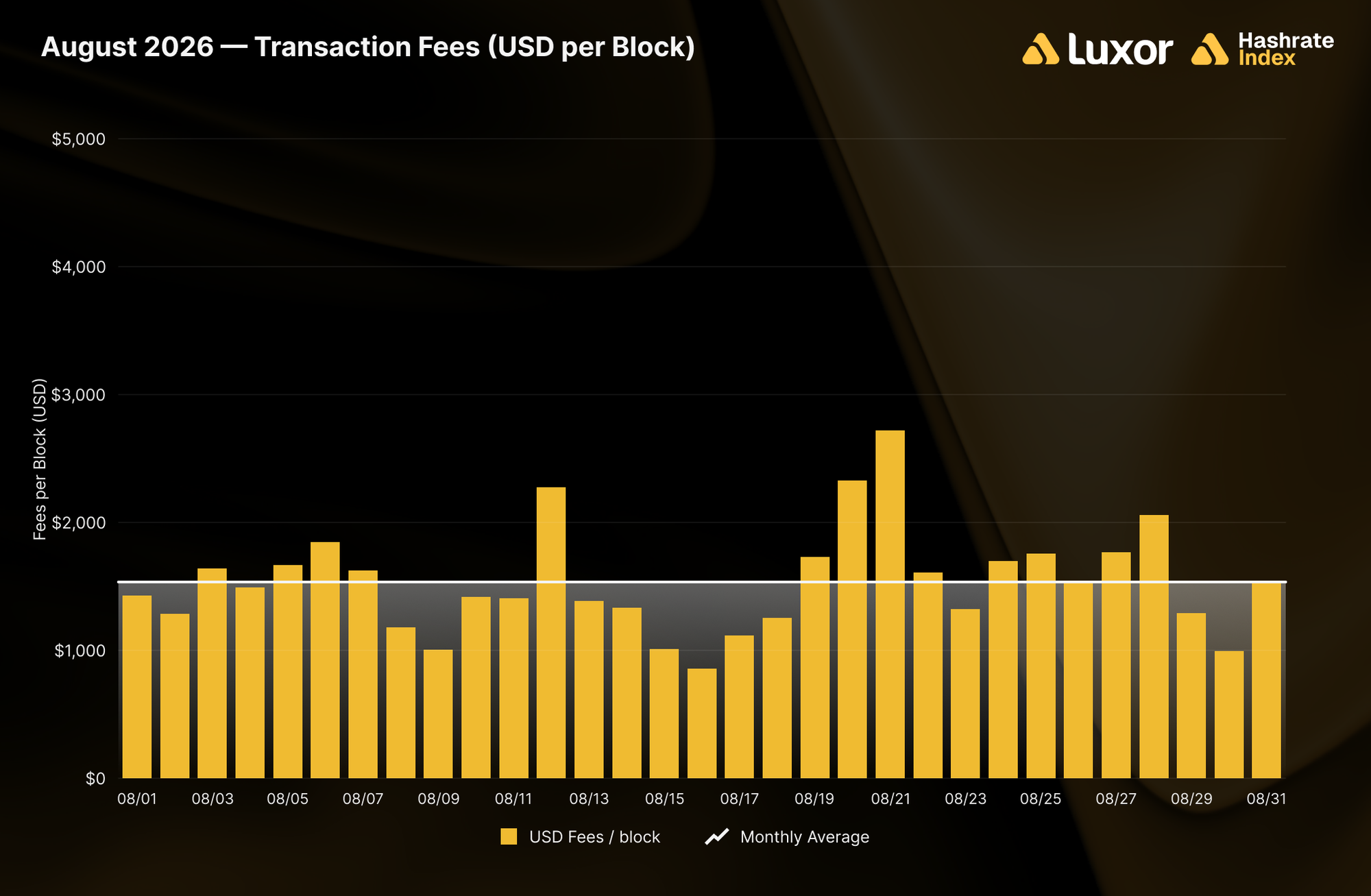
Average fee collection rose +1.5% to 0.02218 BTC per block. Fees were 0.70% of total block rewards, a fourteenth consecutive month below 1%. In USD, the average block earned ~$1,534 in fees (+10.3%) and monthly network fee revenue was ~$6.85M (+10.3%). The BTC figure was flat; the dollar figure rose with BTC price.
Fee collection peaked at 0.03576 BTC per block on August 12, 61% above the monthly average. One block explains it. Block 962,142, mined by SpiderPool at 12:16 UTC, carried 1.82 BTC in fees — 1.60 BTC of it from a single transaction whose automated Replace-by-Fee script kept raising its fee every second until the entire input became the fee and the output carried zero. Someone paid ~$103,000 to send nothing. Strip that block out and August 12 averaged 0.0230 BTC, in line with the month.
BTC Hashprice — A Thirteen-Month High
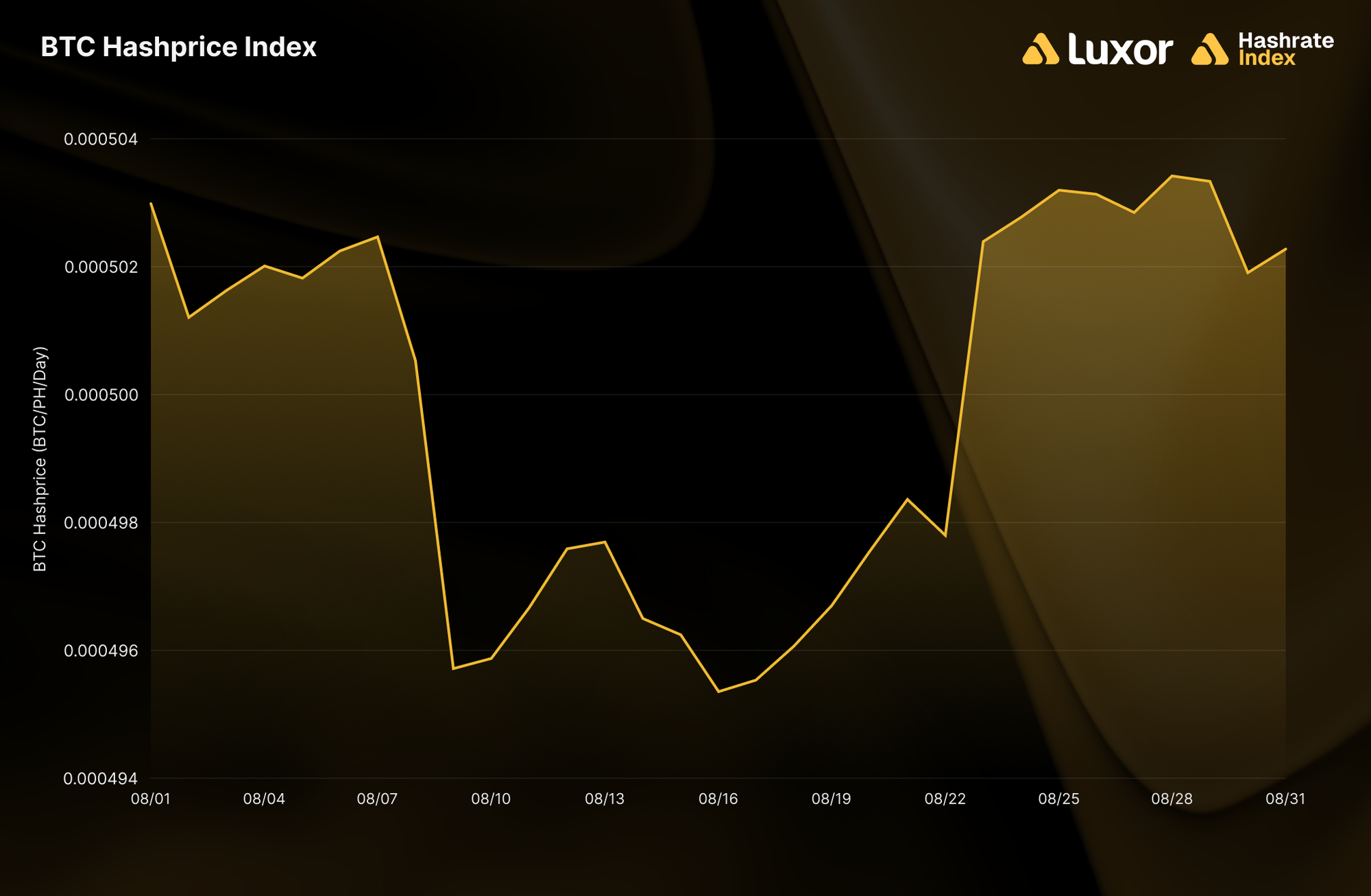
Monthly average BTC hashprice rose +2.1% from 0.00048974 to 0.00049980 BTC per PH/s/day, the highest since July 2025 (0.00051625). Lower average difficulty (−2.0%) provided relief.
BTC hashprice opened at 0.00050298, stepped down at the August 8 adjustment, up at the August 23 adjustment, and closed at 0.00050228 (−0.1%).
Energy Hashprice — The Marginal Tier Crossed Back
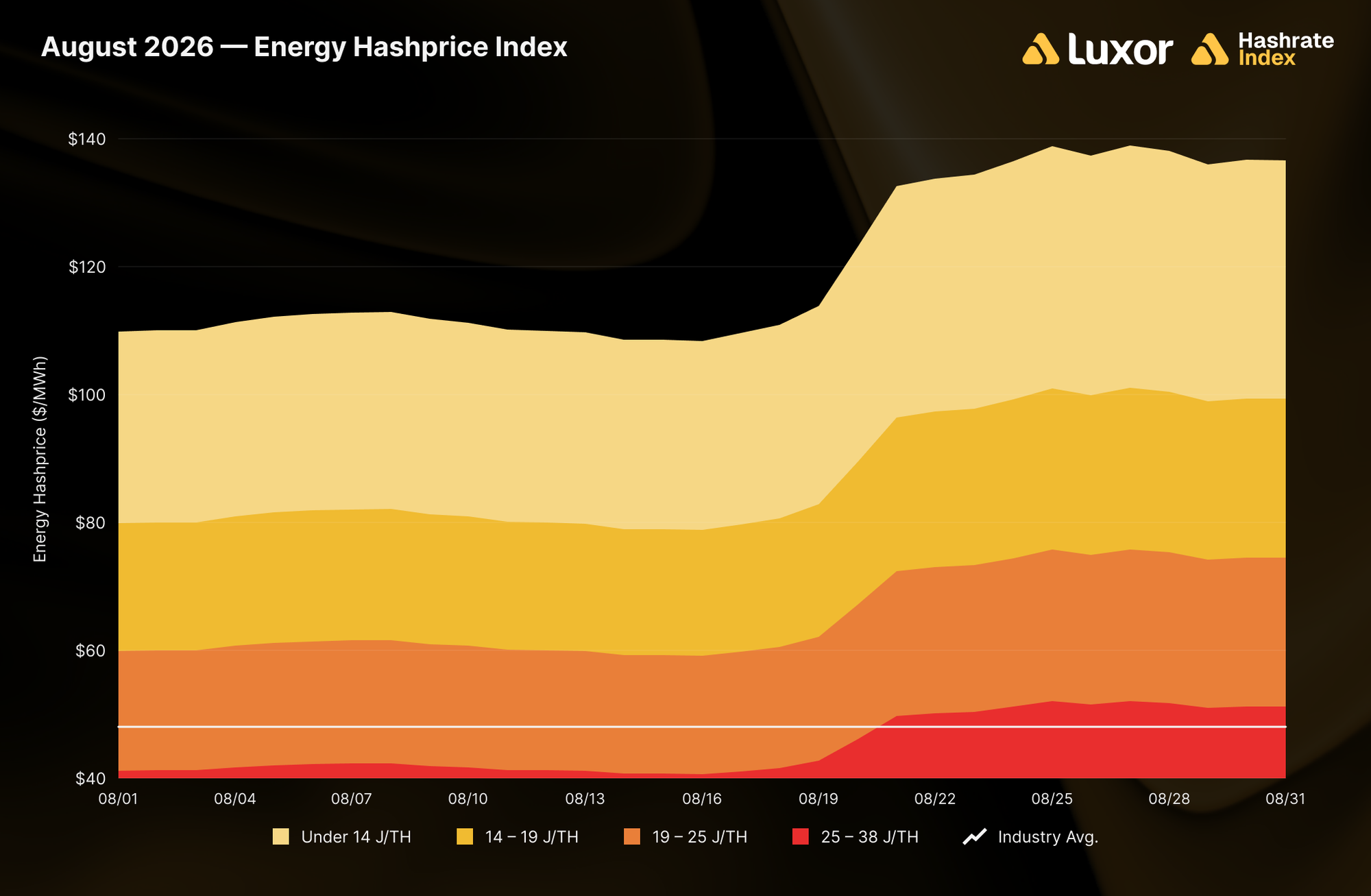
August gave marginal fleets a second life. Based on fleet efficiency, Energy hashprice averaged:
- ~$120/MWh for under 14 J/TH
- ~$87/MWh for 14–19 J/TH
- ~$66/MWh for 19–25 J/TH
- ~$45/MWh for 25–38 J/TH
Against a ~$48/MWh network-average power cost, the 25–38 J/TH tier spent a third month below breakeven on average; but it cleared $48 on 11 of 31 days, peaked at $52/MWh on August 27 and held above $51 into month-end. The most efficient fleets finished above $135/MWh.
August 2026 Hashrate Market Activity
Our analysis of the August 2026 hashrate market focuses on two key points: how the August 2026 hashrate contract traded in previous months and how the forward curve shifted in August, based on pricing for forward hashrate during the month.
The two tables below show the evolution of Luxor's USD and BTC-denominated hashrate forward markets from March 2026 to August 2026. Rows represent specific monthly contracts, columns represent each trading month. Cell values indicate the average monthly mid-market hashprice, except for the bold highlighted main diagonal, which shows actual spot hashprice settlement in each month.
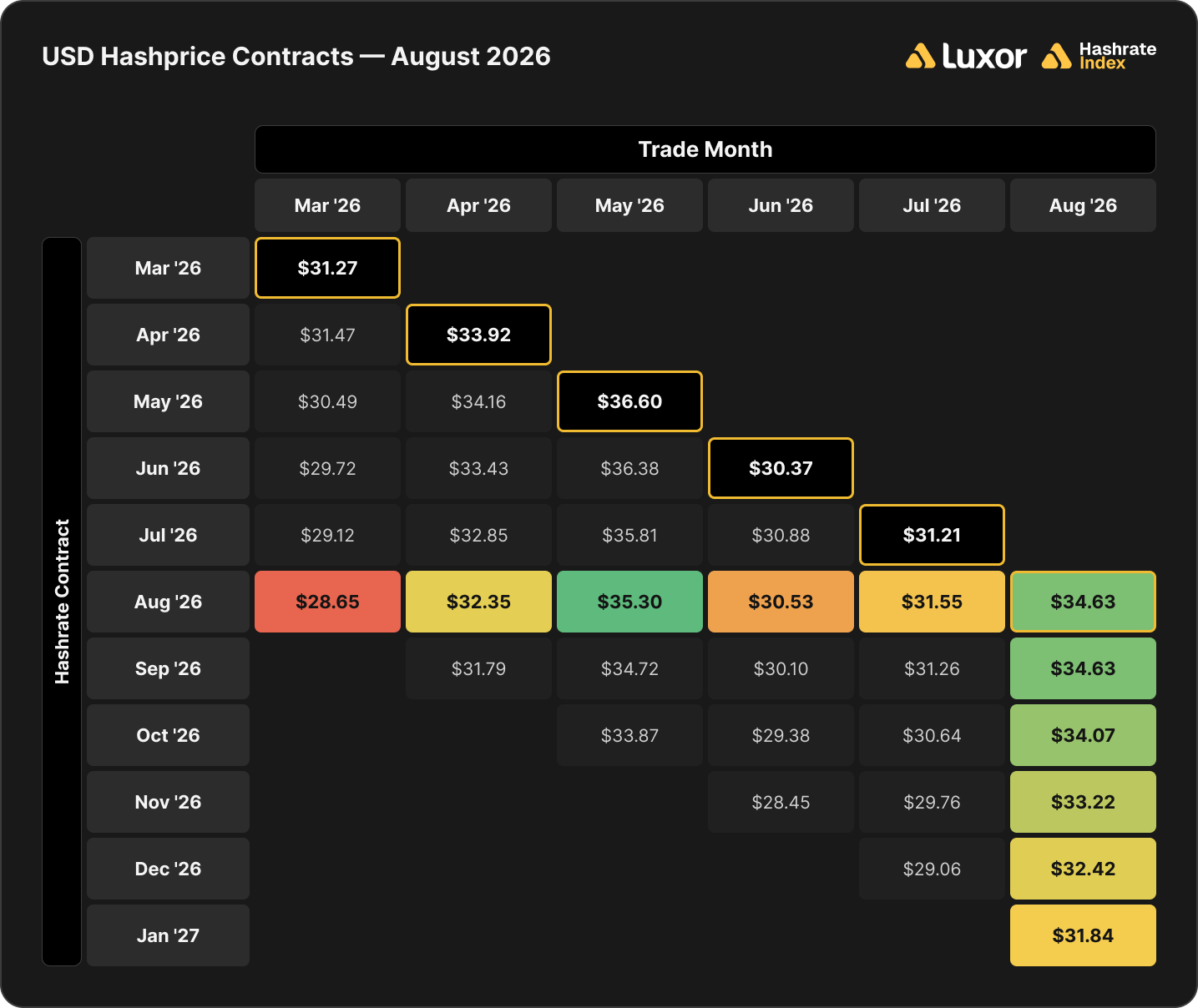
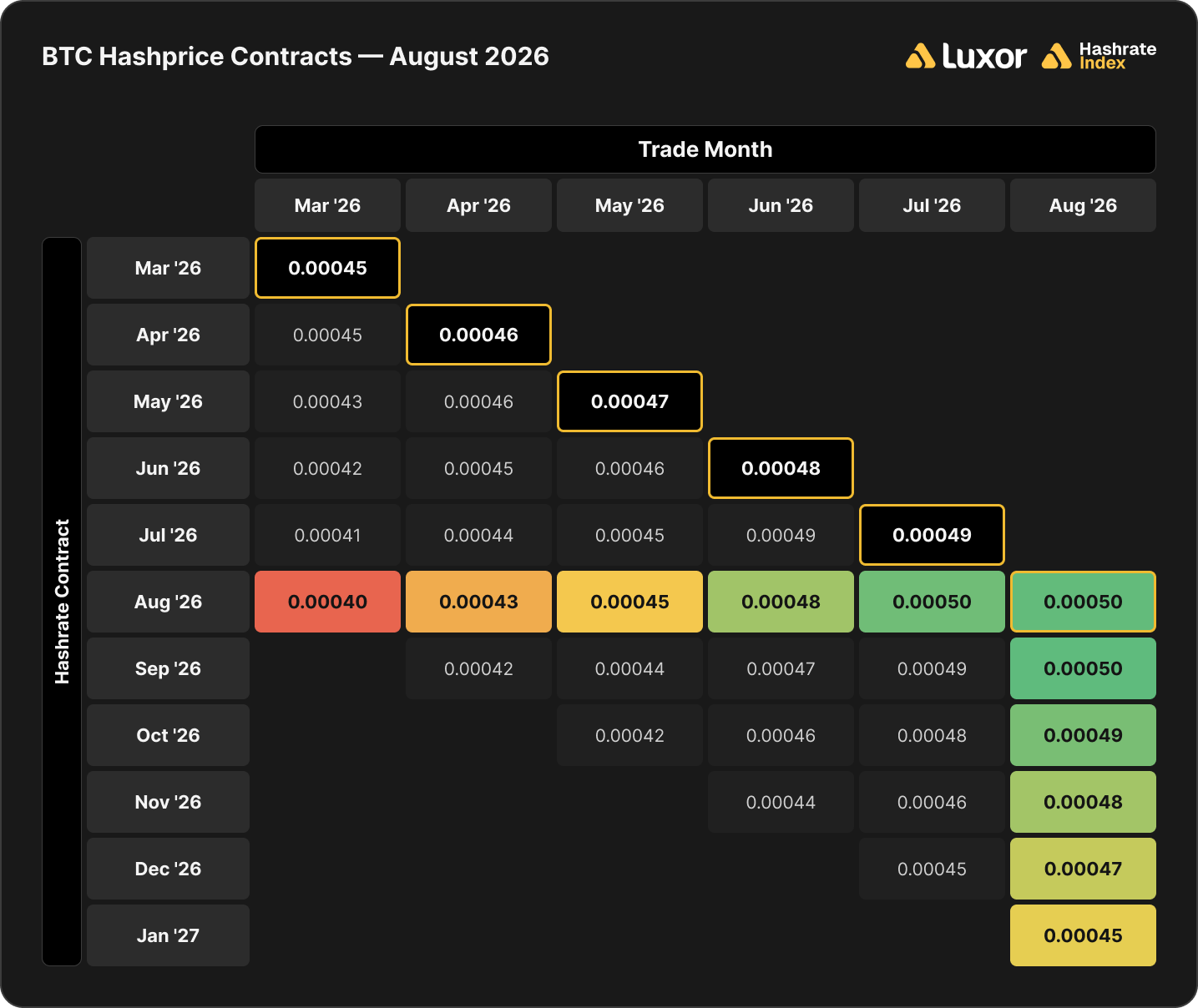
Note: all values (except for the bold highlighted main diagonal) shown in figures represent mid-market rates, the midpoint of the best bid and ask on Luxor's Non-Deliverable Hashrate Forward market. The bold highlighted main diagonal shows actual spot hashprice settlement in each month, measured by Luxor’s Bitcoin Hashprice Index.
The table below shows the type of market participants on the buy and sell side of Luxor’s deliverable (DF) and non-deliverable hashrate forward (NDF) market. In August, lenders were active on the buy side of the DF market, while public and private miners used the contract to sell forward, receive financing, and expand their fleet.
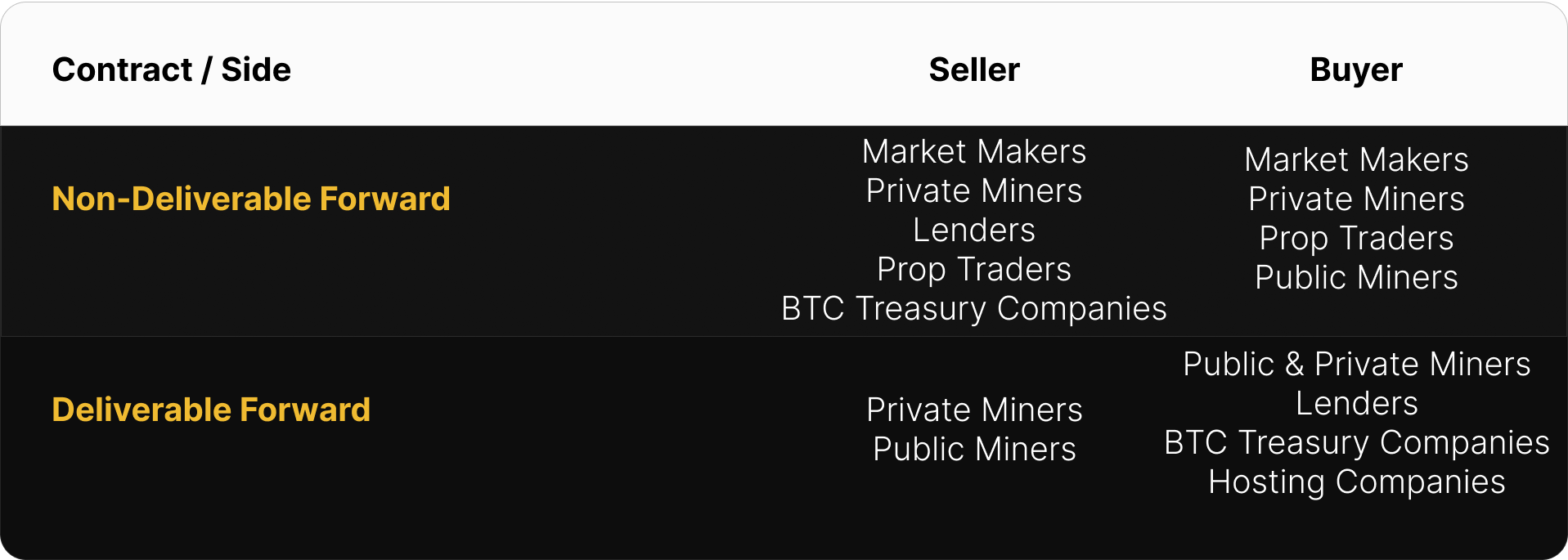
Because DFs are prepaid, they typically trade below NDFs to compensate buyers for credit risk and the cost of capital. Pairing a DF with an offsetting NDF can lock in that spread as a fixed BTC-denominated yield for lenders or a fixed financing cost for miners.
This strategy was used by lenders and Bitcoin treasury companies (buy DF & sell NDF) to earn a BTC-denominated return and by miners (sell DF & buy NDF) to obtain non-dilutive financing. In August 2026, that yield (cost of capital) was 6–13% annualized.
How August 2026 Hashrate Traded
August was a month where dollar-denominated hashprice hedging changed direction.
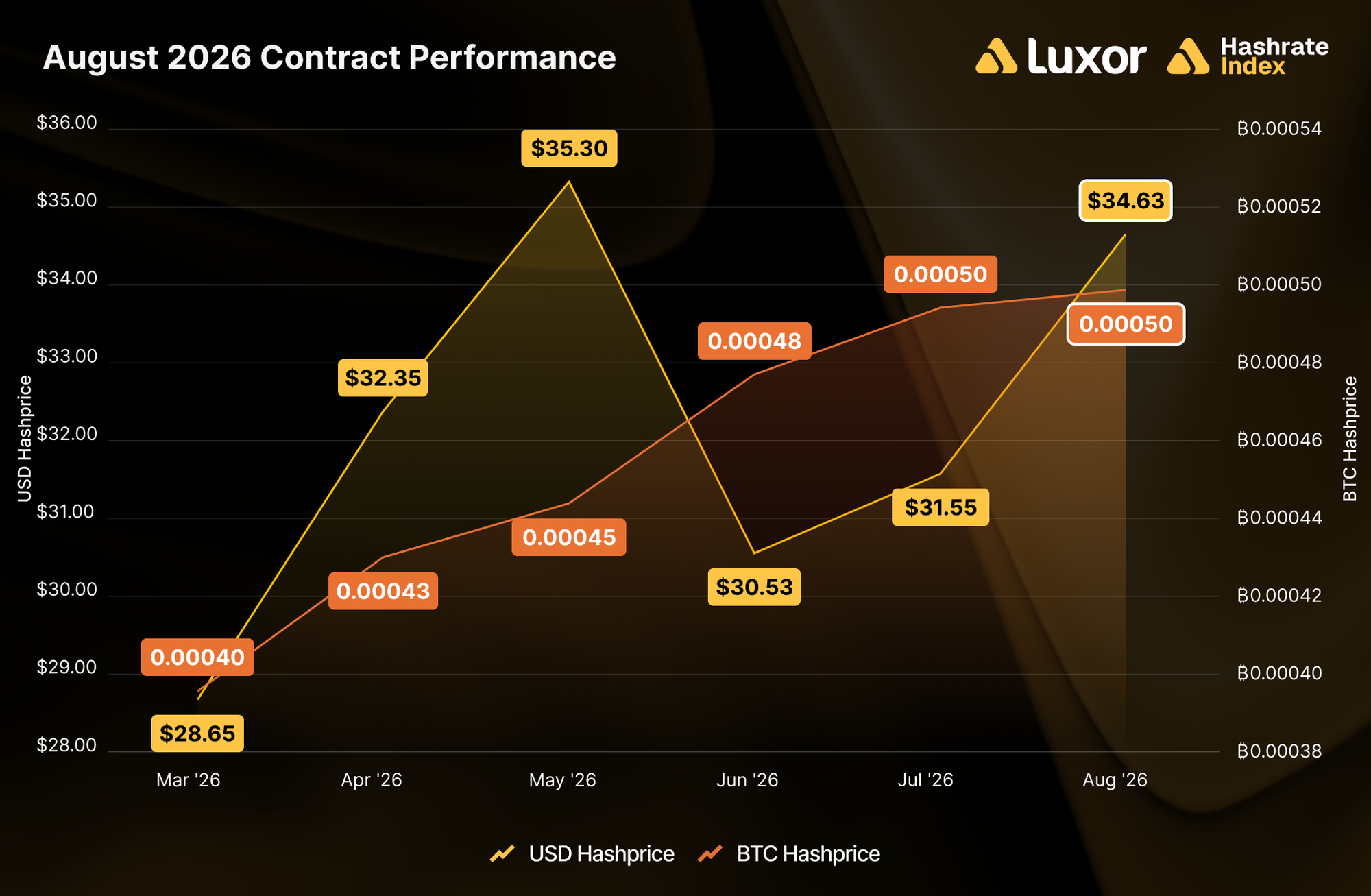
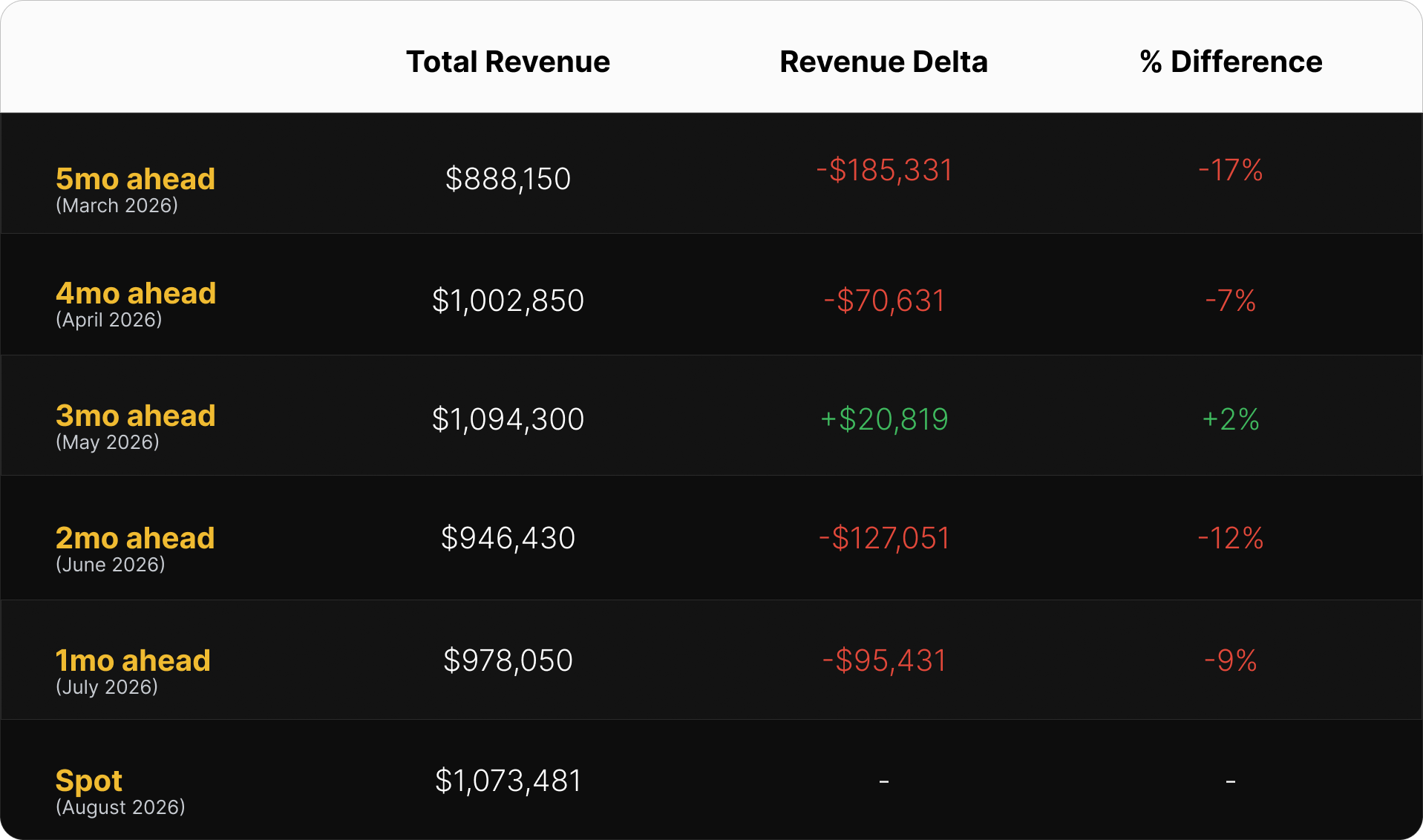
Sellers of the August USD contract locked in between $28.65 and $35.30 per PH/s/day against a $34.63 spot settlement. Only May's three-month sale at $35.30 won: +1.9%, or +$20,819 on 1 EH/s. Every other hedge struck at the 2026 lows missed the rally.
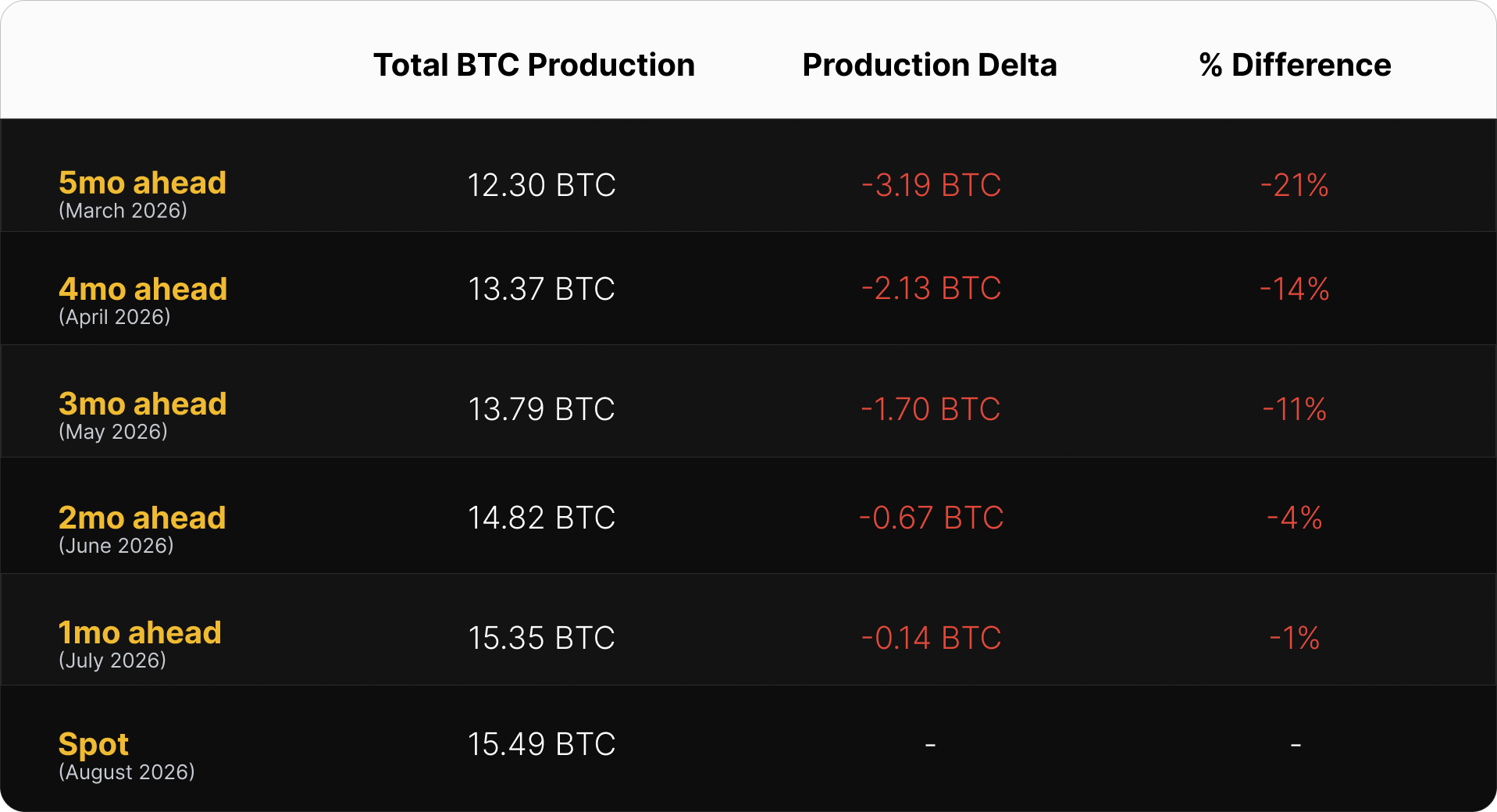
In BTC terms, buyers won at every horizon for a fifth consecutive month. Sellers received 0.00039676 to 0.00049523 BTC per PH/s/day, all below the 0.00049980 spot settlement. Difficulty has now spent five months below where the hashrate forward curve expected it when those contracts were sold.
Rolling Hedge Performance
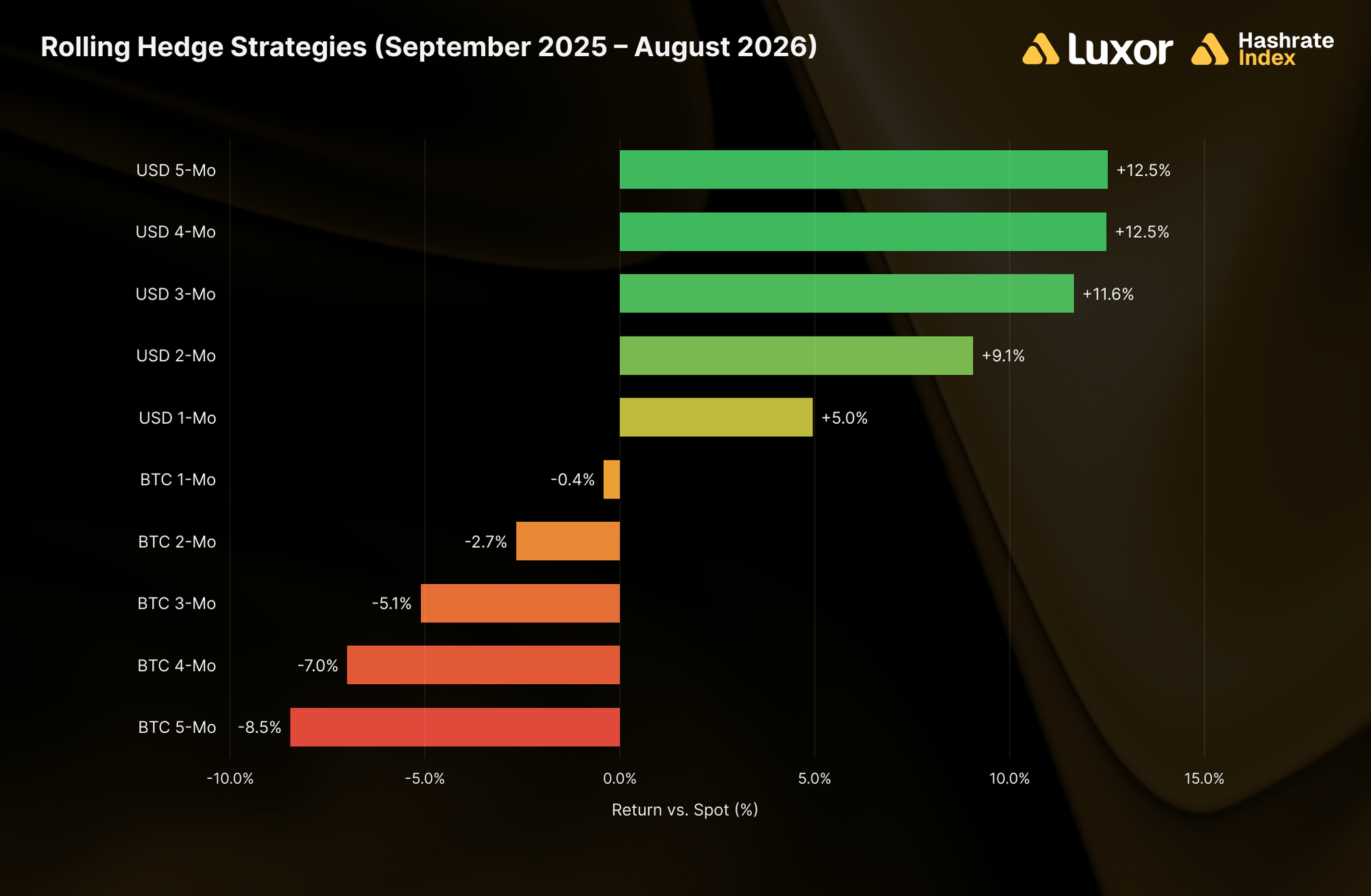
Across the trailing twelve months, rolling USD hashprice hedges beat spot at every horizon, +5.0% (1-month) to +12.5% (5-month), and rolling BTC hashprice hedges lost at every horizon, −0.4% to −8.5%. The picture is clear: the further out you sold hashrate in dollars, the more you made; the further out you sold in BTC, the more you gave up.
Since the 2024 halving, the leaderboard inverts. All ten strategies are ahead of spot, as they have been for most of the cycle, but BTC hashprice hedges lead: the 5-month roll at +7.6% against USD hedges clustered between +1.5% and +2.4%. Long-duration BTC hashprice hedges have given back ground since March, when that same 5-month roll stood at +12.5%.
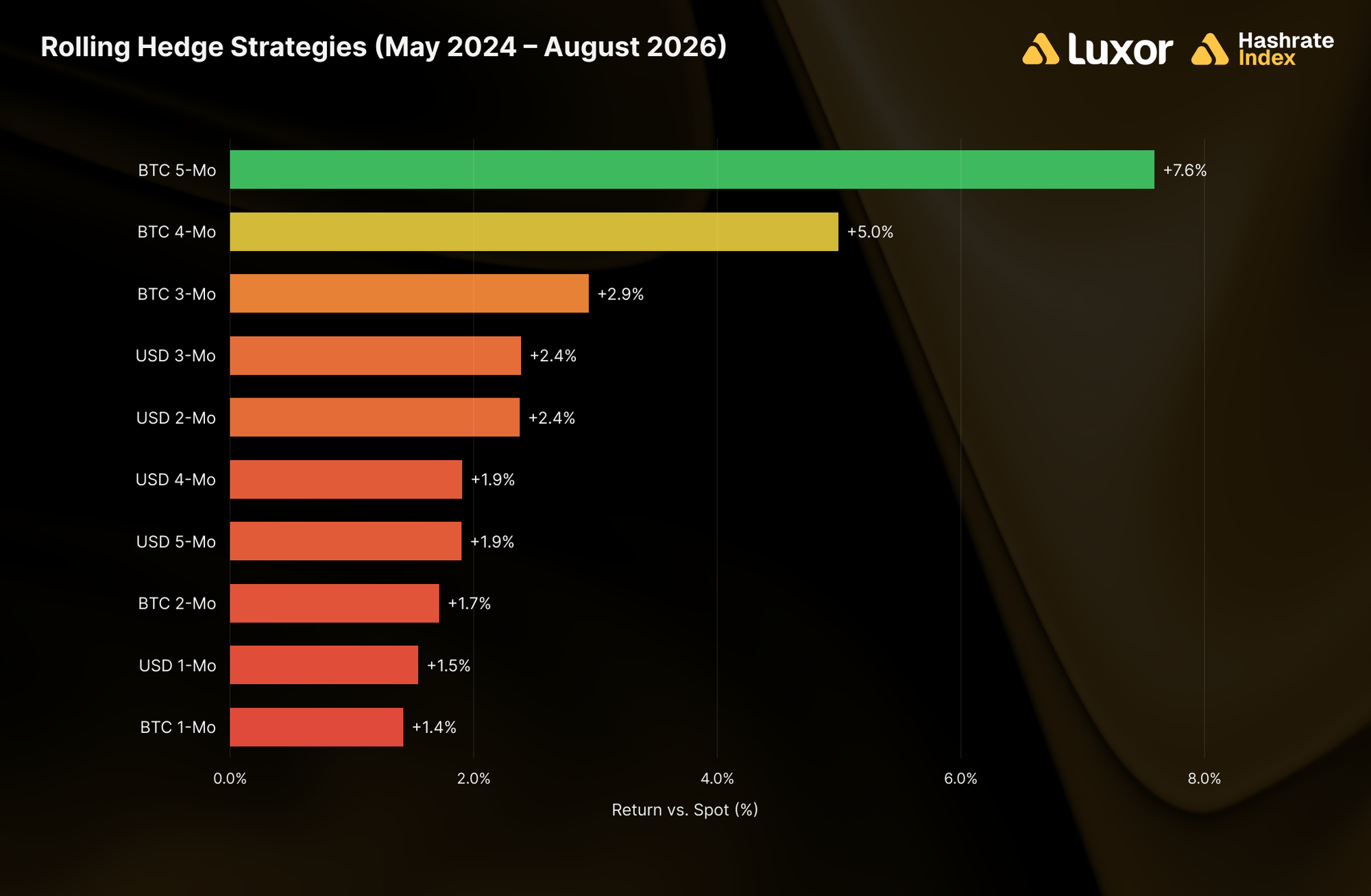
Which denomination wins depends on which variable surprised the forward market more: Bitcoin price, or difficulty-and-fees. Through late 2025, difficulty outran expectations and BTC-denominated forward hashrate sellers captured the spread. Since then, USD hashprice has run below forward expectations and USD-denominated forward hashrate sellers captured it. August was the first month of the second regime where the USD trade lost.
Note: figures exclude fees and bid/ask spreads, and hedging is a cost of business rather than a revenue generation strategy. Hedgers willingly buy the certainty of predictable cash flows, which increases valuations, reduces capital costs, and ultimately attracts investments.
How Future Hashrate Traded in August 2026
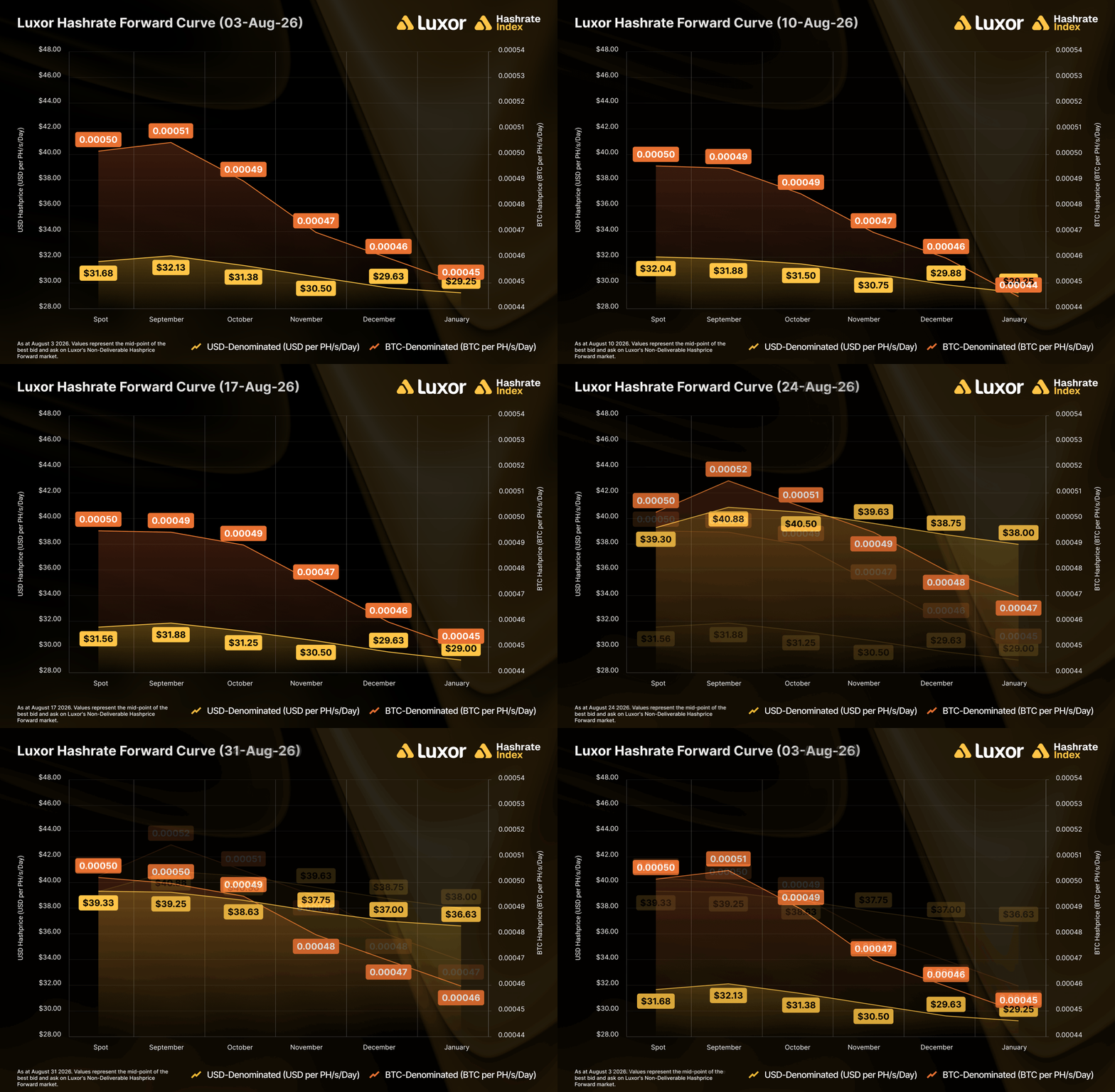
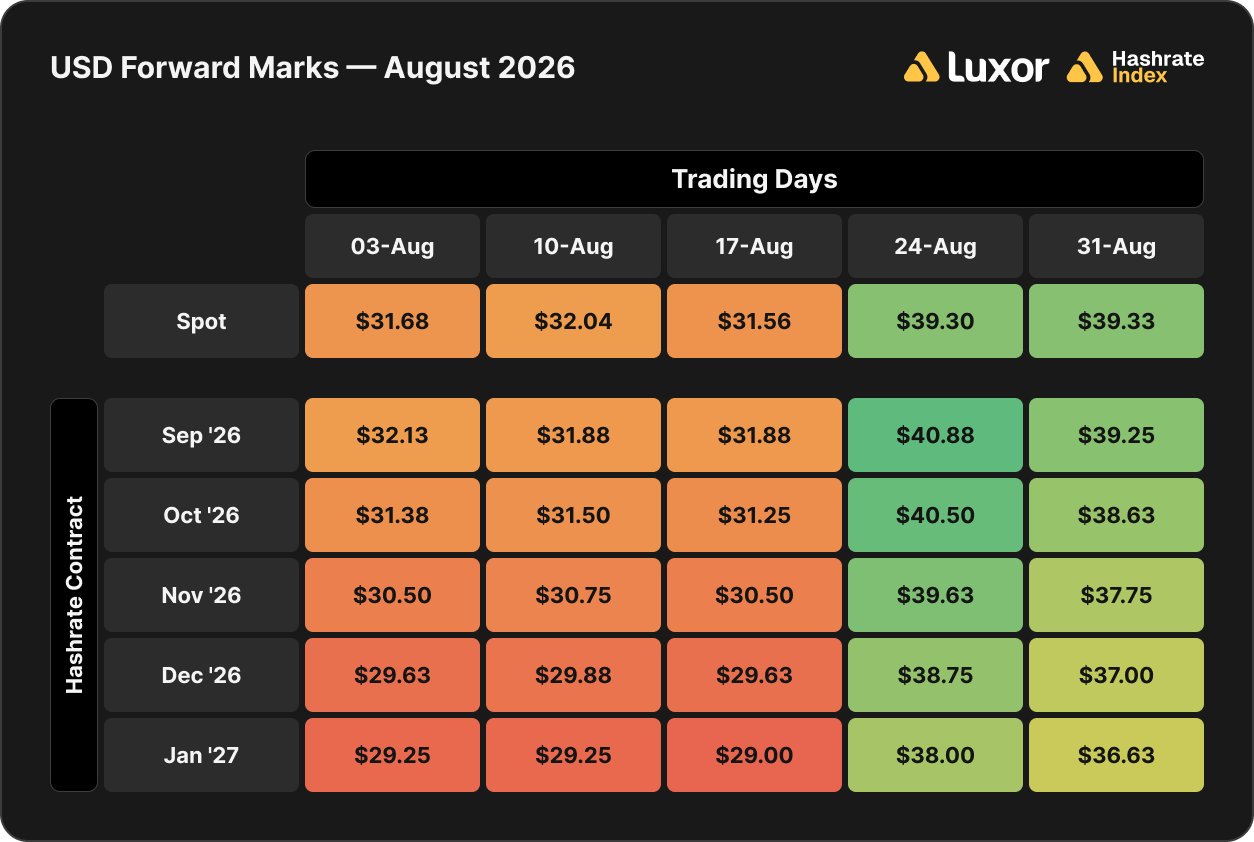
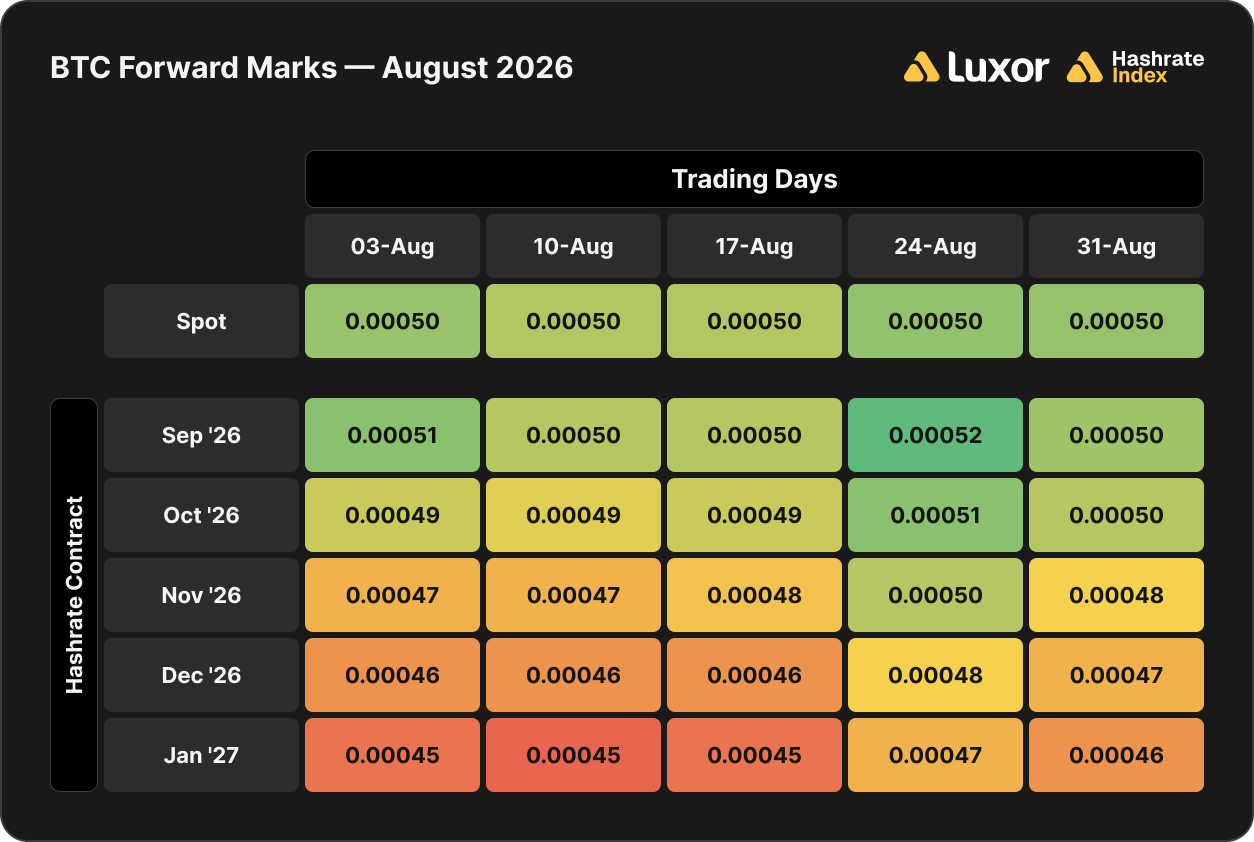
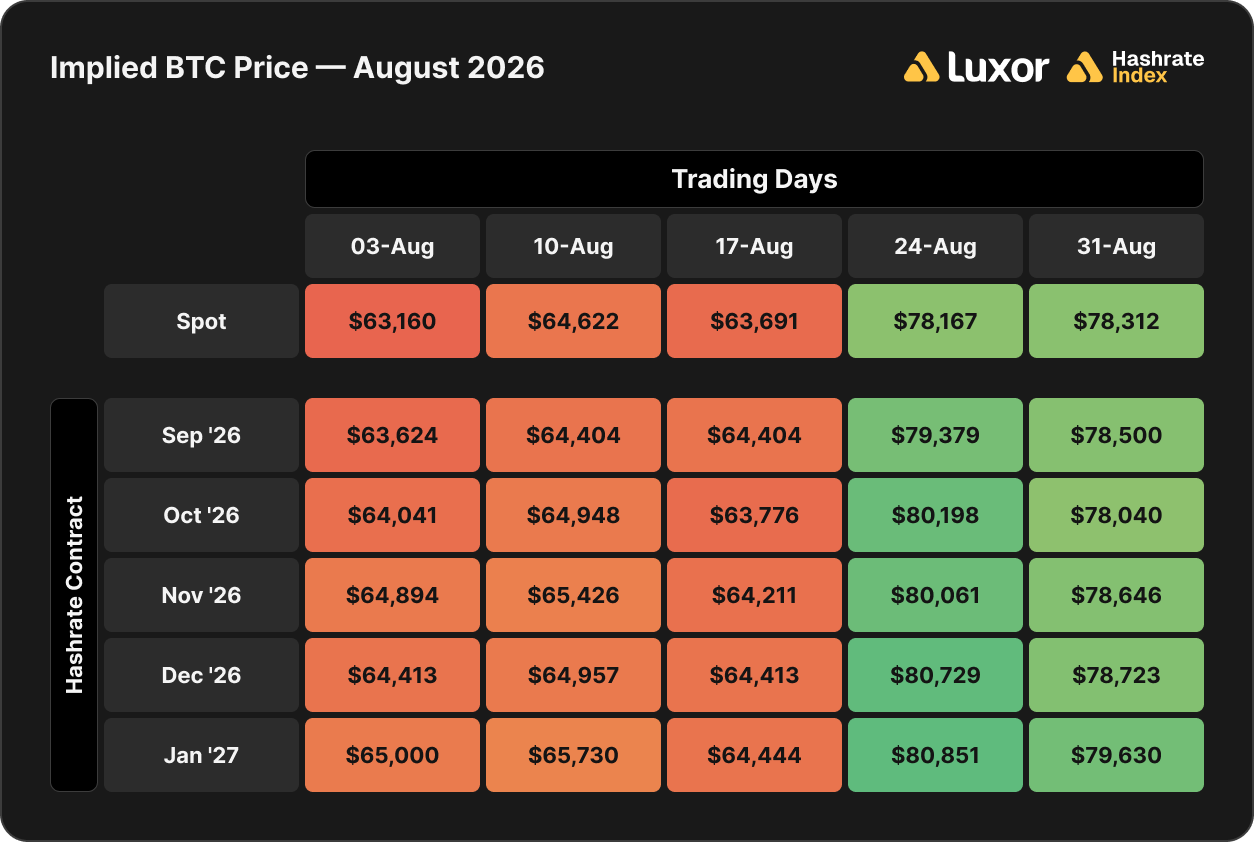
The tables below summarize the forward market during August 2026 for the five subsequent months, September 2026 to January 2027. Rows are monthly contracts; columns are weekly trading days. Cell values are the daily mid-market price, except for spot.
In August the USD-denominated hashrate forward curve moved with spot hashprice. Lock-in rates for September–January rose +23.8% between August 3 and August 31 against +24.2% in spot.
The BTC curve barely moved +1.3% on average. Read together, the two forward curves indicate that the market repriced Bitcoin and maintained its view of difficulty-and-fees almost where it was.
Dividing USD contract values by BTC contract values gives the implied BTC price embedded in the forward hashrate market. The September contract's implied BTC price moved from ~$63,600 to ~$78,500, and the curve sits at $78,000–$79,600 across all five months.
Assuming 0.0222 BTC per block in transaction fees (August's realized average), the same contracts imply the following forward-looking expectations on difficulty and network hashrate:
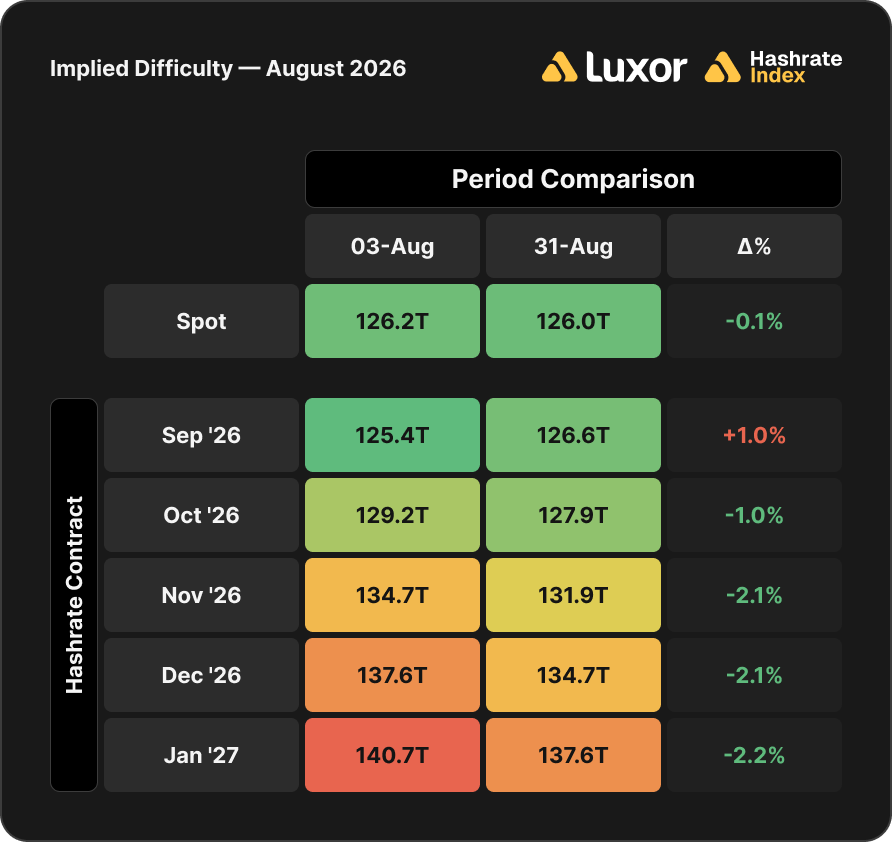
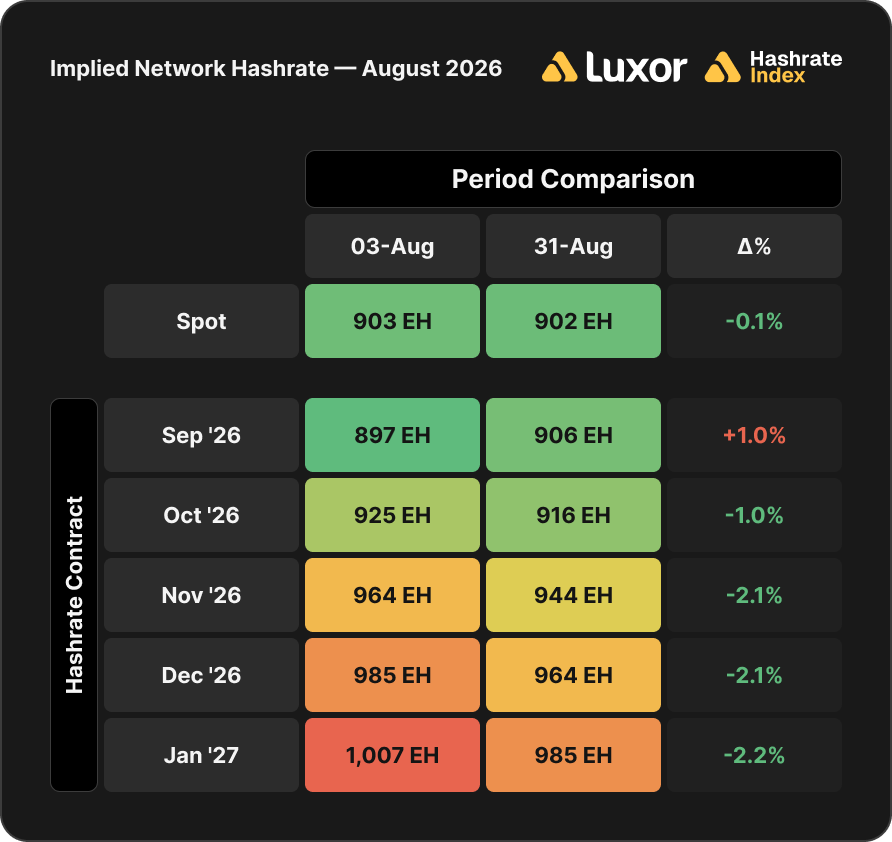
Note: figures assume 0.0222 BTC per block transaction fee collection.
Based on this analysis, The forward market raised its expectation in implied September difficulty by +1.0% to 126.62T, consistent with a network already running faster than target. It also reduced October through January expectations by 1.0–2.2%, taking implied December hashrate from 985 EH to 964 EH and January 2027 from 1,007 EH to 985 EH — the third straight month the curve has shaved its autumn rebound expectation (from 1,054 EH in June). The near-term path now stays below 1 ZH/s through January. October has historically delivered difficulty growth (+4.38% average across 2022–2025).
Concluding Thoughts and Looking Ahead
September opened above August's close and has held steady. Through the first week, hashprice has averaged $39.60 and Bitcoin has hovered around $79,000.
What a BTC Price Rally Fixes, and What It Doesn't
What changed in August? Our Q3-2026 mining economics projections estimate an industry average power cost of $0.048/kWh, which put breakeven efficiency at July's $31.21 hashprice near 27 J/TH. At August's $34.63 average, breakeven moves to ~30 J/TH. At $40 it is ~35 J/TH. The 25–38 J/TH tier that spent two months under water is breathing again.
Two Days to Watch in September
August's catalysts were policy and liquidity. September's are the same, with dates attached.
Tuesday, September 15, 2:15pm ET. The Senate votes on cloture on the motion to proceed to the Clarity Act, the day after it returns from recess. Cloture needs 60 votes; Republicans hold 53. Galaxy Research cut its odds of the bill becoming law in 2026 to 10% in mid-August, down from 75% in May. If cloture fails, the bill is effectively dead for the year with midterms in November.
Wednesday, September 16. The FOMC decides. Rates are 3.50–3.75%, and a hike would be the Fed's first since July 2023; three officials already voted for one in July. Then Chair Warsh used his Jackson Hole keynote to say the summer's inflation readings "do not tell me that underlying trends have meaningfully improved," with PCE at 3.7% over twelve months and 4.1% over six. Odds of a September hike went from 35% the day before that speech to 50% after it, and now stand at 58.5%.
For miners the band is simple. At $79,000 and current difficulty, hashprice is ~$39 and breakeven sits near 34 J/TH. At the August 1–19 average of ~$64,000, hashprice is ~$32 and the 25–38 J/TH tier is back below breakeven. One week of price action separates those two states.
Will Difficulty Deliver?
Our estimate of total net ASIC capacity stands at ~1,150 EH against active hashrate near 915 EH/s, implied by August's 126.68T average difficulty. Roughly 235 EH is idle: unviable, curtailed, in transit, or under maintenance. Every EH that switches back on at $40 hashprice raises difficulty and lowers hashprice for everyone else.
September will signal when that hashrate returns. Texas miners curtail through the summer to dodge 4CP transmission charges, and the last of ERCOT's four coincident peaks is set in September, on the hottest afternoon left. After that the peak-avoidance incentive disappears until June. What follows is the most consistent seasonal pattern in mining: October has delivered positive difficulty growth in every year since 2022, averaging +4.38% per epoch and roughly +10% across the month (+16.4% in 2022, +8.1% in 2023, +7.1% in 2024, +9.1% in 2025). September itself has averaged +1.58%.
Which sets up the next question. August’s rally added $7.70 to hashprice in twelve days. Two October epochs at the seasonal average would bring difficulty back up. Either Bitcoin keeps climbing, or the network takes the hashprice raise back.
Looking Ahead
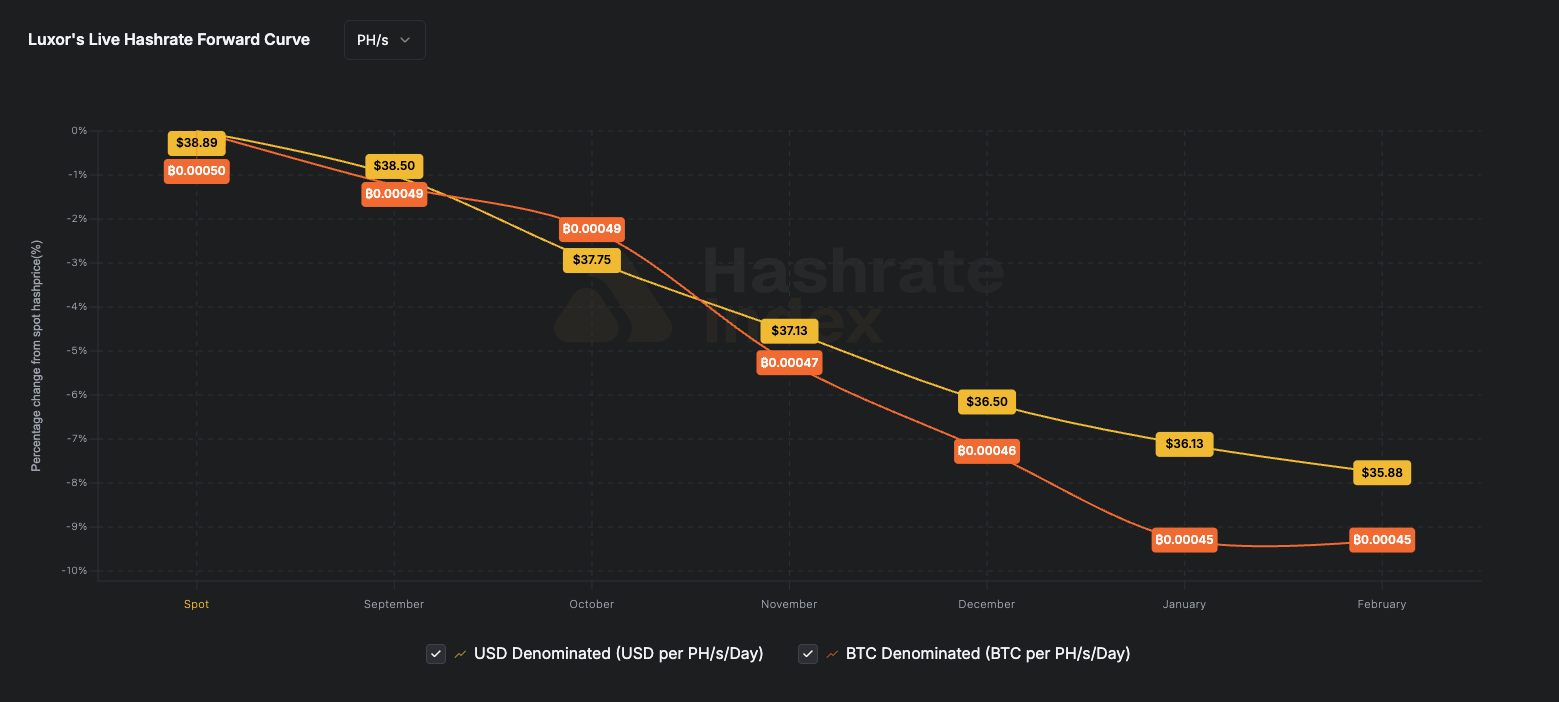
Luxor's Hashrate Forward Market pricing an average hashprice of $36.98 or 0.00047 BTC per PH/s/day over the next September–February window. Sellers can secure this hashprice while buyers have the opportunity to lock in the same hashcost over the next six months.
If you’d like to learn more about Luxor’s Bitcoin mining derivatives, please reach out to [email protected] or visit https://www.luxor.tech/derivatives.
About Luxor Technology Corporation
Luxor delivers hardware, software, and financial services that power the global compute and energy industry. Its product suite spans Bitcoin Mining Pools, ASIC Firmware, Hardware trading, Hashrate Derivatives, Energy services, a Miner Management software, Commander, and a bitcoin mining data platform, Hashrate Index.
Disclaimer
This content is for informational purposes only, you should not construe any such information or other material as legal, investment, financial, or other advice. Nothing contained in our content constitutes a solicitation, recommendation, endorsement, or offer by Luxor or any of Luxor’s employees to buy or sell any derivatives or other financial instruments in this or in any other jurisdiction in which such solicitation or offer would be unlawful under the derivatives laws of such jurisdiction.
There are risks associated with trading derivatives. Trading in derivatives involves risk of loss, loss of principal is possible.




Hashrate Index Newsletter
Join the newsletter to receive the latest updates in your inbox.