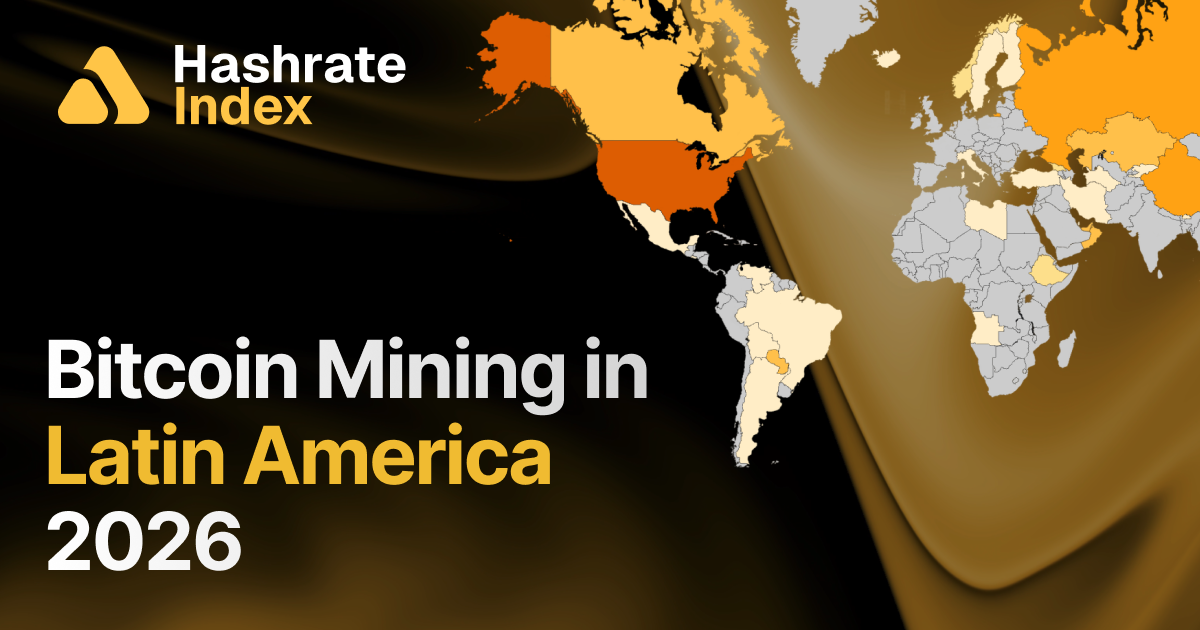
The State of Bitcoin Mining in Latin America (2026)
How a continent with world-class energy resources ends up with a fragmented mining landscape, and what it would take to change.


Latin America has the energy to be a global Bitcoin mining powerhouse. It’s not there yet.
The region sits on some of the most abundant renewable electricity resources on earth: the Paraná River hydroelectric cascade in Brazil, the Vaca Muerta shale gas belt in Argentina, the Caroní basin in Venezuela, the Itaipú dam in Paraguay, and the volcanic geothermal reservoirs of Central America. Several of its countries offer industrial electricity prices that rival the cheapest mining jurisdictions anywhere.
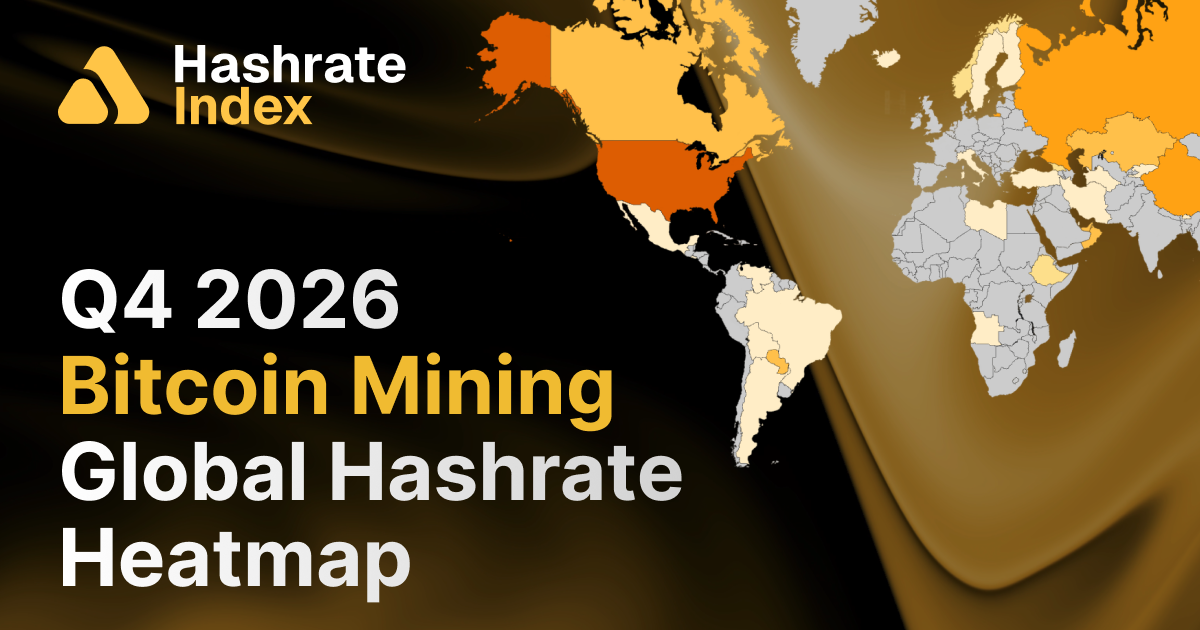
And yet Latin America collectively produces roughly 5-6% of global Bitcoin mining hashrate. The United States alone produces 37.4%, based on our Global Hashrate Heatmap.
The gap between energy potential and mining reality is the central story of Bitcoin mining in Latin America. This piece is an attempt to tell it honestly, country by country: what each market has going for it, what is holding it back, and what it would take to change.
TLDR
- Paraguay is the only world-class Bitcoin mining market in the region. At ~43 EH/s and 4.3% of global hashrate, it ranks #4 globally as of Q2 2026, despite having a population of 7 million. Itaipu's structural hydro surplus prices industrial electricity at ~$0.037–0.050/kWh. That is the entire story.
- Brazil is emerging as a real player. Its hashrate grew +133% YoY to 3.5 EH/s. The 2024 opening of Brazil's deregulated energy market to large consumers suggests this is infrastructure investment, not arbitrage. Q3/Q4 2026 will confirm it.
- Bolivia's +2,400% YoY hashrate spike is an arbitrage trade on subsidized gas. The country's grid runs 70% on gas supplied at $1.30/MMBTU when the international market price is $8–12/MMBTU. That subsidy has a 2–5 year shelf life.
- Argentina has better energy assets than almost any country on this list and a -42% YoY hashrate decline. Vaca Muerta is world-class. YPF already mines Bitcoin with flared gas. Milei's energy deregulation decrees could change the picture. The decline has nothing to do with any of this. The most direct cause of it was Bitfarms (now Keel Infrastructure) shutting down its 40 MW site in Argentina.
- Venezuela runs 5 EH/s but has around 10 GW of stranded hydro energy, an installed generation capacity of 36 GW, and flares an estimated 300,000 barrels per day equivalent of associated gas from the Faja del Orinoco, the Maracaibo Basin, and the eastern fields in Monagas and Anzóategui. Under recently-issued OFAC licenses GL 48A, authorized American companies con generate, distribute, store, and sell electricity in Venezuela. Behind the meter mining could be the way for foreign miners to start testing the waters in Venezuela.
- El Salvador powers 1.1 EH/s and the national grid has 2.2 GW of installed capacity but their geothermal capacity could grow by up to 400 MW long term, and the country became a narrative pioneer in the mining space thanks to their Volcano Energy public-private partnership with Tether.
- The lesson from Q2 2026's global down-cycle: hashprice compression separates durable mining markets from arbitrage plays. Paraguay stayed. Bolivia retreated. Brazil accelerated. The pattern is the diagnosis.
The Global Picture First
Global Bitcoin mining hashrate fell to 1,004 EH/s in Q2 2026, down 5.8% from 1,066 EH/s in Q1. The proximate cause was Bitcoin's price decline from ~$124,000 in October 2025 to ~$65,000 lows in February 2026, which pushed hashprice to all-time lows near $27.89/PH/s/day. Roughly 252 EH/s of older-generation equipment (machines running at 25+ J/TH) went offline because they could not cover operating costs.
The top of the hashrate table is familiar. The United States at 37.4%, Russia at 16.9%, China at 12.0%. Those three countries control about 65% of global hashrate between them.
Then there is Paraguay at #4 with 4.3% of global hashrate (~43 EH/s). A landlocked country of 7 million people sitting alongside the United States, Russia, and China as one of the four dominant Bitcoin mining jurisdictions on earth.
The rest of Latin America, meaning Brazil, Bolivia, Argentina, Venezuela, El Salvador, and every other country in the region, accounts for roughly 1–2% of global hashrate. Understanding why that is, and whether it changes, is what the rest of this article is about.
Source: Hashrate Index Global Hashrate Heatmap, Q2 2026. EH/s figures carry uncertainty inherent to hashrate attribution methodology.
Paraguay: How You Build a #4 Country
To understand why Paraguay ranks #4 in the world for Bitcoin mining, you only need to understand one number: 3,480 MW.
That is the approximate surplus between what Paraguay's hydroelectric plants generate and what the country's 7 million people actually consume. December 2025 peak domestic demand was 5,280 MW. Available capacity is roughly 8,760 MW. The difference is energy that exists, costs almost nothing to produce from long-depreciated dams, and must go somewhere. That surplus is what made Paraguay a Bitcoin mining hub.
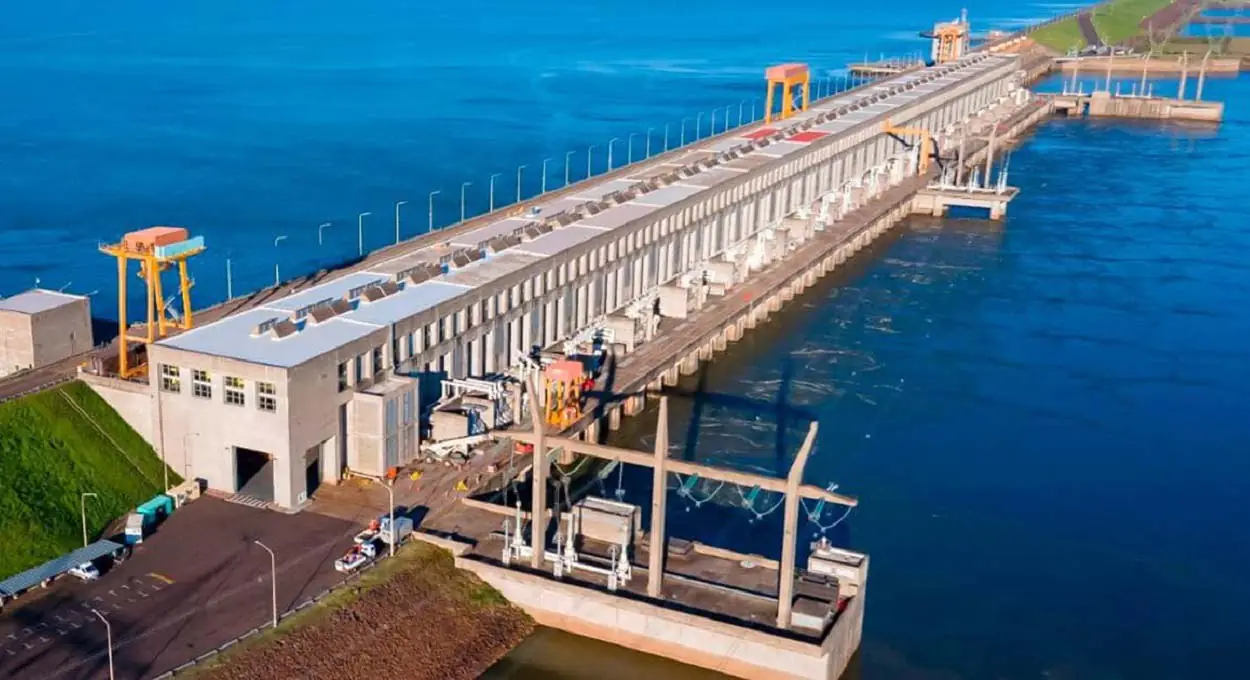
The Itaipu Dam on the Paraná River is the engine. At 14,000 MW total installed capacity across 20 Francis turbines, Itaipu is one of the largest power plants ever built. Paraguay's 50% treaty share is 7,000 MW. The plant supplies roughly 86.3% of the country's total electricity demand. Yacyretá, shared with Argentina, adds another 1,600 MW on Paraguay's side. Acaray adds 210 MW that is 100% nationally owned.
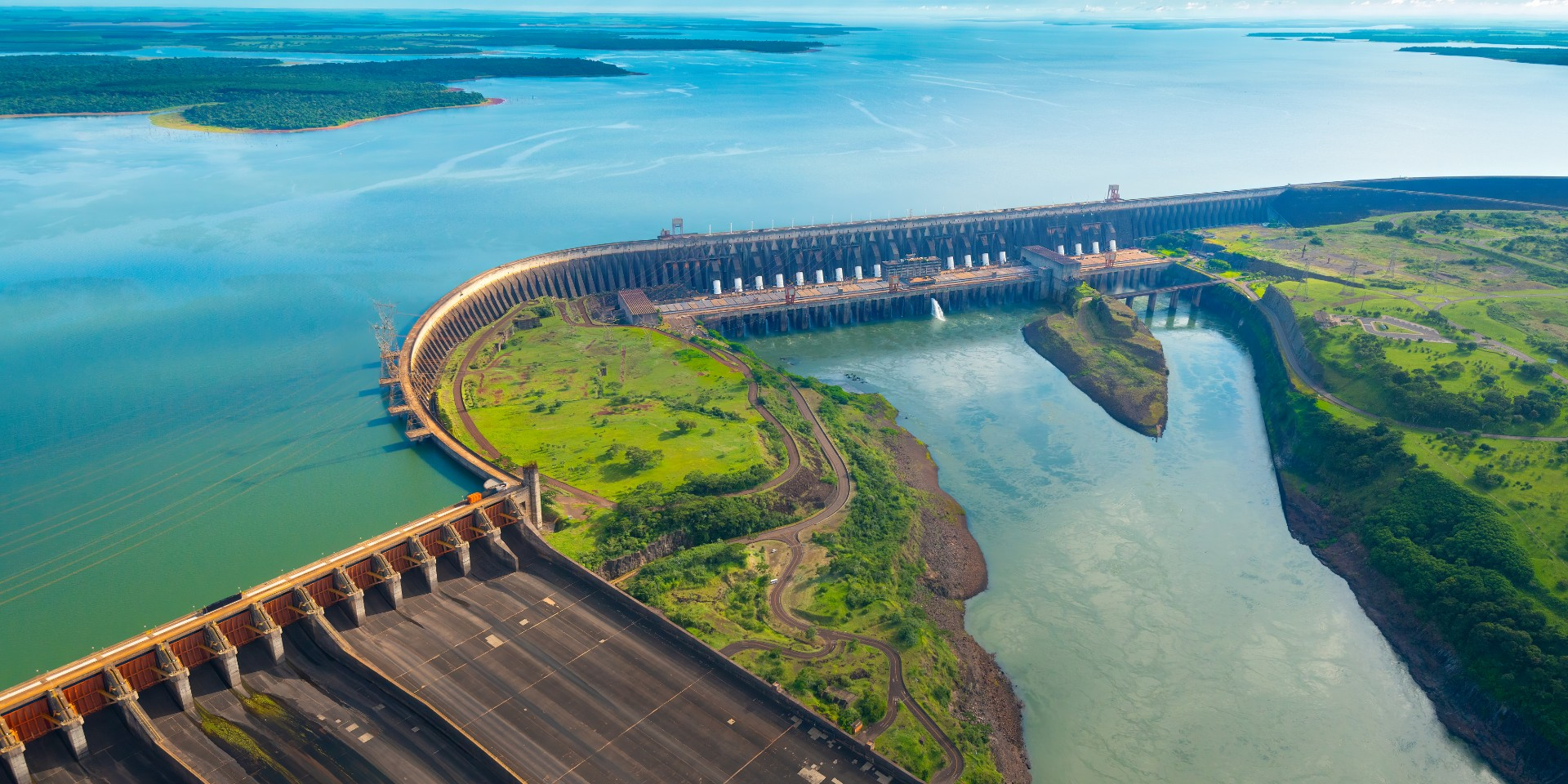
Paraguay can't use all of this power domestically. Historically it has sold the surplus back to Brazil at below-market rates under the terms of the 1973 Itaipu Treaty. That treaty structure is also the reason industrial users in Paraguay access electricity so cheaply. ANDE's tariff for intensive industrial consumers (the GCIE category, which covers metallurgy, data centres, and Bitcoin mining operations) at 220 kV runs $5.27/kW-month in demand charge and $0.03725/kWh in energy charge. At a high utilization factor, that works out to roughly $0.040–0.050/kWh all-in. Among the lowest industrial electricity costs anywhere in the world.
That tariff is not subsidized in the traditional sense. It reflects real production economics from a fully depreciated hydro asset with near-zero marginal cost. It is durable in a way that Bolivia's gas subsidy is not.
The result shows up in the hashrate data. Paraguay held +54% YoY growth through a global contraction that continues to push hashprice to all-time lows. Operations on cheap baseload hydro stay profitable at hashprice levels that destroy older machines running on higher-cost energy.
The country is now attracting AI data center investment through the same mechanism. X8 Cloud USA signed an MOU with ANDE to utilize up to 500 MW for an AI data center complex, roughly the output of one full Itaipu turbine. ANDE invested a record $349.2 million in grid infrastructure in 2025 and is expanding the 500 kV backbone with six new lines under the 2021–2030 Master Plan.
Luxor clients active in the market reflect that operator quality. Penguin Group, the Asuncion-based infrastructure company that built Paraguay's first major Bitcoin mining and AI data center campus near Hernandarias, has become a vocal advocate for treating mining as a strategic national industry. Italian operator Alps Blockchain has developed nine mining farms across Paraguay powered entirely by Itaipu hydropower since 2022, investing over EUR 145 million and operating more than 250 MW of capacity globally across six countries. Both are long-term institutional operators, exactly the profile that sustains a country's hashrate through down-cycles.
The largest single operator in Latin America is HIVE Digital Technologies (Nasdaq: HIVE). HIVE acquired Bitfarms' Paraguay operations in January 2025 and has since built out its Yguazu campus to 300 MW of renewable capacity, with a 100 MW Phase 3 expansion underway targeting commissioning in Q3 2026 as per Yahoo Finance. Which would bring its total Paraguay footprint to 400 MW and make it the country's largest mining facility of any kind. HIVE scaled its global hashrate from 6 EH/s at the start of 2025 to 25 EH/s by November 2025, with its Paraguay operations representing the core of that growth. HIVE is the clearest proof point that institutional capital can flow to LATAM when the energy economics and regulatory environment are right.
The one structural risk worth taking seriously is Itaipu Treaty renegotiation. The treaty's Annex C governs how Paraguay is compensated for surplus energy, and those rates have historically been far below market price. Any renegotiation of the pricing formula could shift the economics that underpin Paraguay's industrial tariff. Miners planning 5–10 year deployments should understand this as the primary variable.
Brazil: The One to Watch
Brazil's hashrate growth tells the story more clearly than any analysis could: 1.5 EH/s to 3.5 EH/s in a year, +133% YoY, during a global down-cycle. Operators chasing short-term arbitrage do not build infrastructure during a down-cycle. They exit.
Brazil has the grid to support serious Bitcoin mining at scale. The SIN generated 708.1 TWh in 2023, with installed capacity reaching ~232 GW in 2024. The generation mix is extraordinary: Itaipu's 14,000 MW (shared with Paraguay), Belo Monte's 11,233 MW in Pará connected to São Paulo via a 2,518 km HVDC link, Tucuruí's 8,370 MW, and 19.6 GW of wind capacity across 693 plants. Brazil's grid runs at 88–90%+ renewable composition on most days.
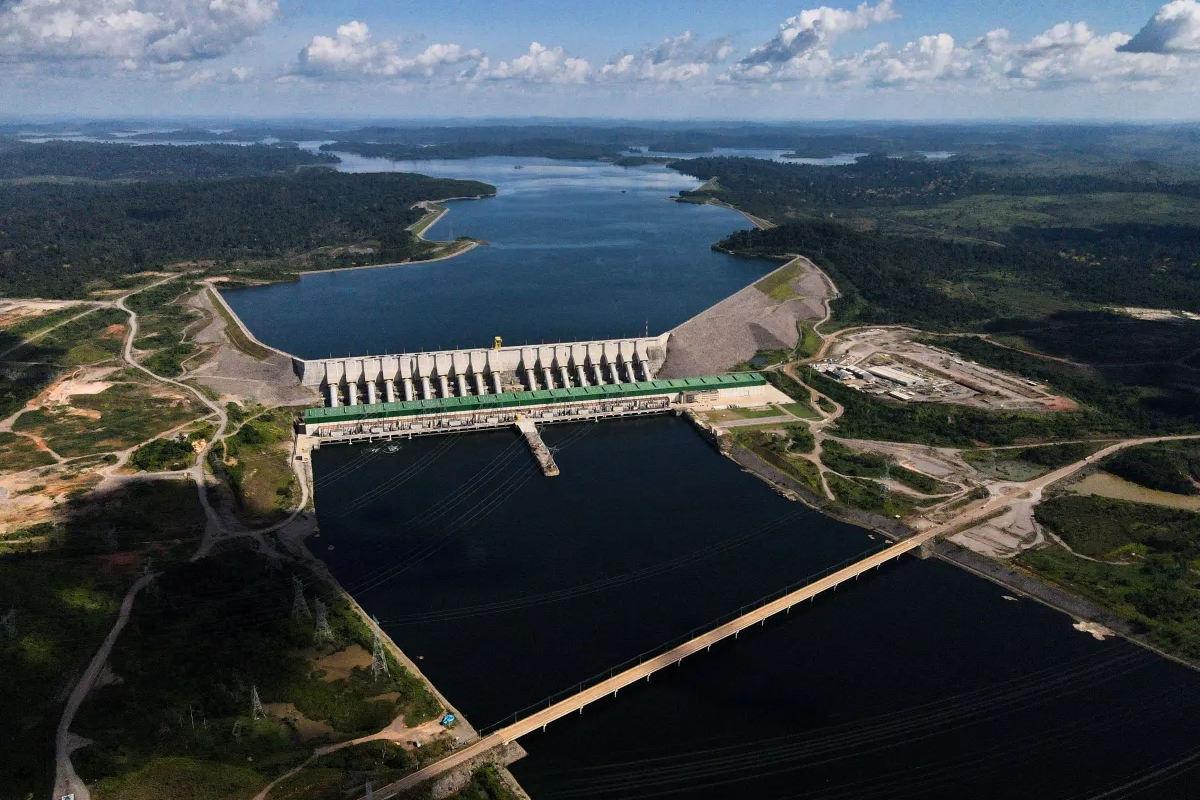
The electricity cost picture depends on location. The Sul region (Rio Grande do Sul, Santa Catarina, Paraná) carries the lowest industrial tariff at approximately R$652/MWh (~$0.046/kWh). The national average is R$694/MWh (~$0.049/kWh). Not Paraguay, but competitive with the middle tier of serious global mining jurisdictions.
The most important development for Bitcoin miners in Brazil happened quietly: the full opening of Brazil's ACL (Ambiente de Contratação Livre) to all high-tension consumers in 2024. The ACL allows large consumers, including Bitcoin mining operations that reach the Grandes Consumidores threshold, to negotiate directly with generators for bilateral contracts. That means bypassing the default distributor tariff, bypassing the Bandeira Tarifária surcharge risk, and potentially locking in fixed-price hydro or wind energy for the duration of a contract.
Operators already building in Brazil point to a wider opportunity. Minter Digital, a Brazil-based Bitcoin mining company, is focused on deploying operations in the country's remote regions, combining Bitcoin mining with local energy infrastructure to create technology jobs and raise human development indices in areas far from the industrial Southeast. Their thesis: Brazil's renewable surplus does not have to be captured only where demand is concentrated. It can be monetized where the generation actually is, as transmission infrastructure closes the gap.
The problem is geography. Brazil's renewable buildout has massively outpaced its transmission expansion. In 2024, 1,445 renewable plants were curtailed, totalling approximately 400,000 forced interruption hours. Since 2021, over 9.5 million MWh of wind energy in the Northeast has been curtailed because there are not enough wires to move it to where demand is. The Sul region avoids this problem. For now, Sul is the right answer for Bitcoin mining in Brazil.
Bolivia: A Good Trade, While It Lasts
Bolivia's Bitcoin mining story is a clean illustration of what happens when cheap electricity is a policy decision rather than a structural reality.
The country's grid runs approximately 70% on thermoelectric generation powered by natural gas. ENDE Andina's three flagship plants, Termoeléctrica Entre Ríos (526.77 MW), Termoeléctrica del Sur (505.83 MW), and Termoeléctrica Warnes (527.41 MW), form the backbone of the SIN. Gas is supplied by YPFB at approximately $1.30/MMBTU. The international market price runs $8–12/MMBTU.
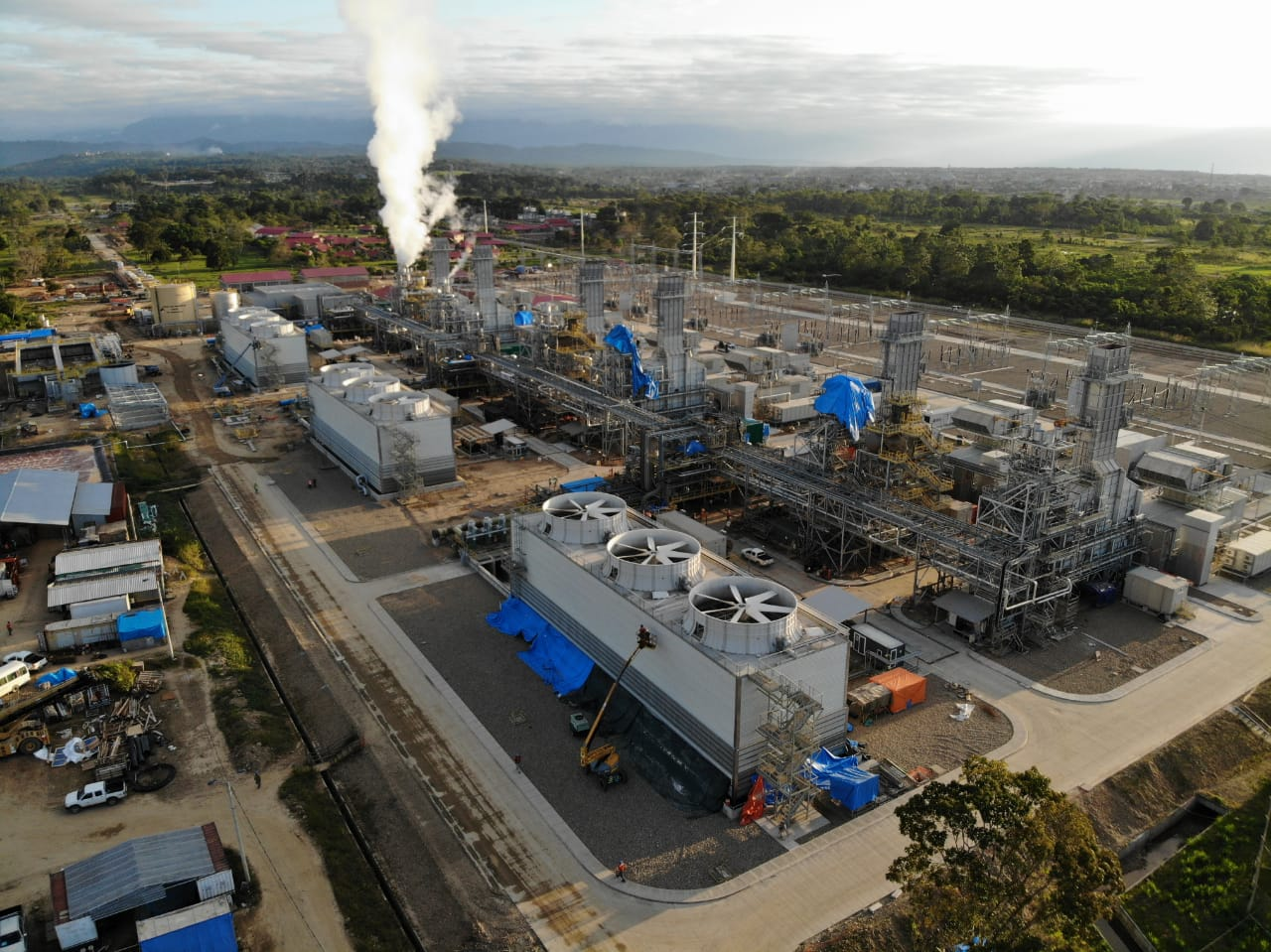
That $6.70–$10.70/MMBTU spread is the source of Bolivia's cheap industrial electricity, and it may explain the reason the country saw +2,400% YoY hashrate growth through early 2026. It was a rational trade. The problem is that the spread has an expiration date.
Bolivia's gas reserves are depleting. The country's thermoelectrics consume approximately 1,500 million m³ of gas per year. Bolivia is on a trajectory toward net gas importer status within 2–5 years. At market import prices, the annual cost increase would be approximately $400 million, a number that exceeds ENDE's entire annual profit of roughly $160 million. Q2 2026 showed Bolivia's hashrate pulling back even as the YoY headline still looked remarkable. Operators who pay attention to fundamentals were already pricing at the end of the subsidy.
The durable opportunity in Bolivia is not based on thermal power. It is near the renewable assets that don't carry subsidy risk: COBEE's Sistema Zongo hydroelectric cascade (10 Pelton-turbine plants, 188 MW), the Uyuni solar installation (62.5 MW at 3,700+ MASL), the Santa Cruz wind parks (108 MW, 30 Vestas 3.6 MW turbines), and the Laguna Colorada geothermal pilot targeting 100 MW. Mining anchored to those resources survives the gas unwind.
Argentina: An Energy Market Under Reform With The Right Assets
Argentina's hashrate declined 42% year-over-year as of Q2 2026. It is not because Argentina lacks the energy to mine Bitcoin.
Argentina's SADI has approximately 43,350 MW of installed capacity. Its Patagonian wind belt is among the most productive in the world. Its hydroelectric infrastructure includes Yacyretá (3,100 MW shared with Paraguay), Piedra del Águila (1,400 MW), and El Chocón (1,260 MW), among others. And then there is Vaca Muerta, one of the world's largest unconventional shale gas formations. YPF already operates a flared gas Bitcoin mining pilot there, monetizing associated gas that would otherwise be flared. The model is identical to what Crusoe Energy built across US shale basins.
Unblock Computos, the Argentine arm of Unblock Global, has already proven the flared gas model works. The company raised $15 million in 2023 to deploy Bitcoin mining operations directly at Vaca Muerta wells in partnership with Crusoe Energy, Pampa Energia, and Petrocuyo, positioning itself as the second largest flared gas Bitcoin miner in the world at the time of announcement. The US ambassador to Argentina praised the initiative publicly as a way to combust methane, generate electricity, and help Argentina meet its climate goals. The infrastructure is operational. The energy source is proven. What the macro environment has prevented is scaling it.
The -42% decline has nothing to do with any of this. The most direct cause of the hashrate decline was Bitfarms (Keel Infrastructure) shutting down its 40 MW site in Argentina, a single operational decision that accounted for the bulk of the reported contraction. Bitfarms had been one of the largest operators in the country, and its exit due to its ongoing AI pivot, compressed the country's reported hashrate significantly. For instance the -42% drop is better read as a specific capacity exit than as a broad industry collapse.
The Milei administration's Decrees 450, 451, and 452/2025 are the most significant restructuring of Argentina's energy sector since the 1990s reforms. They move the market toward marginal-cost pricing, reduce CAMMESA's intermediary role, and create the framework for bilateral PPAs between generators and large industrial consumers, including Bitcoin mining operations potentially in USD-denominated structures. If Argentina's macro stabilization holds through 2026, the combination of Vaca Muerta's gas, YPF's mining precedent, and functioning bilateral contracts could reverse the hashrate trend. The energy is there. The variable is macro confidence.
Venezuela: The Biggest Untapped Opportunity
Venezuela appears in the Global Hashrate Heatmap with approximately 5 EH/s, a signal that formal mining activity exists in the country despite the operating challenges. That figure is not yet large enough to place Venezuela in the Top 10 countries by Hashrate, but it represents operations that have found a way to function within the current environment.
What Venezuela has, and what no other country in Latin America has at the same scale, is a combination of stranded energy and an OFAC licensing framework that is already opening up the country's energy, and minerals industries. The electrical grid is the next logical step because without more electricity, there won't be any real oil production or economic recovery.
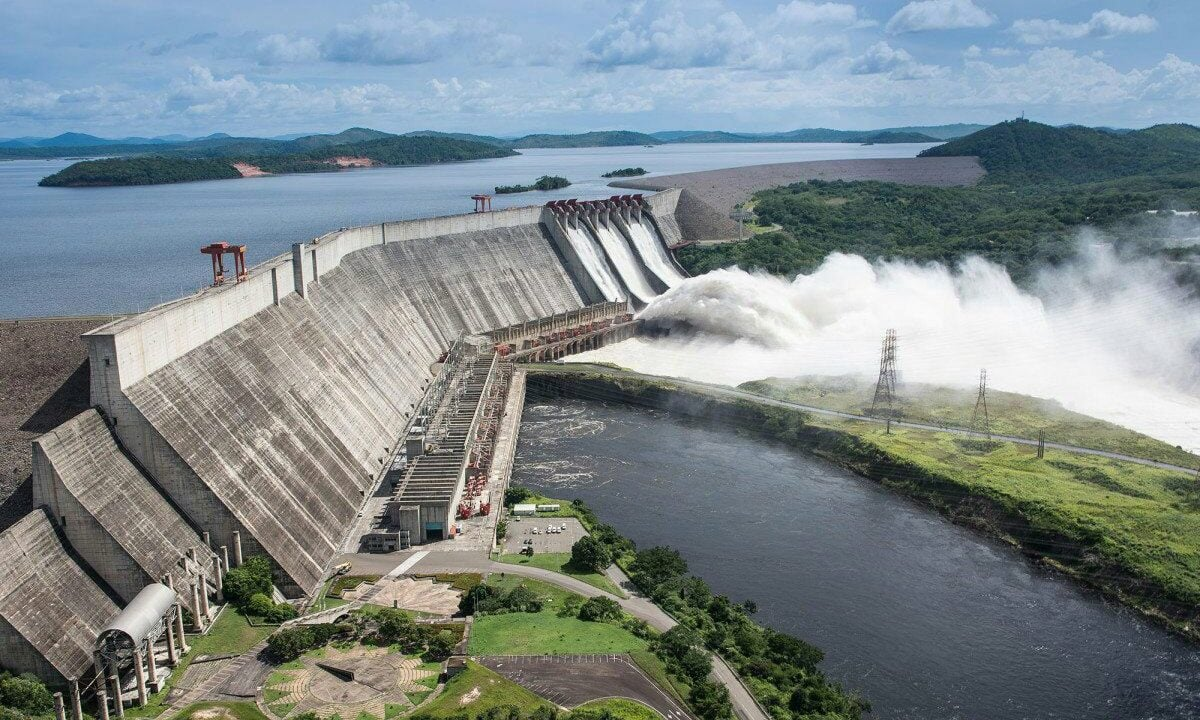
The Venezuelan grid has over 34 GW of nominal installed capacity and roughly 12–14 GW actually dispatchable. Transmission losses of approximately 30% and distribution losses of approximately 40% mean that roughly 42 of every 100 MW generated at the Guri dam reaches a paying customer. The Bajo Caroní bottleneck captures the opportunity precisely: approximately 16,000 MW of hydroelectric potential in the Caroní basin, but the 765 kV transmission backbone can only dispatch ~8,500 MW to load centres. That 7,500 MW gap is energy that is generated but cannot reach consumers. Bitcoin mining deployed near the generation source captures it before it is lost in transmission.
On the gas side, Venezuela flares an estimated 300,000 barrels per day equivalent of associated gas from the Faja del Orinoco, the Maracaibo Basin, and the eastern fields. Modular gas turbines co-located with oil field operations, running Bitcoin mining loads, would convert it to hard dollar income with no grid infrastructure required. It is the same model YPF is testing in Vaca Muerta.
DoctorMiner, founded in Caracas in 2016, operated at some point as one of Venezuela's most established Bitcoin mining companies and are the pioneers behind the first Latin American Bitcoin mining pool. The company built from a two-person startup into a network of over 1,500 connected miners, an early demonstration that Bitcoin mining could generate hard dollar income in an economy with near-zero electricity costs and chronic currency collapse. The company's founders have noted that Venezuela's oil, gas, and hydro resources make the country structurally suited for mining at industrial scale once the regulatory environment permits it. DoctorMiner represents what a post-licensing Venezuelan mining ecosystem could anchor itself around: domestic operators who understand the grid, the political environment, and the opportunity, ready to work alongside incoming private capital.
The regulatory pathway is further along than most people realize. OFAC General Licenses 48A and 49A are already issued, authorizing American companies to operate in Venezuela's energy sector. Siemens and GE have received specific OFAC licences for grid maintenance work. US investment fund Arc Energy, which acquired IMPSA, is actively lobbying OFAC for licences to rehabilitate the Tocoma hydroelectric plant: 2,160 MW that cost approximately $8.9 billion and was never completed. The template for private capital entering Venezuela's energy sector with OFAC authorization already exists. Bitcoin miners con leverage the same legal structure.
El Salvador: The Narrative Pioneer
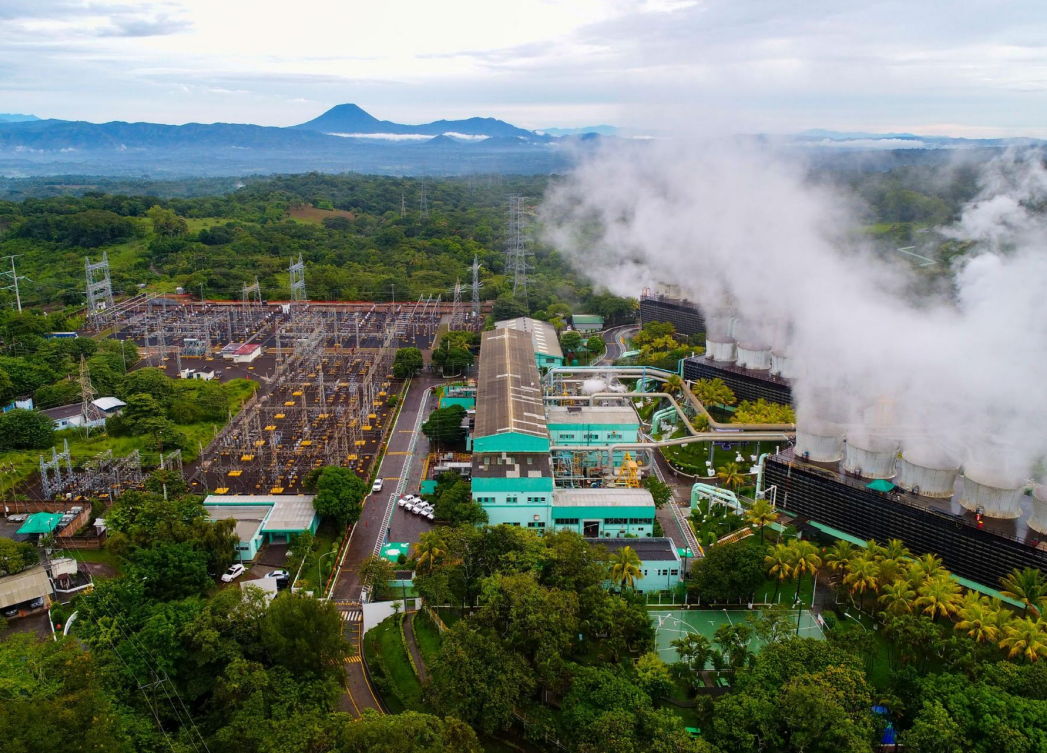
El Salvador holds a specific place in the Bitcoin mining story: it was the first country to make Bitcoin legal tender, in September 2021, and it operates the world's only government-run geothermal Bitcoin mining programme through LaGeo. Volcano Energy — the government's public-private partnership with Tether— became one of the most widely covered stories in the mining space when President Bukele announced the project in 2021.
It is not a competitive Bitcoin mining market.
The grid has approximately 2,200 MW of installed capacity for 6.5 million people and no structural surplus. The large industrial electricity tariff runs approximately $0.20/kWh, roughly four times what miners pay in Paraguay. Grid reliability sits at 13.7 average interruptions per customer per year with 18.2 hours of average annual downtime. The Bitcoin Law has also been partially walked back: the IMF's 2024 loan agreement required El Salvador to make merchant Bitcoin acceptance voluntary rather than mandatory.
The credible long-term thesis runs through geothermal expansion. LaGeo operates approximately 204 MW across the Ahuachapán and Berlín plants. The Chinameca field is under active World Bank-supported exploration, with a long-term target that could expand total geothermal capacity to 400+ MW. At scale, geothermal in El Salvador has a levelized cost estimated at $0.03–0.06/kWh, with 24/7 baseload availability and zero fuel price exposure. If Chinameca reaches commercial production and creates a genuine energy surplus, El Salvador would have the prerequisites for competitive Bitcoin mining for the first time.
El Salvador invented the volcano mining narrative. Paraguay built the actual hashrate. The gap between those two outcomes is measured entirely in megawatts and tariffs.
What the Data Tells Us
Industrial electricity cost
Regulatory posture
Q2 2026 mining activity
The Bottom Line
Latin America collectively produces ~5–6% of global Bitcoin mining hashrate. The United States produces 37.4%. The difference is not explained by energy. It is explained by economics and policy.
Paraguay proves the point in both directions. A country that most of the world overlooks, with a grid that still loses 21% of all electricity to theft and technical losses, with a population smaller than many US metro areas, is the fourth largest Bitcoin mining jurisdiction on earth. It got there because the energy surplus from Itaipu is real, the tariff that reflects that surplus is stable, and the regulatory environment does not add friction that destroys the economics.
The rest of the region has energy. Bolivia's Uyuni plateau rivals the Atacama for solar irradiation. Argentina's Patagonian wind belt is world-class. Brazil's hydro cascade — Itaipu, Belo Monte, Tucuruí — generates more clean electricity than most countries will ever build. Venezuela's Caroní basin contains hydroelectric potential that was partially built, partially abandoned, and partly waiting for American capital and an OFAC licence to unlock. El Salvador's geothermal field, fully developed, would be among the cheapest baseload sources in the hemisphere.
What most of these countries have lacked, in different combinations, is the ability to deliver that energy to mining operations at competitive prices, through stable enough regulatory frameworks to make multi-year capital deployment rational, in macro environments that allow dollar-denominated operations to function predictably.
Down-cycles are diagnostic. When hashprice hits all-time lows, the arbitrage trades unwind and the durable infrastructure investments stay. Paraguay grew. Bolivia retreated. Brazil kept building.
The question over the next 12–18 months is which other markets cross that line. Brazil's ACL reform, Argentina's energy decrees, Venezuela's OFAC licensing pipeline, and El Salvador's Chinameca exploration are all live variables. The energy is there. The work is in making the policy and economics match it.
That is what this series will track.
— Happy Hashing!
This is the first installment of Hashrate Index's State of Bitcoin Mining in Latin America series. Individual country deep dives will follow over the coming weeks.
About Luxor Technology Corporation
Luxor delivers hardware, software, and financial services that power the global compute and energy industry. Its product suite spans Bitcoin Mining Pools, ASIC Firmware, Hardware trading, Hashrate Derivatives, Energy services, a Miner Management software, Commander, and a bitcoin mining data platform, Hashrate Index.
Disclaimer
This content is for informational purposes only, you should not construe any such information or other material as legal, investment, financial, or other advice.


Hashrate Index Newsletter
Join the newsletter to receive the latest updates in your inbox.








)