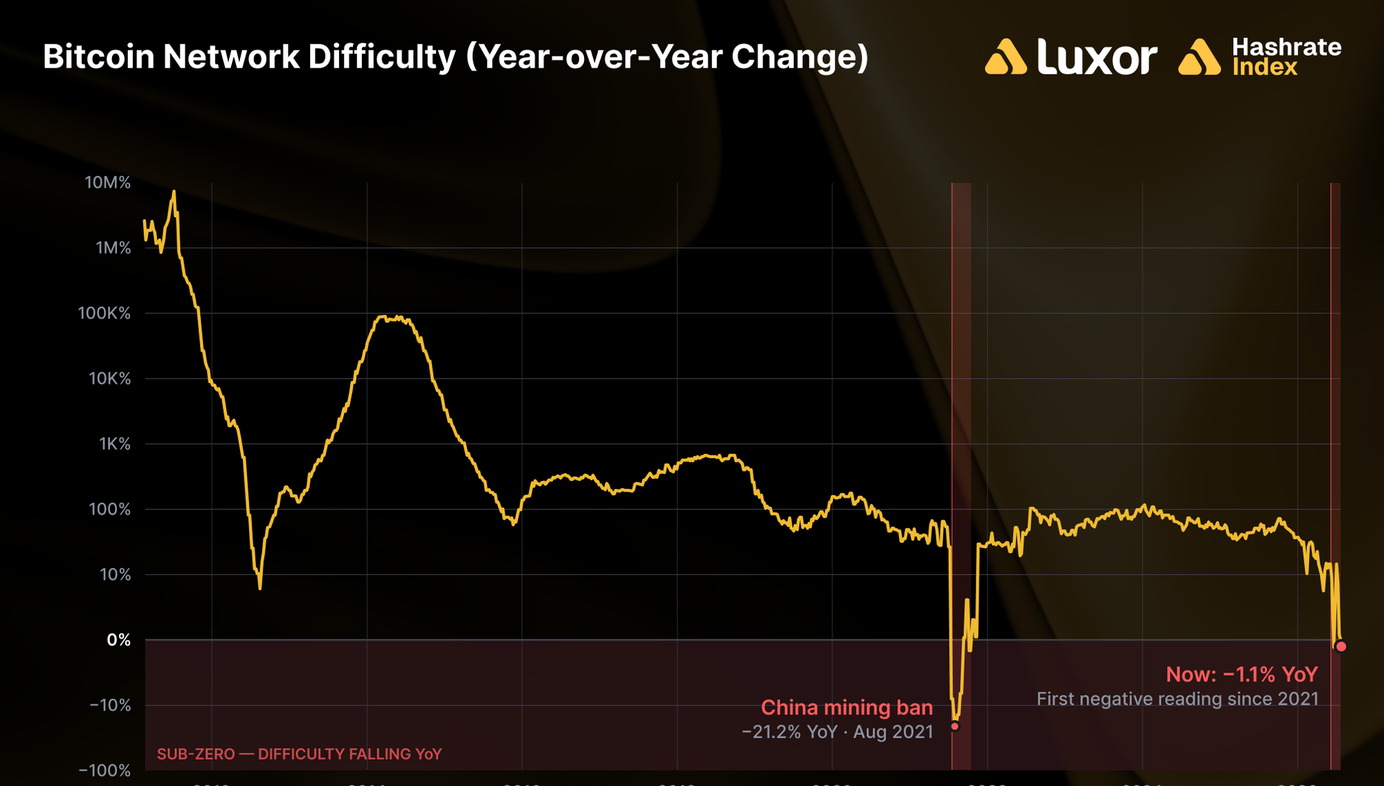
Bitcoin Difficulty Is Down Year Over Year for the Second Time Ever


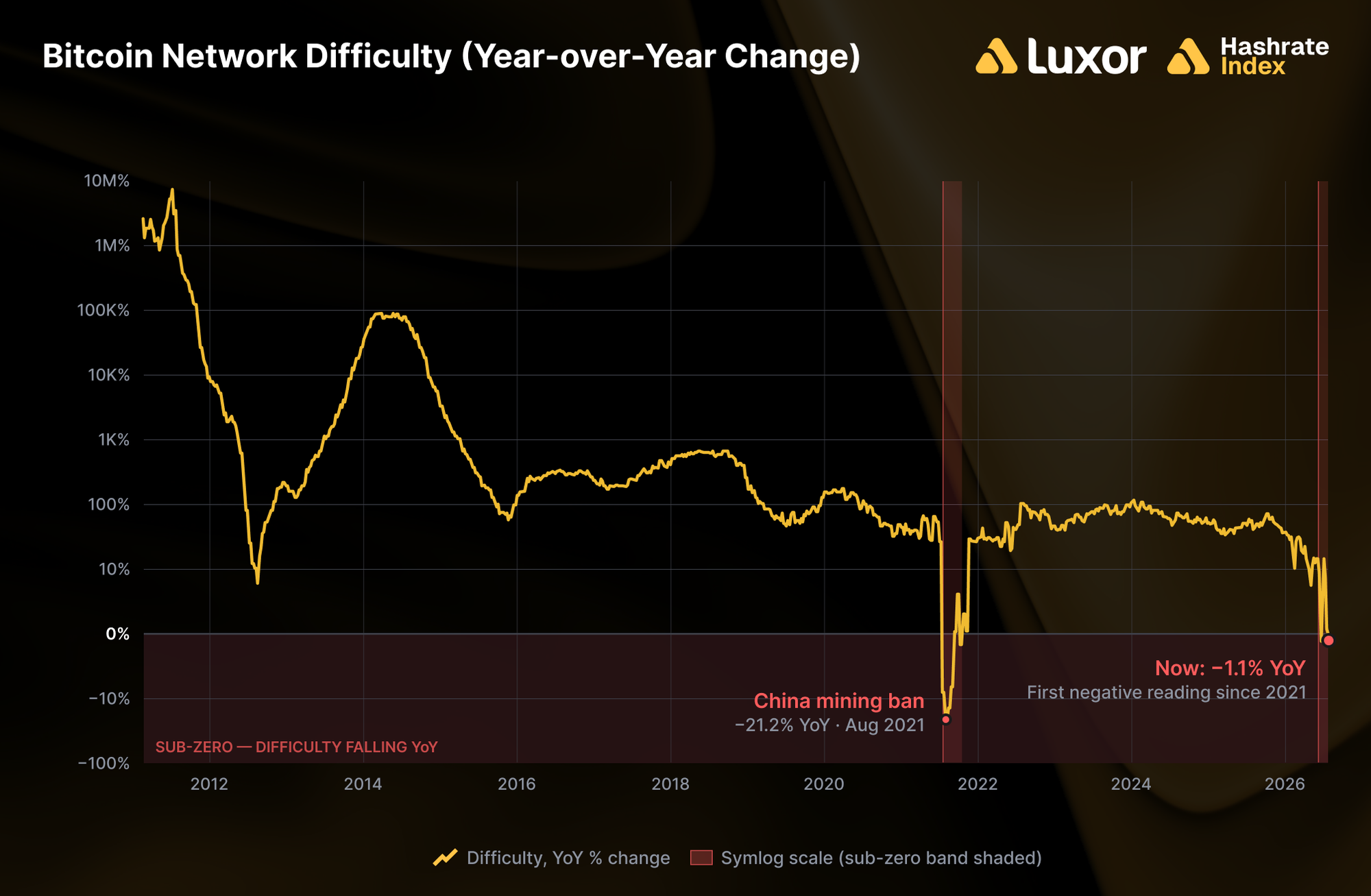
For only the second time in Bitcoin’s history, network difficulty, and with it, hashrate, is down year-over-year.
This almost never happens. Two structural forces keep difficulty grinding higher over any twelve-month window. The first is Moore’s Law: each new generation of mining rigs is more performant and efficient than the last. The second is the long-run uptrend in bitcoin’s price, which keeps bringing new hashrate online. When both are working, difficulty only goes one way — up.
The last time year-over-year difficulty turned negative was mid-2021, when China banned mining and roughly half the network went dark overnight. That was a clean supply shock: an obvious cause and effect. Machines went offline, moved elsewhere, and plugged back in. Within months, difficulty was back to breaking new all-time highs.
This time is different. There’s no single clear-cut cause; it’s a combination of overlapping pressures:
- Worsening mining economics — Falling BTC prices and hashprice compression have squeezed mining margins to breakeven or below. USD hashprice fell to $27.67 per PH/s/day in June, within a cent of February's all-time low. Marginal miners are switching off instead of scaling up.
- The AI transition — The AI/HPC buildout is pulling capital, power, and operators away from bitcoin mining. Compute capacity expansion that would once have become new SHA-256 hashrate is now going into AI compute instead.
- A long tail of smaller drags — The war in Iran (~7 EH/s knocked offline), 4CP curtailment in Texas, and regulatory actions across mining hotspots around the world have each shaved off hashrate at the margin.
Together, these factors have caused a consequence only briefly seen during China’s ban: difficulty growth below zero.
We’ve monitored and tracked these forces on Hashrate Index. What’s new is that they’re now showing up in the one mining metric that’s supposed to move one way only.
What This Means for Miners
- For fleets on the margin: manage hashprice risk with Fixed & Upfront pool payouts. Stabilize your revenues by locking in a forward hashprice for up to 12 months. Access non-dilutive capital today to fund equipment, facilities, or working capital.
- For more competitive fleets: Boost mining rewards during this period of difficulty relief. Instantly scale your mining operations by purchasing future hashrate, capturing market share without additional equipment.
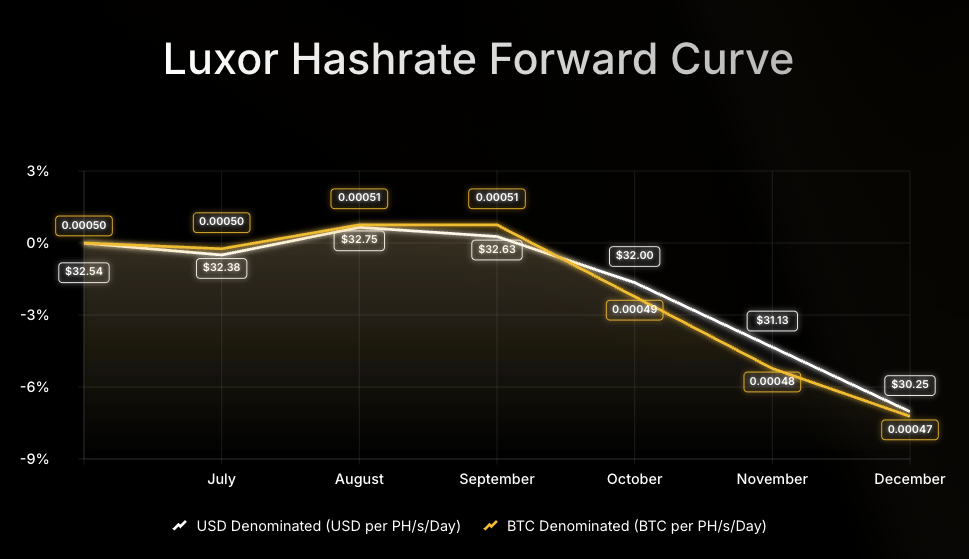
Looking forward, Luxor’s Hashrate Forward Market is pricing in an average hashprice of $31.85 or 0.00049 BTC per PH/s/day over the next six months. Sellers can currently secure this hashprice while buyers have the opportunity to lock in the same hashcost through December 2026.
If you’d like to learn more about Luxor’s Bitcoin mining derivatives, please reach out to [email protected] or visit luxor.tech/derivatives.
About Luxor Technology Corporation
Luxor delivers hardware, software, and financial services that power the global compute and energy industry. Its product suite spans Bitcoin Mining Pools, ASIC Firmware, Hardware trading, Hashrate Derivatives, Energy services, a Miner Management software, Commander, and a bitcoin mining data platform, Hashrate Index.
Disclaimer
This content is for informational purposes only; you should not construe any such information or other material as legal, investment, financial, or other advice. Nothing contained in our content constitutes a solicitation, recommendation, endorsement, or offer by Luxor or any of Luxor’s employees to buy or sell any derivatives or other financial instruments in this or in any other jurisdiction in which such solicitation or offer would be unlawful under the derivatives laws of such jurisdiction.
There are risks associated with trading derivatives. Trading in derivatives involves risk of loss; loss of principal is possible.


Hashrate Index Newsletter
Join the newsletter to receive the latest updates in your inbox.