
Bitcoin Network Hashrate Is Back Above 1 ZH/s
Twelve months after the October 2025 peak, difficulty is back above the zettahash line. Here is a look back on what took it down and what the forward market thinks happens next.



Bitcoin’s difficulty adjustment at block 971,712 on October 16 came in at +5.92%, lifting network difficulty to 140.58T — above 139.70T, the level equivalent to a 1 ZH/s network hashrate. It ends a run of fifteen consecutive adjustments below that line, going back to March 20. The next adjustment, on October 29, added another +5.54% to 148.36T.
TLDR
- Back above 1 ZH/s: the 7-day SMA hashrate crossed 1,000 EH/s on October 11 for the first time since June 1 and has held above it since. The October 16 adjustment is the first difficulty epoch above 139.70T since March 5–20. The October 29 adjustment (+5.54%) took difficulty to 148.36T, about 5% below its 155.97T record of October 29, 2025.
- What took it down: a 36% drawdown in Bitcoin from its $124,485 peak of October 6, 2025, a late-January Arctic blast that knocked ~200 EH/s offline, and a Texas 4CP season that pulled the network down to 853 EH/s in June.
- 4CP is a seasonal signature: across 2022–2026, June–September adjustments averaged +0.75% (versus +1.90% in the other eight months of the year), and October has been the strongest month on average at +4.25%. This year's 4CP season averaged −0.44%; the rebound since ERCOT's final peak on September 12 has been +16.4% across four adjustments, and the forward curve now prices a pause through December.
- The forward curve priced it first: the USD-denominated hashrate forward curve has fallen $4–7 across the strip since the beginning of October and flattened after the October 29 adjustment: the five-month contract sits about 6% below spot, versus 13% before the October 16 adjustment. The curve implies 1,056 EH/s for November and 1,059 EH/s for December, close to the ~1,062 EH/s the network averaged over the last epoch, and 1,100 EH/s by March 2027.
The Drawdown From the October 2025 Peak
Network hashrate peaked at 1,156 EH/s on a 7-day basis on October 18, 2025, and difficulty followed to a record 155.97T eleven days later. Bitcoin was two weeks off its $124,485 all-time high and hashprice was $46 per PH/s/day. The next twelve months saw most of this unwind.
Three forces stacked:
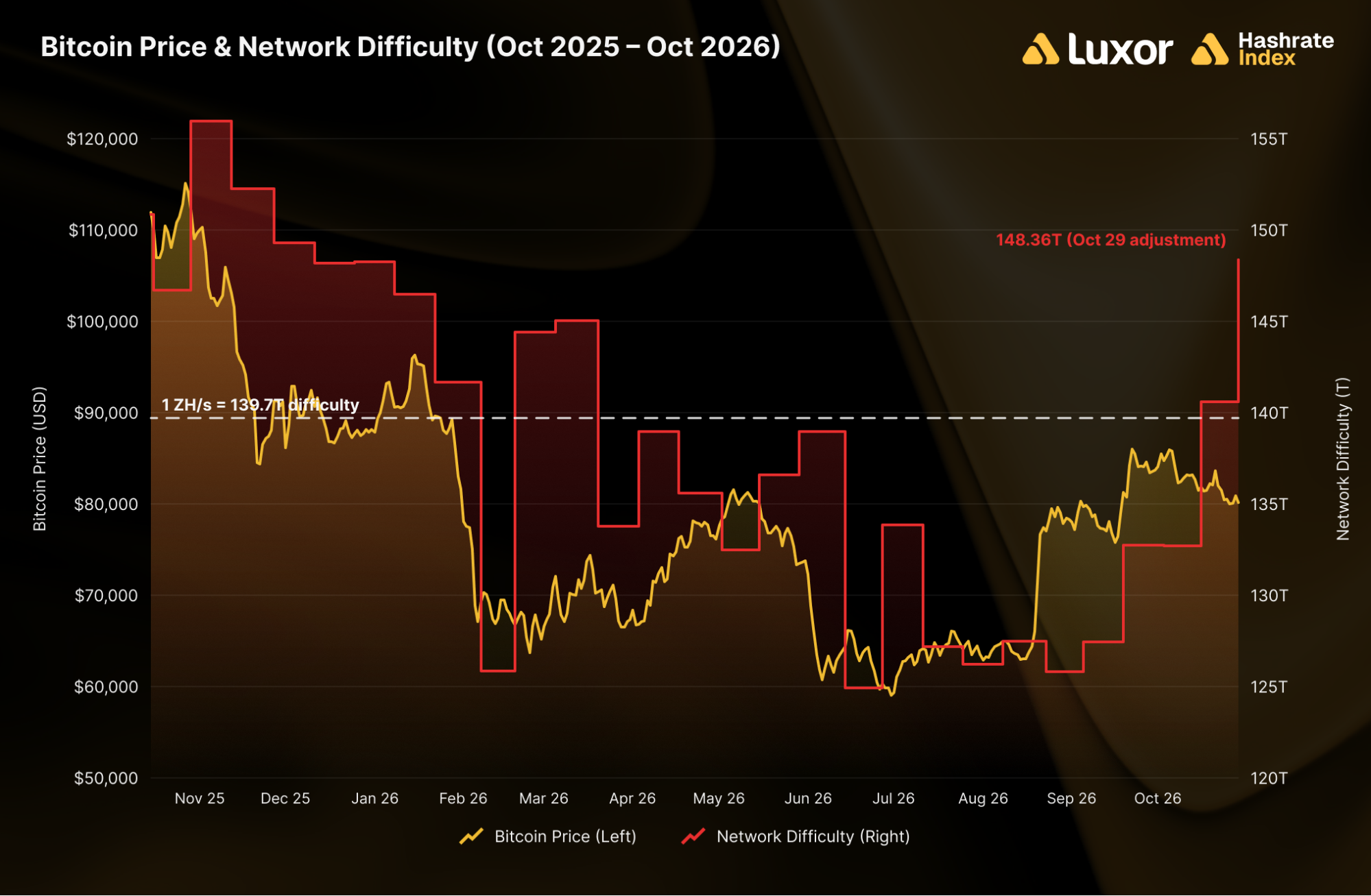
- Price. Bitcoin fell to a cycle low of $59,005 by June 30, a 53% drawdown. USD hashprice had already bottomed at $27.74 on June 6; the −10.09% June 14 adjustment, as early 4CP curtailment took hashrate offline, briefly lifted it back above $32 before the last leg of the price decline pushed it to about $28 by month-end. By July difficulty was down year over year for only the second time in Bitcoin's history.
- Weather. The late-January Arctic blast cut the 7-day average from 1,051 to 833 EH/s in a week and produced the two largest adjustments of the year, −11.16% on February 7 and +14.73% on February 19, as curtailed loads came straight back.
- Summer. ERCOT's 4CP season took the network below 900 EH/s repeatedly between June and August.
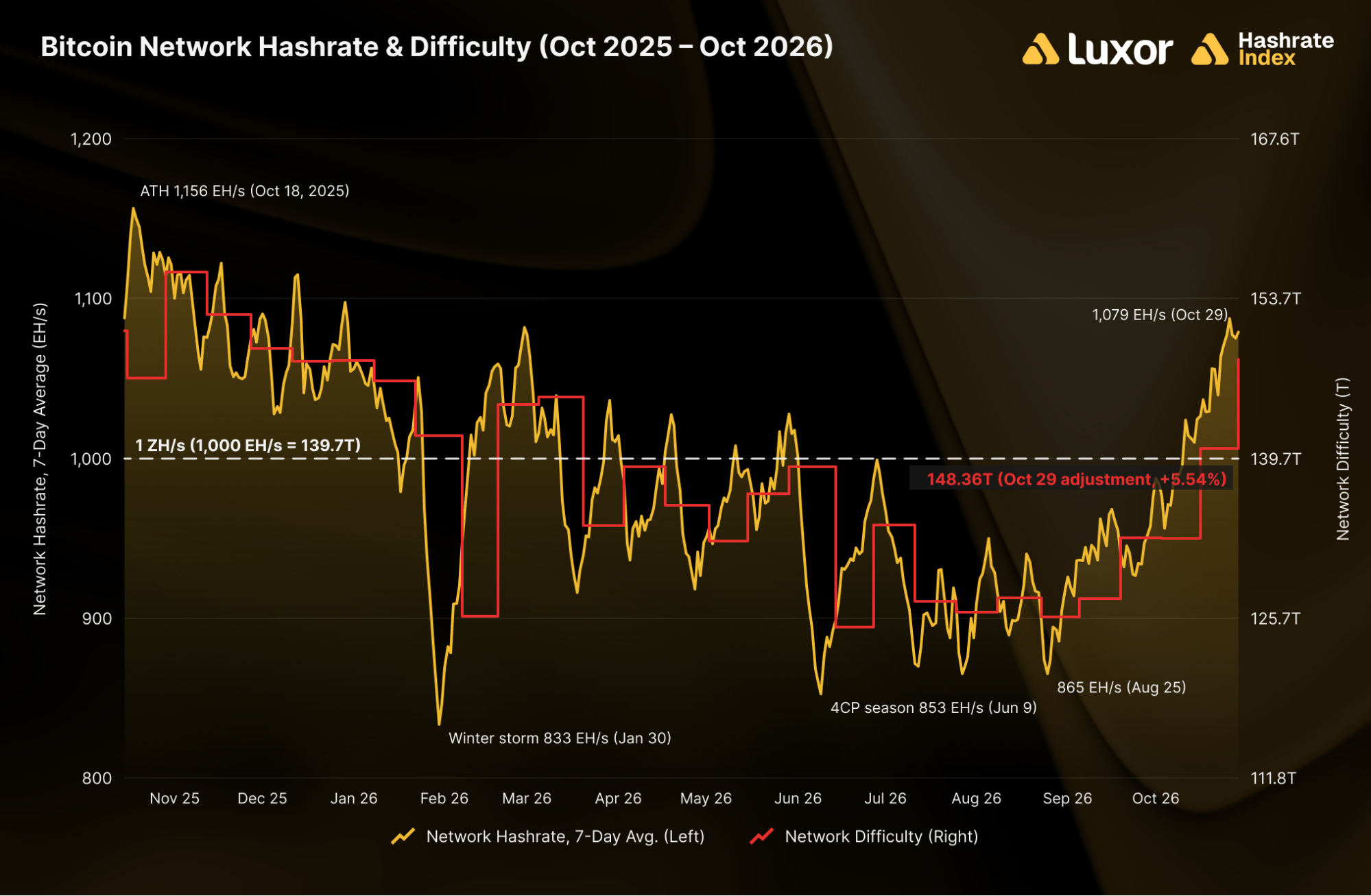
Difficulty tracked Bitcoin: down through the first half of the year and recovering with it after the August rally. At about $80,150 on October 29, Bitcoin is 36% below its peak while difficulty, at 148.36T after the October 29 adjustment, is 4.9% below its own; the 7-day average hashrate reached 1,088 EH/s on October 26, its highest since December 29, 2025. Hashrate came back faster than price, which is why hashprice has fallen to about $34 after the October 29 adjustment, against $46 at the all-time hashrate high.
4CP, Then and Now
ERCOT's four coincident peaks this year landed on June 18 (82.0 GW), July 22 (90.8 GW), August 24 (90.2 GW) and September 12 (86.2 GW), a four-interval average of 87.3 GW.
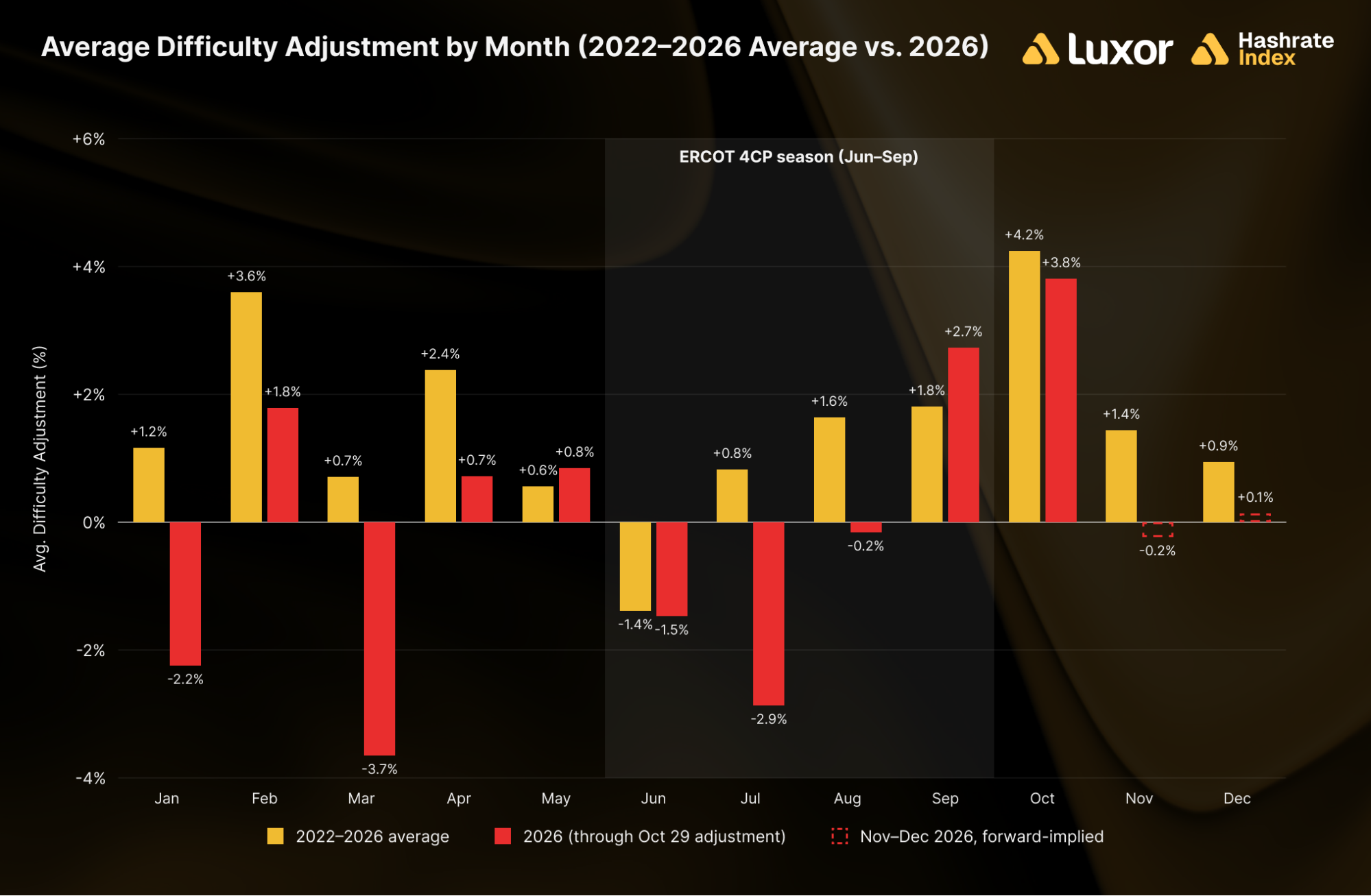
The eight difficulty adjustments between June 14 and September 19 averaged −0.44%. The June 14 adjustment (which stacked early 4CP curtailment on top of price-driven marginal shutdowns) was −10.09%, the eighth-largest decrease of the modern ASIC era (since 2016), and July 11 followed at −5.00%.
Taking every adjustment from 2022 through 2026, June–September adjustments averaged +0.75% against +1.90% in the other eight months. October averaged +4.25%, the strongest calendar month, as curtailed load in Texas returns.
The same shape is visible this year: since the final peak passed on September 12, difficulty has moved +4.16% (September 19), −0.03% (October 3), +5.92% (October 16) and +5.54% (October 29), a cumulative +16.4% from 127.45T to 148.36T, with October averaging +3.8% per adjustment. The hashrate forward curve now expects the rebound to pause, implying roughly −0.2% per adjustment in November and +0.1% in December (the dashed outlines in Figure 3):
How the Forward Market Moved
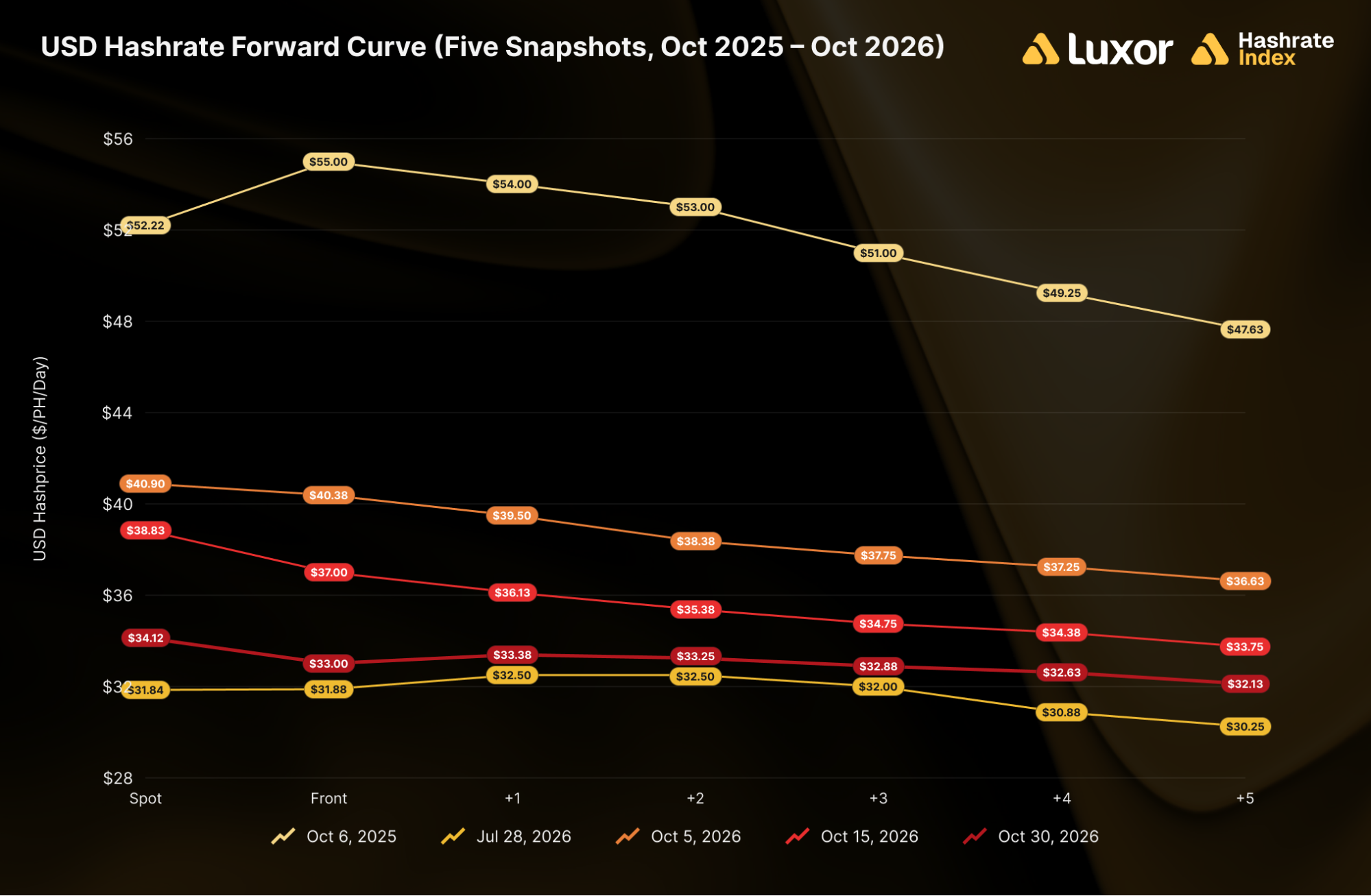
Five snapshots from Luxor's Hashrate Forward Market tell the story: October 6, 2025 (the day of Bitcoin's price peak), July 28, 2026 when year-over-year difficulty went negative, October 5 (the last snapshot in the September lookback), October 15, the day before the October 16 adjustment, and October 30, the day after the October 29 adjustment.
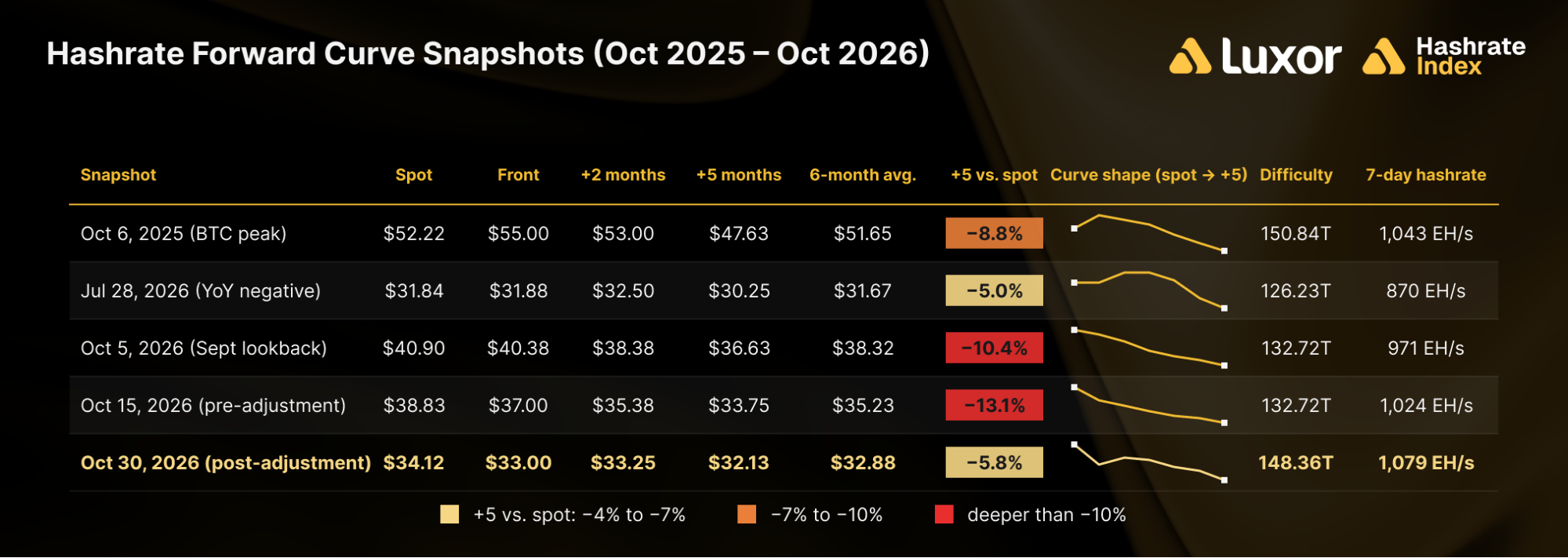
Table 1. USD hashrate forward curve mid-market marks from Luxor's Hashrate Forward Market: the front (current-month) contract, the contracts two and five months out, and the six-month average (the mean of the six listed monthly contracts). The sparkline traces each curve from spot to five months out; the colour chip grades the depth of backwardation. Difficulty and 7-day hashrate as of the snapshot date. Source: Luxor, Hashrate Index.
What changed? In July 2026 the curve was flat: the forward market expected no difficulty growth, and contracts five months out traded within $2 of spot. By October 5 it had steepened into backwardation, implying the network would cross 1 ZH/s in January 2027 at 1,029 EH/s.
The network got there in October instead, and the curve has moved in three steps since. Into the October 16 adjustment, the strip fell while spot held: by October 15 the front month sat $1.83 below spot and the five-month contract 13% below. After it, spot caught down, falling to $35.91 by October 26 as backwardation eased to 11%. Then the October 29 adjustment took spot to about $34, and the back of the curve stopped falling with it: the March 2027 contract moved from $32.00 to $32.13, leaving the five-month contract about 6% below spot.
This time the shape changed, not just the level: the curve has flattened. On the same basis as before, the October 30 curve implies:
- 1,056 EH/s for November and 1,059 EH/s for December
- 1,070 EH/s for January 2027
- 1,100 EH/s for March 2027
That is 2–4% below what the October 26 curve implied, and close to the ~1,062 EH/s the network averaged over the epoch that ended October 29. Having watched two +5% adjustments land, the forward market now prices difficulty to hold around current levels through year-end, with modest growth resuming in early 2027.
What This Means for Miners
Crossing 1 ZH/s with Bitcoin's price still a third below its all-time high says something about fleet efficiency. The hashrate that has come back is cheaper to produce than the hashrate that left. For the forward market, the more important fact is the shape of the curve. Until this week it was pricing difficulty growth into the winter; since the October 29 adjustment it prices a pause through year-end, with growth resuming in 2027. With difficulty up 16% since early September, selling hashprice forward is a hedge against that growth resuming sooner than the market expects, and it makes sense for any fleet, efficient or not; what differs between fleets is how much of their revenue the hedge needs to cover, and what the other side of the trade is for. Three use cases we see most often:
- Marginal fleets (older or higher-cost machines): the forward curve currently lets an operator lock in $32.88 per PH/s/day on average through March 2027, on the flattest strip of the five snapshots. Locking in that revenue turns an uncertain winter into a known cash flow, which is what a lender or hardware vendor wants to see: forward-sold hashrate is collateral for financing a fleet upgrade. The same operator can buy hashrate forward against the new machines' delivery window so the upgrade arrives already hedged.
- Hosts and fixed-cost operators: a hosting provider with fixed-price power and a dollar-denominated cost base carries hashprice risk on every client's behalf. Selling the fleet's hashrate forward converts a floating revenue line into a fixed one that matches the power contract, which is the same logic a power producer uses when it sells its power generation forward.
- Efficient fleets: with a lower breakeven, the hedge covers a smaller share of the revenue stack, so the decision is about the shape of the curve rather than survival. Buying hashrate forward at about a 6% discount to spot expresses a worldview that the difficulty growth the forward market expects does not fully arrive: if the network is below 1,100 EH/s in March 2027, the forward buyer paid less for that hashrate than the spot market will. If it is above, the seller was right to hedge.
If you would like to learn more about Luxor's Bitcoin mining derivatives, reach out to [email protected] or visit luxor.tech/derivatives.
About Luxor Technology Corporation
Luxor delivers hardware, software, and financial services that power the global compute and energy industry. Its product suite spans Bitcoin Mining Pools, ASIC Firmware, Hardware trading, Hashrate Derivatives, Energy services, a Miner Management software, Commander, and a bitcoin mining data platform, Hashrate Index.
Disclaimer
This content is for informational purposes only; you should not construe any such information or other material as legal, investment, financial, or other advice. Nothing contained in our content constitutes a solicitation, recommendation, endorsement, or offer by Luxor or any of Luxor's employees to buy or sell any derivatives or other financial instruments in this or in any other jurisdiction in which such solicitation or offer would be unlawful under the derivatives laws of such jurisdiction. There are risks associated with trading derivatives. Trading in derivatives involves risk of loss; loss of principal is possible.



Hashrate Index Newsletter
Join the newsletter to receive the latest updates in your inbox.