Texas Power Prices, Not Bitcoin, Drove the 9.13% Difficulty Drop
Expensive evening power in West Texas switched off enough machines to force the biggest difficulty cut since June. When power prices eased, hashrate came straight back, even as bitcoin fell.




Bitcoin difficulty fell 9.13% on Nov 14, the largest cut since June. The obvious suspect is bitcoin's price, but the data points to West Texas power instead.
Power Cost More Than Mining Paid
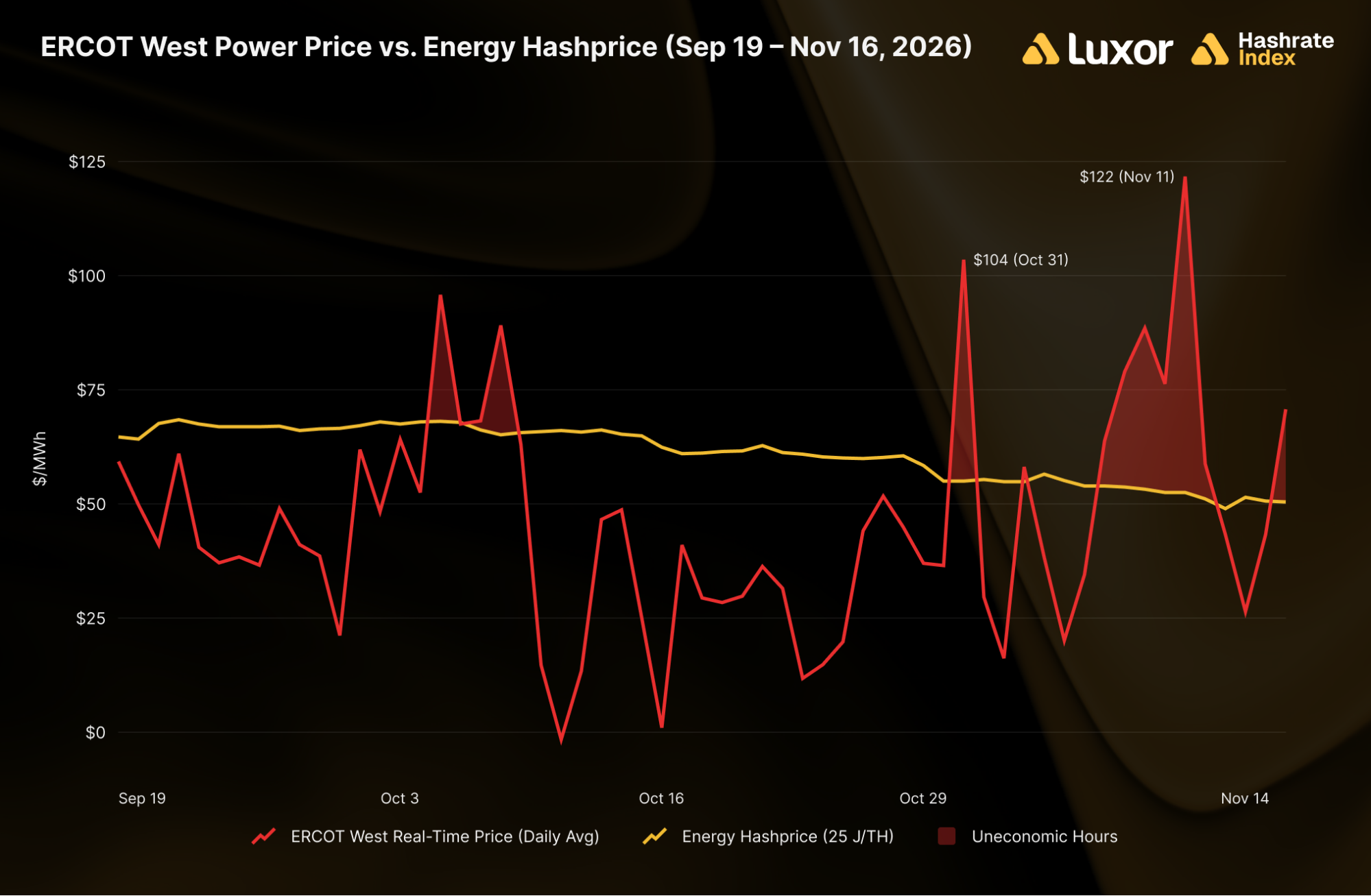
A mining machine runs when it earns more than its power costs. Energy hashprice is that break-even: what a machine earns for each megawatt-hour it uses. For a 25 J/TH machine, it averaged $54/MWh in the Oct 29 – Nov 14 epoch.
West Texas power blew through it. Daily averages reached $64 to $122/MWh from Nov 7 to 11. Wind was the main driver: West Texas wind output fell from 12.6 GW on Nov 4 to roughly 1 GW on Nov 7–9, and the 345-kV lines bringing power in hit their limits, leaving West Texas $47/MWh above the rest of the state on Nov 9.
Evenings were the worst: once the sun set and solar output fell away, power averaged $80 to $98/MWh from 5 p.m. to 11 p.m. On Nov 11 the squeeze went statewide, as wind fell to 2–4 GW after sunset and North, South and West prices hit $500–650/MWh around 9 p.m.
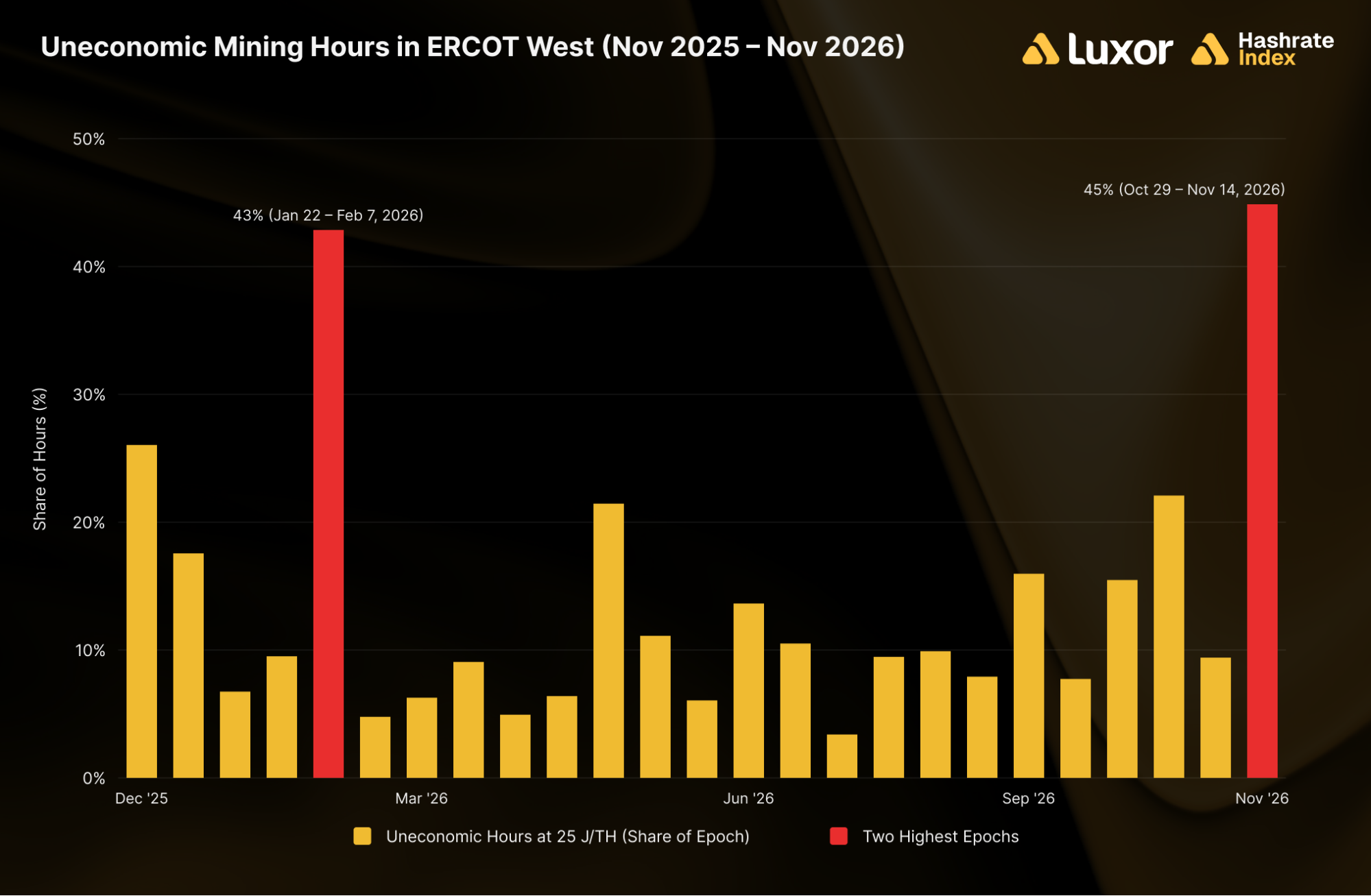
From Oct 29 to Nov 14, power cost more than a 25 J/TH machine earned in 45% of West Texas hours, up from 9% during the Oct 16 to 29 epoch. That is the most uneconomic stretch in at least a year, ahead of the late-January winter storm.
Power, Not Bitcoin's Price
Hashprice fell too, so we separated the two. Uneconomic hours rose from 9% to 45%, a 36-point jump. Keeping hashprice at its Oct 16 – 29 level, Oct 29 – Nov 14 power prices alone would have lifted the share to 39%, or 30 of those 36 points. Keeping power prices at their Oct 16 – 29 level, the lower hashprice alone would have lifted it to only 17%, or 8 points. Power did about four-fifths of the damage.
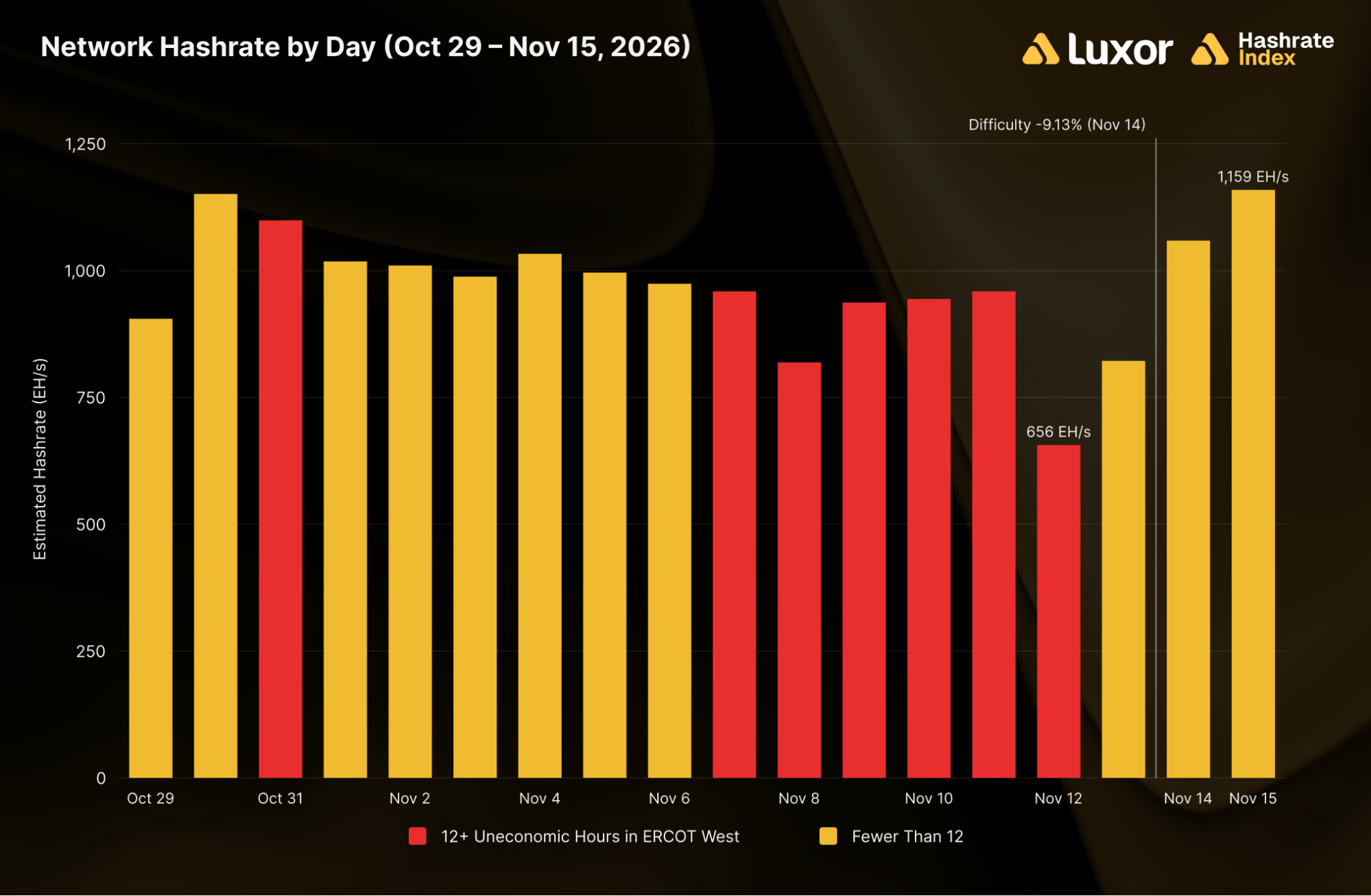
A rough check at the network level points the same way. Texas hosts an estimated 17% of global hashrate, or 180 EH/s, per our Global Hashrate Heatmap. Switching that off for an extra 36% of hours removes about 65 EH/s on average. Network hashrate fell 91 EH/s on a 14-day average, so Texas curtailment can account for roughly three-quarters of the drop.
The weekend gave a cleaner test. Bitcoin fell 13%, from $73,900 on Nov 11 to $64,500 on Nov 16. If miners were curtailing on BTC price, hashrate should have kept falling. Instead, West Texas power eased, with daily averages of $26 to $43/MWh from Nov 13 to 15, and hashrate climbed back near 1,100 EH/s within a day.
What Comes Next
Machines that switch off on power prices come back when power gets cheaper. Blocks have averaged 9.1 minutes since the cut, which points to an increase of roughly 10% at the next adjustment, even with bitcoin lower. That would take hashprice from $30 to $27 and 25 J/TH energy hashprice to $45/MWh. With 538 of 2,016 blocks in, it is too early to tell. West Texas power topped $120/MWh again on Monday afternoon.
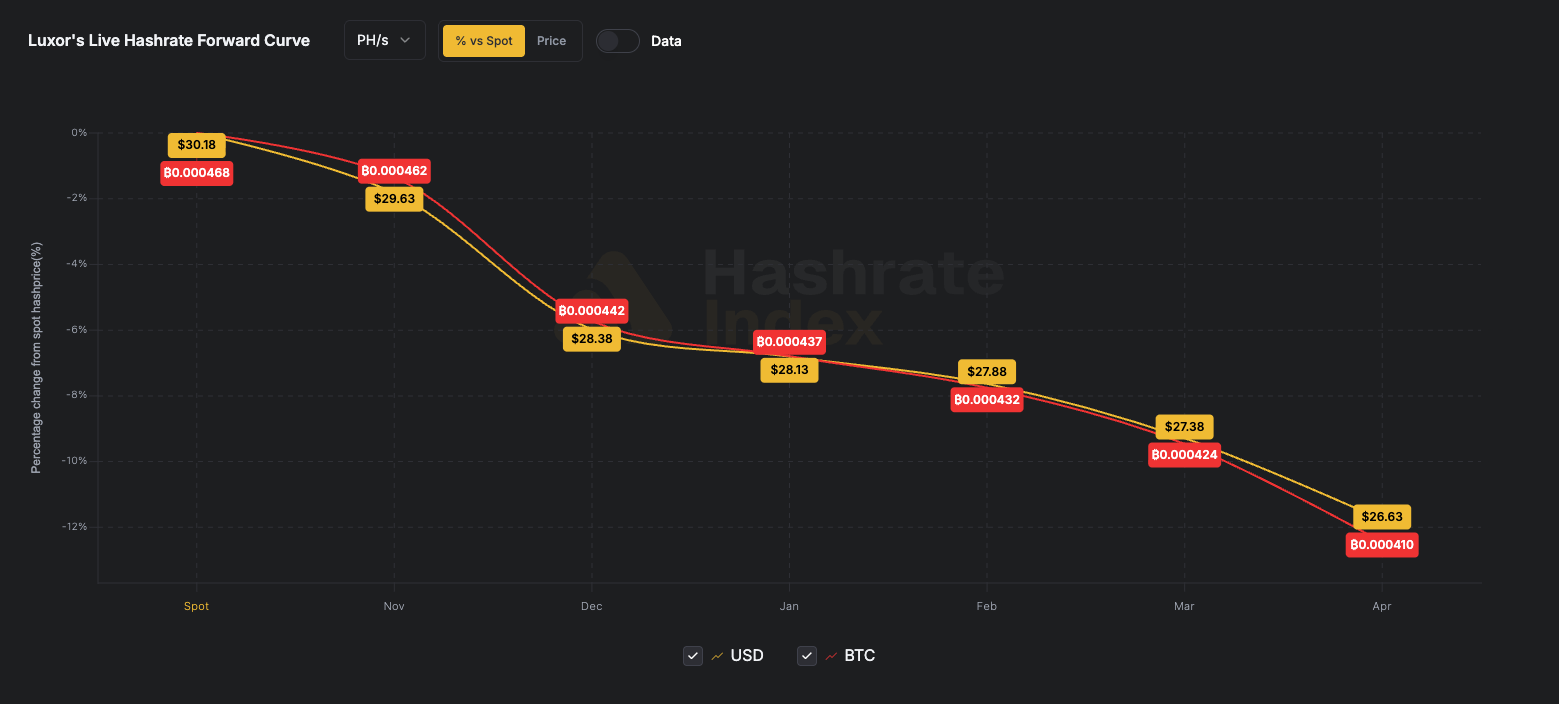
Looking forward, Luxor's Hashrate Forward Market is pricing in an average hashprice of $28.23 or 0.000437 BTC per PH/s/day over the next six months. Sellers can currently secure this hashprice while buyers have the opportunity to lock in the same hashcost through May 2027.
If you'd like to learn more about Luxor's Bitcoin mining derivatives, please reach out to [email protected] or visit luxor.tech/derivatives.
About Luxor Technology Corporation
Luxor delivers hardware, software, and financial services that power the global compute and energy industry. Its product suite spans Bitcoin Mining Pools, ASIC Firmware, Hardware trading, Hashrate Derivatives, Energy services, a Miner Management software, Commander, and a bitcoin mining data platform, Hashrate Index.
Disclaimer
This content is for informational purposes only; you should not construe any such information or other material as legal, investment, financial, or other advice. Nothing contained in our content constitutes a solicitation, recommendation, endorsement, or offer by Luxor or any of Luxor's employees to buy or sell any derivatives or other financial instruments in this or in any other jurisdiction in which such solicitation or offer would be unlawful under the derivatives laws of such jurisdiction. There are risks associated with trading derivatives. Trading in derivatives involves risk of loss; loss of principal is possible.




Hashrate Index Newsletter
Join the newsletter to receive the latest updates in your inbox.