LuxOS Comes to WhatsMiner: What the Launch Means for MicroBT Fleets
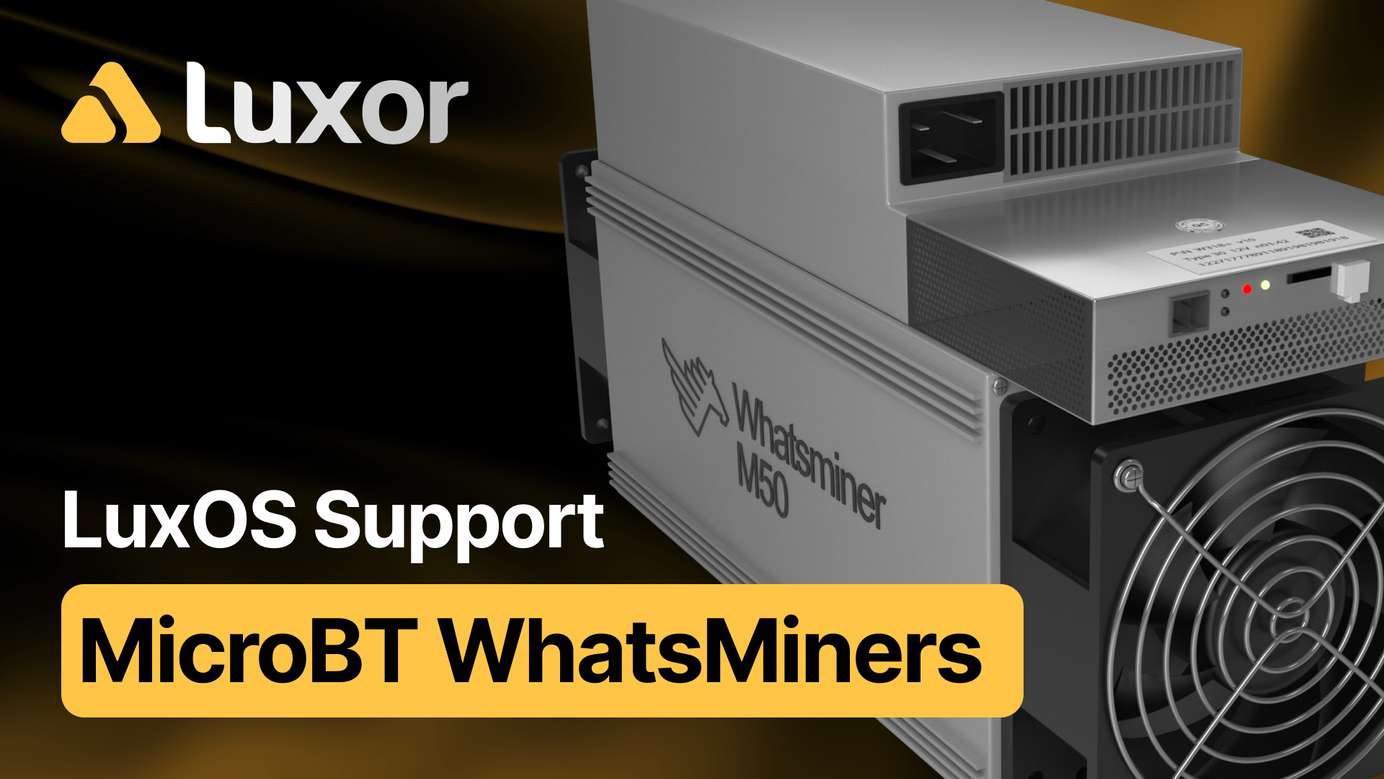
For the first time, WhatsMiner operators can run LuxOS on their hardware.

TLDR
- LuxOS now runs on MicroBT WhatsMiner hardware — the first time Luxor's firmware has shipped for Bitcoin mining machines beyond Bitmain. Over 300,000 machines and 35+ EH/s already run LuxOS globally across 30+ supported models.
- Launch scope covers the M50 series — Additional models to follow.
- Rollout is phased and capacity-gated — Operators cannot self-install on day one. Onboarding is managed directly with Luxor's firmware team, starting with a select group of partner operations.
- Five core features are net-new for WhatsMiner operators: , Advanced Thermal Management (ATM), fast hashrate ramp, safe rapid curtailment, dynamic power targeting, and access to the full Luxor ecosystem.
- Interested operators can express interest at luxor.tech/firmware.
What's Shipping
LuxOS support for WhatsMiner is the first time Luxor's firmware runs on hardware outside the Bitmain Antminer family. The engineering effort to extend LuxOS to a second chip architecture has been in development for over a year. It is a foundational shift in what LuxOS is from a single-OEM product to a multi-OEM platform.
For WhatsMiner operators, the framing matters less than what it unlocks. Until today, running a WhatsMiner fleet meant running stock MicroBT firmware. There was no meaningful third-party alternative that combined feature depth, operator control, and the surrounding software ecosystem. That changes now.
Supported Models at Launch
The M50 series are supported on day one:
Additional WhatsMiner models — including M60 and M60S series — will roll out in the weeks and months following launch. Operators running WhatsMiner hardware outside this initial list may submit their fleet composition by contacting us.
Why This Is a Phased Rollout
The initial roll out will not be a general-availability release. Onboarding is capacity-gated, managed directly with Luxor's firmware team, and starting with a select group of partner operations. There are two reasons for that.
The first is product quality. LuxOS has spent over five years maturing on Bitmain hardware. WhatsMiner support is production-ready, but tuning, operator feedback, and long-tail edge cases are still being validated across real-world fleet conditions. A managed rollout lets the Luxor firmware team work closely with each early operator, collect field data, and harden the product faster than a public release would allow.
The second is deliberate focus. Luxor would rather install LuxOS on one hundred WhatsMiners that are monitored and supported rather than ten thousand machines running with no feedback loop. Operators who onboard early get direct support from the firmware team and a voice in the roadmap. That access narrows as the rollout expands.
The Five Features WhatsMiner Operators Get for the First Time
Luxor is not publishing hashrate uplift or efficiency claims on WhatsMiner hardware — the product is too early in its lifecycle on MicroBT chips for those numbers to be meaningful. The story is what WhatsMiner operators gain access to that was simply not available on stock.
1. Advanced Thermal Management (ATM)
Thermal stability has been a long-running friction point for WhatsMiner operators. The stock response to heat is binary: run at the set profile until an internal sensor trips, then either force a low-power mode or shut down. That protects the machine, but it forfeits hashrate at the exact moments ambient conditions shift.
ATM replaces that binary behavior with continuous, progressive adjustment. LuxOS monitors thermal conditions in real time and modulates the operating profile dynamically — overclocking into available thermal headroom when conditions allow, underclocking progressively when they don't, and holding the machine inside a safe envelope throughout. The result is fewer thermal-induced shutdowns, less hashrate lost to overcorrection, and meaningfully better hardware longevity. For WhatsMiner operators running in variable-temperature environments (summer in Texas, ambient-heated containers, off-grid sites) ATM is a direct answer to a problem the community has lived with for years.
2. Fast Hashrate Ramp
Ramp speed — the time between a machine receiving a resume command and reaching its target hashrate — is a pure revenue variable for any operation that curtails. Every second spent ramping is hashrate left on the table. Stock WhatsMiner firmware initializes conservatively, and the hashrate recovery profile reflects that.
LuxOS reaches target hashrate faster, benchmarked against stock WhatsMiner ramp-up. For fleets running in ERCOT, participating in demand response programs, or operating behind-the-meter alongside intermittent generation, compressed ramp time translates directly into recovered hashrate per event.
3. Safe Rapid Curtailment
Frequent curtailment on stock WhatsMiner firmware is known to be hard on machines. Repeated cold starts, inconsistent ramp behavior, and lack of a safe idle state are all reasons many operators participating in grid programs have either underutilized their flexibility or looked to third-party solutions.
LuxOS makes curtailment safe and repeatable. Machines can drop to an ultra-low idle power state in seconds, hold there indefinitely without stress, and ramp back to target on command. That reliability makes curtailment usable as an operational tool rather than a managed risk — critical for energy contract compliance, demand response participation, and grid-interactive operations.
4. Dynamic Power Targeting
On stock WhatsMiner firmware, changing a machine's power target requires a reboot and retune cycle. That constraint is invisible in steady-state operation, but it becomes expensive the moment an operator wants to flex power for real-time hashprice signals, intraday energy price movements, or grid-balancing events. Each change costs a reboot.
LuxOS Power Targeting eliminates that constraint. Operators set a wattage target and LuxOS adjusts frequency and voltage continuously to hold the machine at that target — no reboot, no retune. Power can ramp up or down smoothly in response to external signals. This unlocks workflows that were simply not practical on stock firmware: demand charge avoidance, interval-based energy trading, real-time load management, and selective demand response without sacrificing subsequent uptime.
5. Access to the Luxor Ecosystem
Installing LuxOS is the entry point to the rest of Luxor's full-stack mining platform. WhatsMiner operators running LuxOS can plug into Commander for fleet management and automated profitability optimization, hedge hashprice and access capital through Fixed and Upfront Payouts on Luxor Pool, trade and upgrade hardware through Luxor's Hardware desk, and purchase and pay for power through Luxor Energy — all under a unified platform.
For operators who have stitched together a pool, a fleet management tool, an energy partner, and a hardware broker across four or five vendors, consolidating to a single platform is a major advantage.
Who This Is For
The primary audience for this release is WhatsMiner fleet operators — groups running M50 hardware at scale, particularly those who curtail, participate in grid programs, or operate in variable-temperature environments. Mixed-hardware operations running both Bitmain and WhatsMiner machines are a close second: LuxOS across the whole fleet is now possible for the first time. Hosting providers managing multi-tenant environments also benefit.
What Comes Next
Expansion of supported models, deeper data validation, and continued iteration based on field deployments.
Operators running WhatsMiner hardware can express interest in LuxOS access at luxor.tech/firmware.
— Happy Hashing!
About Luxor Technology Corporation
Luxor delivers hardware, software, and financial services that power the global compute and energy industry. Its product suite spans Bitcoin Mining Pools, ASIC Firmware, Hardware trading, Hashrate Derivatives, Energy services, a Miner Management software, Commander, and a bitcoin mining data platform, Hashrate Index.
Disclaimer
This content is for informational purposes only, you should not construe any such information or other material as legal, investment, financial, or other advice. Nothing contained in our content constitutes a solicitation, recommendation, endorsement, or offer by Luxor or any of Luxor’s employees to buy or sell any derivatives or other financial instruments in this or in any other jurisdiction in which such solicitation or offer would be unlawful under the derivatives laws of such jurisdiction.

Hashrate Index Newsletter
Join the newsletter to receive the latest updates in your inbox.