Top 5 Bitcoin Mining Fleet Management Software for 2026
Coordinating hashrate operations at scale.

Bitcoin mining fleet management software is the orchestration layer for modern mining operations. It coordinates thousands of machines across facilities by ingesting telemetry, market data, and grid signals, then translating those inputs into automated, executable actions.
Fleet management platforms perform three core functions. Configuration management enables bulk actions such as firmware updates and pool switching, in addition to performance parameter changes across entire fleets. Automation handles routine tasks like reboots, failure recovery, and exception handling, which reduces operational overhead. Real-time monitoring tracks machine health, performance variance, and environmental conditions at both the unit and site level.
At scale, complexity compounds. Each machine behaves differently based on silicon quality, in-field history, and thermal conditions. Advanced fleet managers must optimize individual machines while still achieving site-wide objectives and responding to external signals such as power prices, curtailment events, or hashprice dynamics. Integration with energy markets, grid operators, and financial systems is increasingly defining the frontier.
Here is Hashrate Index’s list of the top Bitcoin mining fleet managers in 2026.
1. Luxor Commander
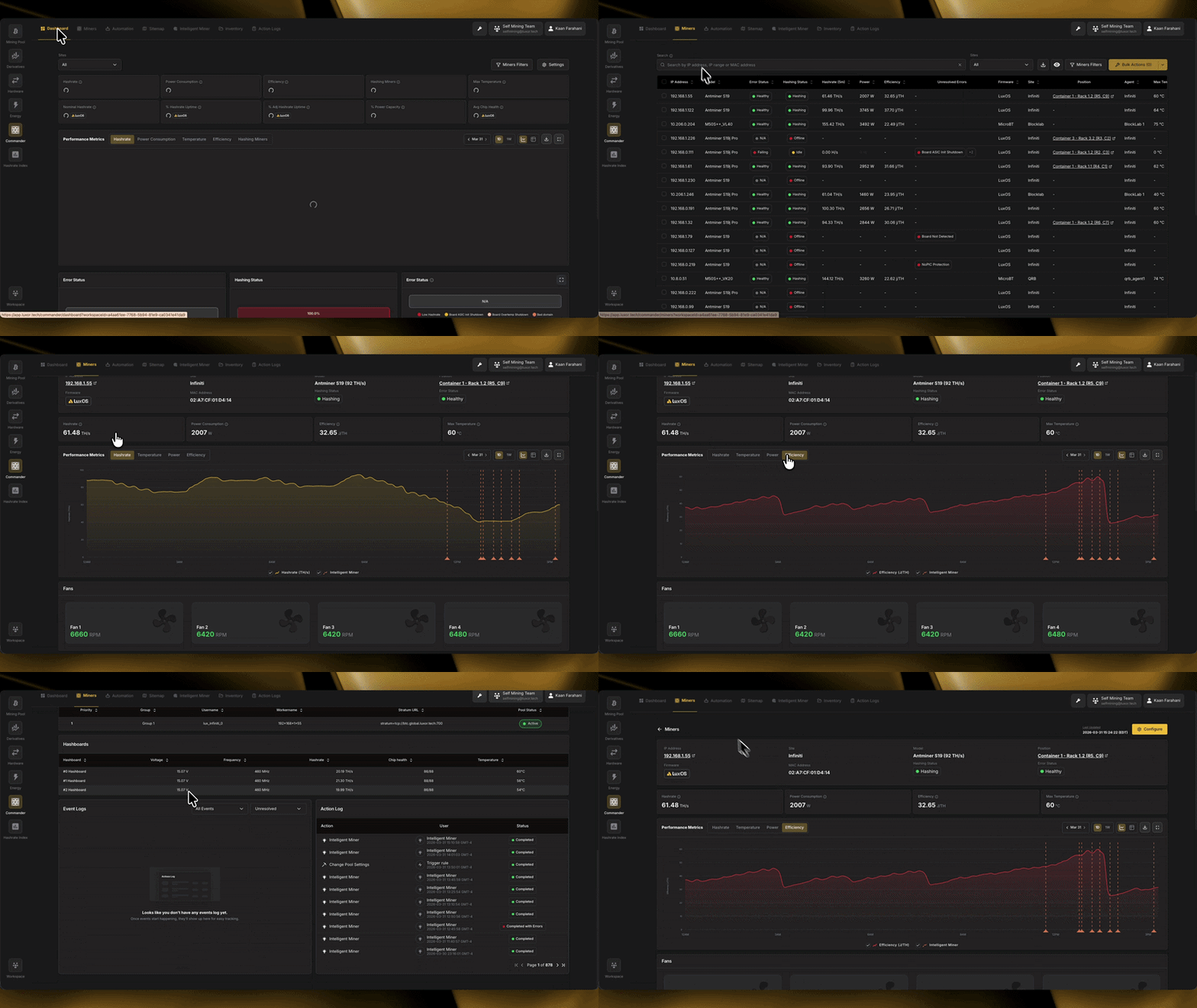
Commander is Luxor's miner management software: real-time monitoring, bulk remote commands, and automated profitability optimization for Bitcoin mining operations; live at app.luxor.tech.
Commander completes Luxor's full-stack mining experience: software (pool + fleet management) + hardware + firmware + finance + energy. All in one unified platform.
Key features:
- Real-Time Fleet Monitoring — Aggregated KPIs, time-series charts, and a sortable/filterable table of every machine across all sites with health status, firmware version, and error tracking.
- Bulk Remote Commands — Execute reboots, sleep/wake, pool changes, and power targets across hundreds or thousands of ASICs simultaneously, with a full audit trail on every action.
- Automation: Triggers & Scheduled Actions — Conditional rules that fire automatically when miner metrics hit defined thresholds (reactive), plus repeating scheduled operations like daily reboot windows or weekly curtailment schedules (planned).
- Site Maps — Physical facility layout with a heatmap overlay for hashrate, temperature, and health status per machine — find a thermal hotspot by rack position, not by hunting IP addresses.
- Intelligent Miner — Profitability optimization engine that runs every five minutes, dynamically adjusting power profiles across the fleet based on live hashprice and energy costs. ERCOT backtests show 8–14% more profitability vs. binary curtailment.
2. Foreman
Foreman is one of the most widely adopted Bitcoin mining fleet management platforms, known for its reliability, breadth of hardware support, and clean operational interface. It serves as a foundational coordination layer for both proprietary and hosted mining operations.
Foreman excels at large-scale configuration management and monitoring, offering granular visibility into machine-level performance while maintaining simple fleet-wide controls. Its stability and ecosystem integrations have made it a default choice for professional operators.
Key features:
- Fleet-wide configuration and firmware management.
- Real-time machine and environmental monitoring.
- Automation for reboots, failures, and alerts.
- Broad ASIC model and firmware compatibility.
3. Braiins Manager
Braiins Manager represents the control-plane extension of the Braiins software ecosystem. Introduced as a rebranded and expanded management platform, it integrates closely with BraiinsOS firmware and Braiins pool.
The platform is designed for automation-first operations, enabling API-driven curtailment, power management controls, and coordinated fleet actions tied to external signals.
Key features:
- API-driven fleet automation and curtailment.
- Tight integration with BraiinsOS firmware.
- Batch configuration and optimization tooling.
- Designed for programmatic, large-scale operations.
4. ItsMiner
ItsMiner positions itself as a modern, performance-focused fleet management platform with strong automation and analytics capabilities. It emphasizes ease of deployment and rapid scaling across geographically distributed sites.
The platform is often favored by operators managing heterogeneous fleets who want centralized visibility and control without heavy operational overhead.
Key features:
- Centralized fleet monitoring across multiple sites.
- Automated maintenance and recovery workflows.
- Performance analytics at machine and site level.
- Support for mixed hardware and firmware environments.
5. OptiFleet
OptiFleet by Foundry focuses on optimization-driven fleet management, with tooling designed to maximize uptime and efficiency across large installations. The platform emphasizes performance tuning for industrial-scale operations.
OptiFleet is commonly deployed in environments where operators prioritize detailed performance analytics and enterprise-grade operations across standardized fleets.
Key features:
- Advanced performance and monitoring analytics.
- Fleet-level optimization and tuning features.
- Automated curtailment workflows.
- Emphasis on standardized, large-scale deployments.
As Bitcoin mining enters its next phase of evolution, fleet management software becomes the execution engine for Intelligent Mining. The platforms that will matter most are those capable of translating real-time power prices, grid constraints, and market signals into synchronized machine and site-level decisions. Coordination now defines competitiveness. Fleet managers are evolving from monitoring dashboards into autonomous control systems, and this transition will shape how mining sites compete in an increasingly dynamic energy and compute commodity landscape.
— Happy Hashing!

Hashrate Index Newsletter
Join the newsletter to receive the latest updates in your inbox.