Intelligent Mining — Case Studies
In this blog post, we cover case studies on Intelligent Mining.

The Intelligent Miner — a new comprehensive guide published by Luxor Technology — introduces a fundamentally different approach to bitcoin mining operations. Download the full guide to learn how your operation can transition from binary to intelligent mining.
In Part I of this series, we explored the two markets that shape profitability —hashrate and energy — and how the most advanced operators now treat them as tradable commodities.
In Part II, we turned to two elements in the software stack that make this evolution possible: firmware and fleet management.
In Part III, we made the case for and outlined our vision of what Intelligent Mining means.
In Part IV, we dove into the race car revolution and explore dynamic gear-shift strategies for riding real-time power markets.
In Part V, we close the case for Intelligent Mining — but this is not an ending. It is the starting point of the infinitely variable future.
Miner Case Studies
In order to showcase the power of intelligent mining, we performed a simulation backtest using operational data captured through Luxor’s R&D mining fleet:
Case Study #1 — Miner facing Spot Hashprice & Power
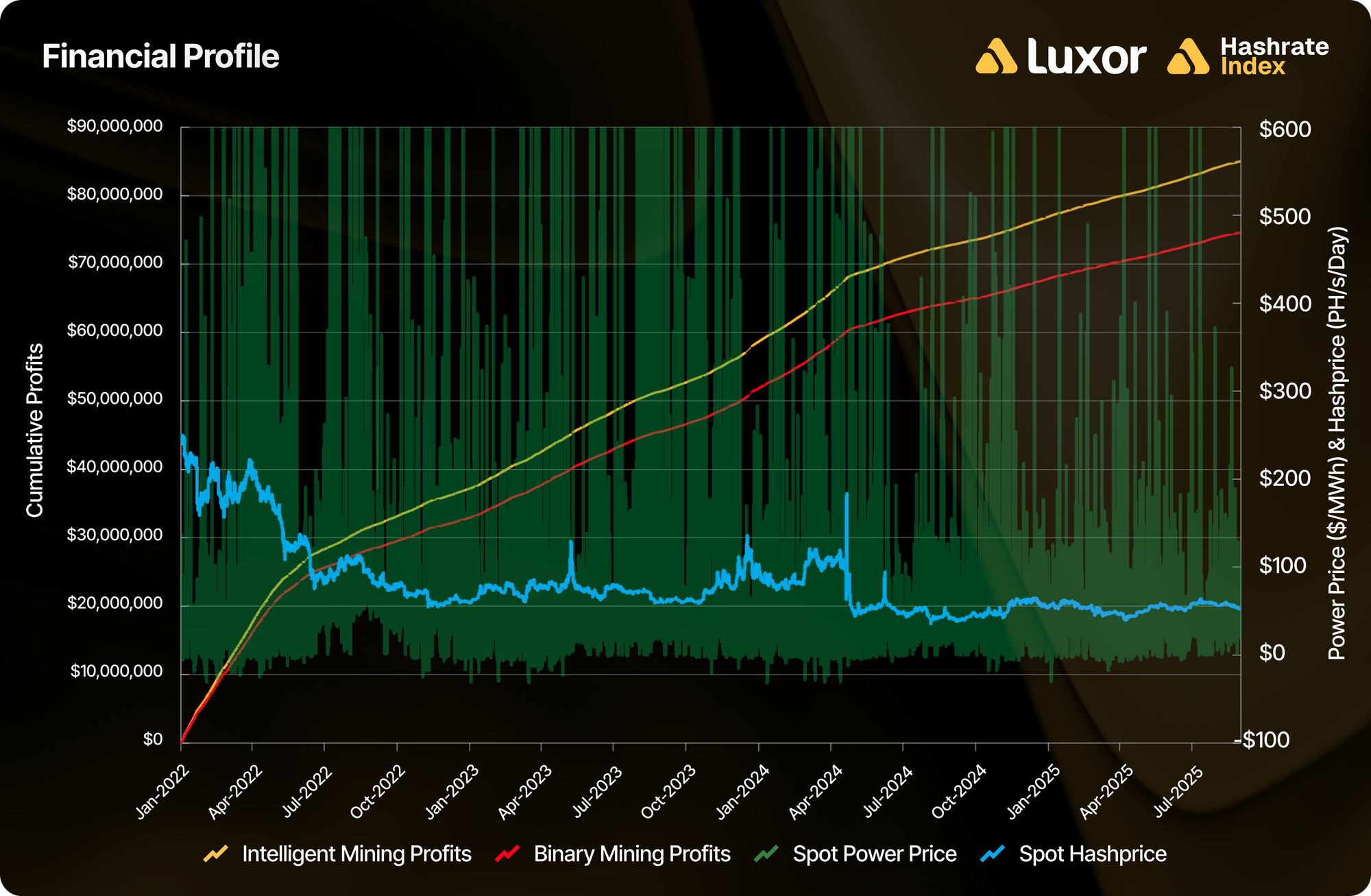
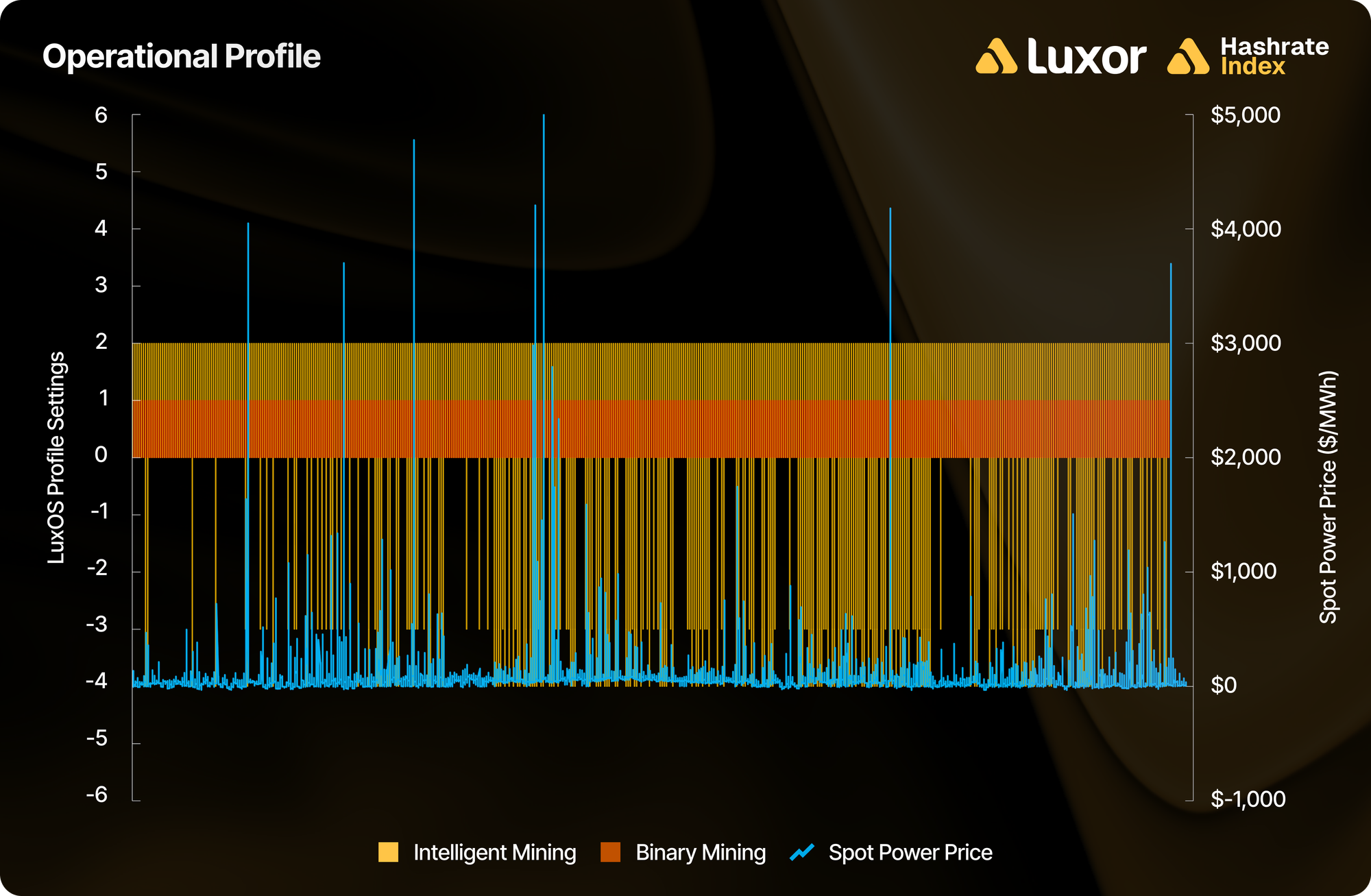
A miner operating in ERCOT West Texas Load Zone with full exposure to both spot hashprice and spot power. This operator makes no use of hedges, embracing volatility on both sides of the margin. We compare performance from January 2022 through August 2025 for a 1 EH/s fleet of the Antminer S19j Pro (100 TH/s) under two scenarios: Intelligent Mining and binary mining.
Case Study #2 — Miner facing Fixed Hashprice & Spot Power
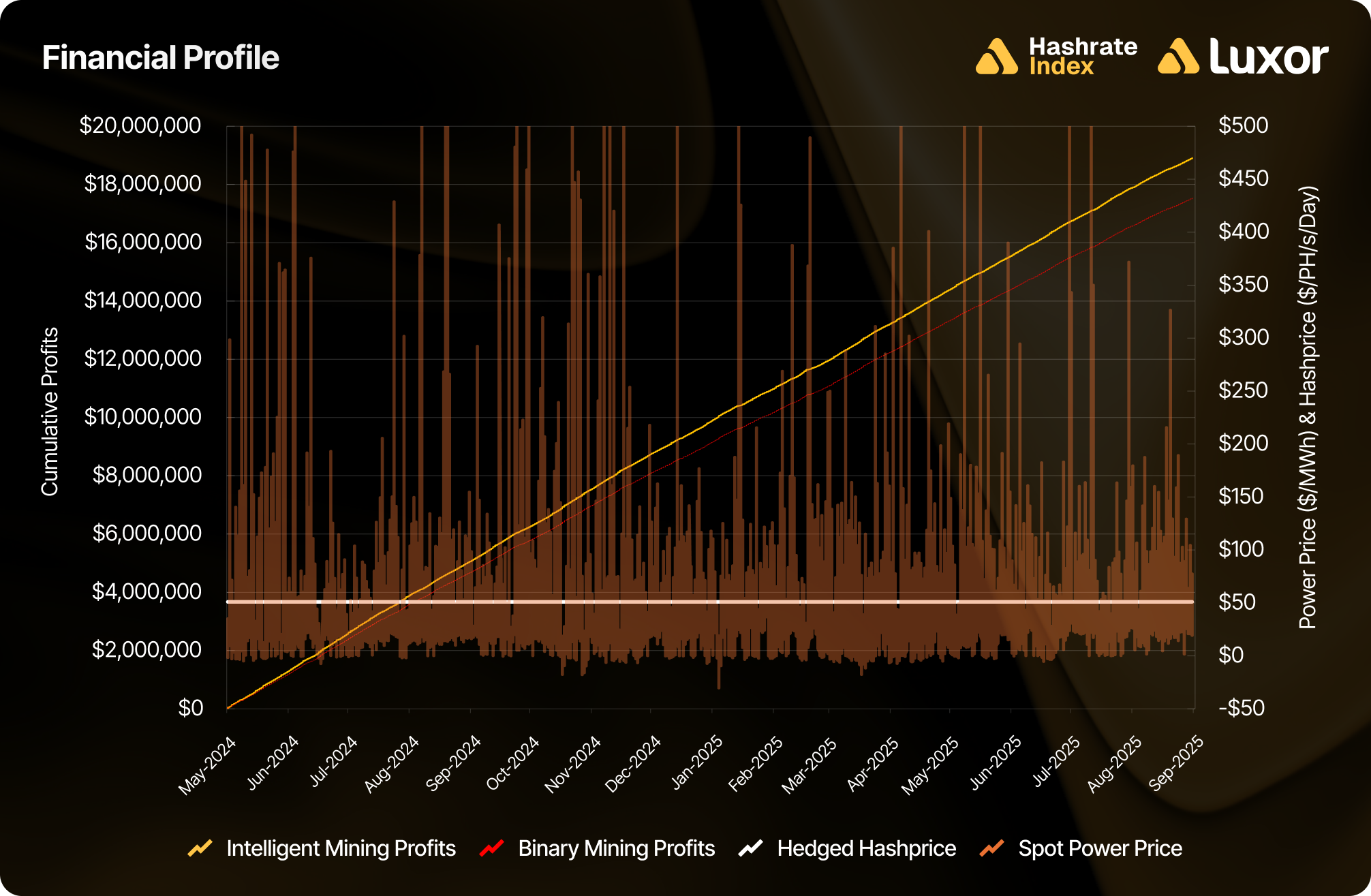
A miner in ERCOT West Texas Load Zone with hedged hashprice exposure via rolling 6-month non-deliverable forward (NDF) contracts (USD-denominated), but unhedged power exposure to real-time spot electricity prices. This profile reflects an operator that secures predictable revenues while remaining flexible on the cost side. We compare post-halving performance from May 2024 through August 2025 for a 1 EH/s fleet of the Antminer S21 (200 TH/s) under Intelligent Mining and binary mining scenarios.
Case Study 1: Spot Hashprice & Power
Profile
1 EH/s miner operating in ERCOT West Texas Load Zone, fully exposed to both real-time hashprice and real-time power. The fleet consists of 10,000 Antminer S19j Pros (100 TH/s), deployed from January 2022 – August 2025.
Results
Insights
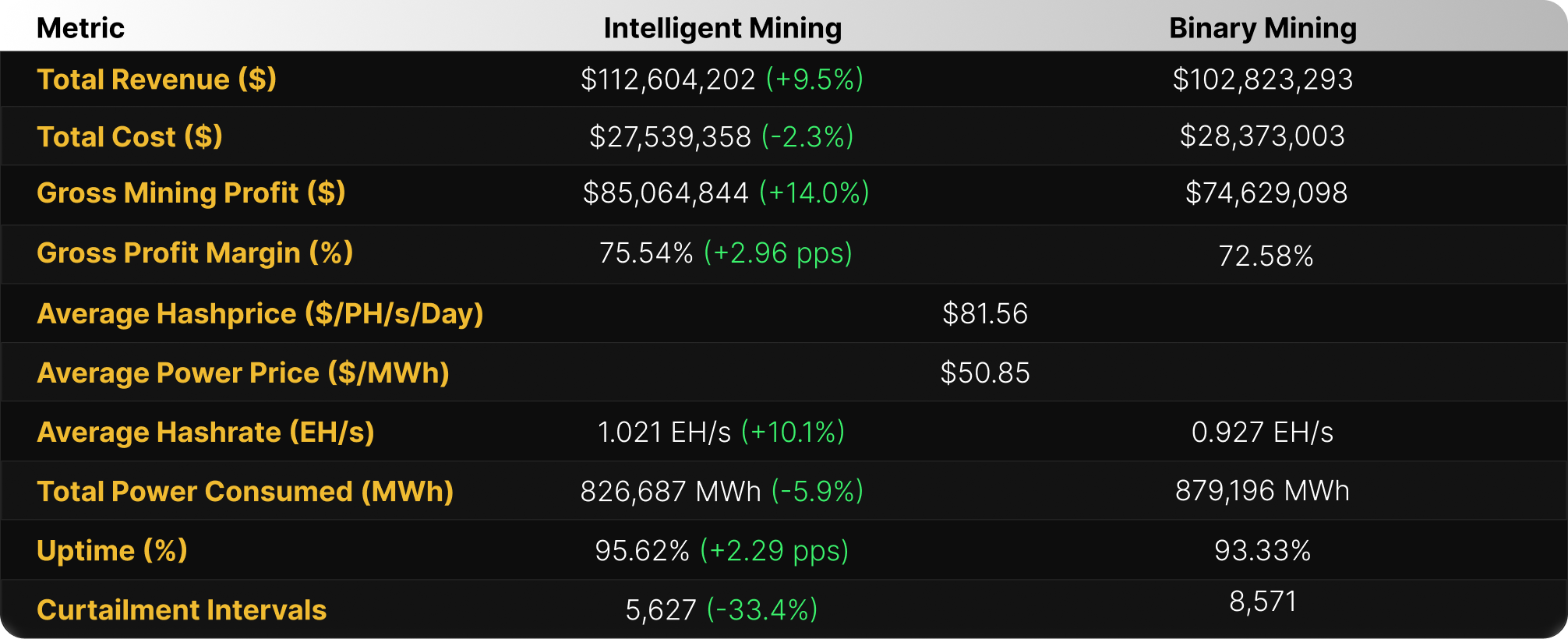
- Efficiency gains compound: By continuously autotuning and profile switching, Intelligent Mining reduced power consumption by over 52,500 MWh compared to binary mining, while delivering over 10% more average hashrate.
- Reduced curtailment: Intelligent Mining required 33% fewer curtail intervals, keeping machines online longer while still avoiding unprofitable operations. As a result, overall uptime improved by 2.5%.
- Margin expansion: Tighter cost control and higher hashrate performance improved profit margins by 2.96 percentage points.
- Snowball effect: Over four years, Intelligent Mining outperformed binary mining by 14% in cumulative profit, demonstrating how disciplined intra-interval optimization can compound into competitive advantage over time.
Conclusion
For miners exposed to the volatility of ERCOT’s West Texas zone, binary on/off strategies leave significant money on the table. Intelligent Mining turned this risk into opportunity, delivering more hashrate, lower costs, higher uptime, better efficiency, and ultimately stronger margins.
Case Study 2: Fixed Hashprice & Spot Power
Profile
1 EH/s miner operating in ERCOT West Texas Load Zone, hedging hashprice via rolling 6-month contracts (USD-denominated) while remaining exposed to spot power price. The fleet consists of 5,000 Antminer S21 units (200 TH/s) deployed from May 2024 – August 2025.
Results
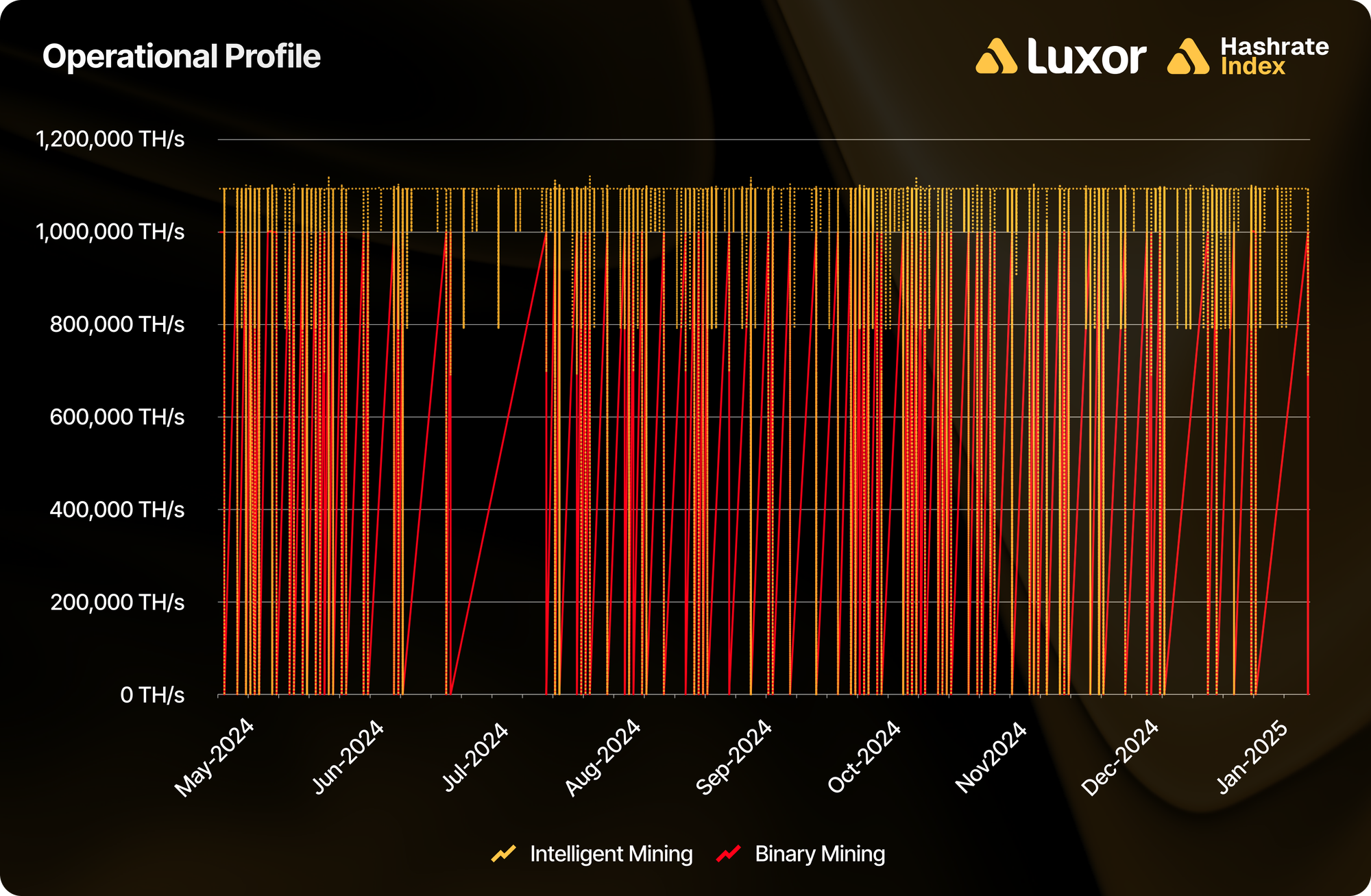
Insights
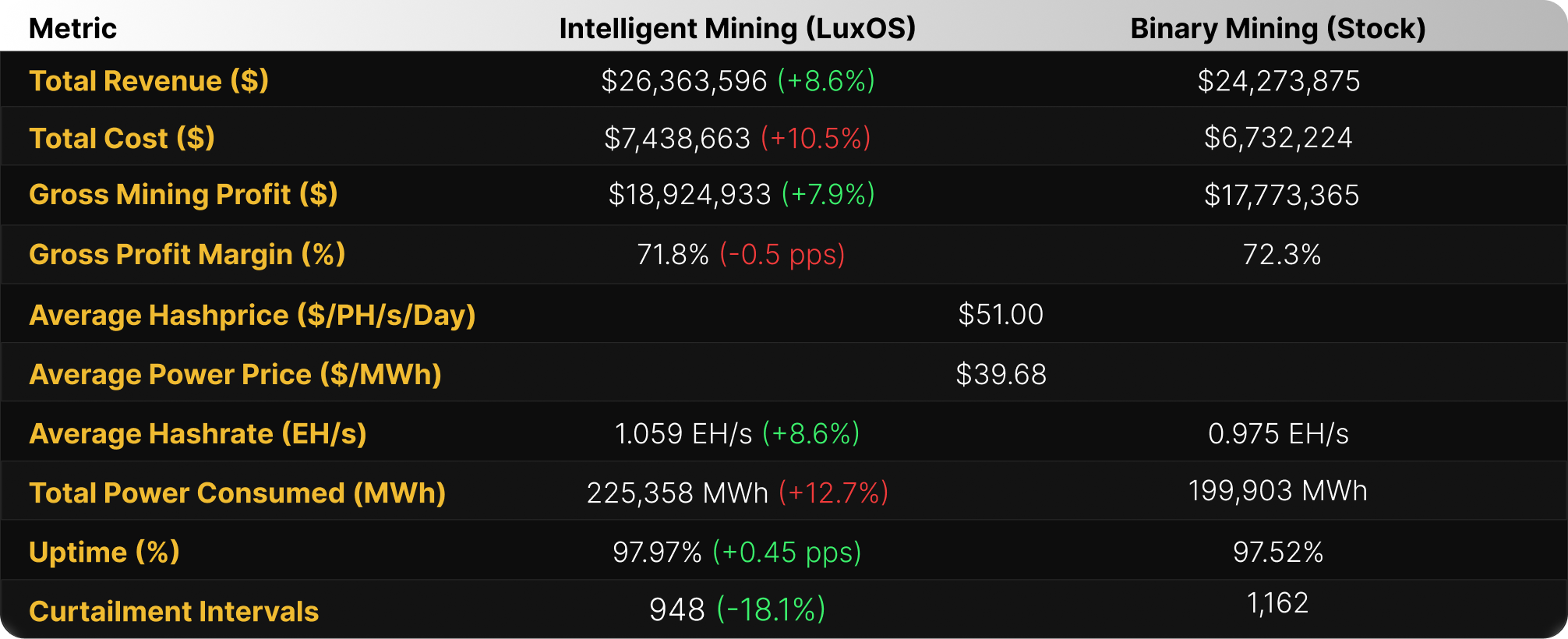
- Revenue uplift: Intelligent Mining generated $2.1 million additional revenue (+8.6%), as a result of higher uptime and increased hashrate from overclocking.
- Efficiency vs. power tradeoff: Power costs climbed ~10.5% as Intelligent Mining consumed ~12.7% more MWh. Yet, the revenue uplift outweighed these higher costs, driving $1.4 million in additional profit (+7.9%). Counterintuitively, overclocking next-gen machines like the S21 can expand overall profitability even if margins compress. Overclocking burns more power but still delivers higher absolute profit.
- Curtailment precision: Intelligent Mining encountered ~18% fewer curtailment intervals, avoiding unnecessary downtime while still responding to unprofitable prices.
- Capitalizing on cheap: There were 2,769 intervals when prices fell to zero or below. Intelligent mining exploited these windows by overclocking, squeezing out extra hashrate while the hedged hashprice guaranteed stable revenue.
Conclusion
For miners hedging hashprice but riding real-time power, Intelligent Mining is decisive. Despite drawing more power, it delivered higher uptime, stronger hashrate, and nearly 8% more profit than binary operations. Hedged or unhedged: real-time fleet optimization turns volatile markets into opportunities, ensuring miners capture every possible edge.
If you’d like to learn more about how to build your Intelligent Mining operation across Luxor’s full technology stack — including hashrate derivatives, firmware, and energy services — reach out to us at [email protected] or visit https://luxor.tech/energy.
About Luxor Technology Corporation
Luxor delivers hardware, software, and financial services that power the global compute and energy industry. Its product suite spans Bitcoin Mining Pools, ASIC Firmware, Hardware trading, Hashrate Derivatives, Energy services, and a bitcoin mining data platform, Hashrate Index.
Disclaimer
This content is for informational purposes only, you should not construe any such information or other material as legal, investment, financial, or other advice. Nothing contained in our content constitutes a solicitation, recommendation, endorsement, or offer by Luxor or any of Luxor’s employees to buy or sell any derivatives or other financial instruments in this or in any other jurisdiction in which such solicitation or offer would be unlawful under the derivatives laws of such jurisdiction.
There are risks associated with trading derivatives. Trading in derivatives involves risk of loss, loss of principal is possible.

Hashrate Index Newsletter
Join the newsletter to receive the latest updates in your inbox.