Four Strategies to Maximize Profitability in Low Hashprice Environments
Make the most of every hash, watt and dollar.

In this post, we cover Bitcoin mining optimization strategies across firmware, hardware, and finance for maximizing profitability in low hashprice environments.
Introduction
In February 2026, Luxor’s Bitcoin Hashprice Index averaged $32.31 per PH/s/Day, marking a new monthly all-time low. In this environment, margins are thin (if not below breakeven), and fleets without flexible firmware are the most exposed. However, miners can come out ahead during downturns like this by treating low hashprice as an operational and capital allocation problem to solve. Here are four strategies to protect margins and build a lower cost base today.
TLDR
- Luxor Firmware — LuxOS — improves breakeven hashprice (i.e., hashcost) by up to 11.4% on S21 XP hardware and by 16.9% on S19-series machines.
- Strategic underclocking via LuxOS can improve efficiency (J/TH) by 12–16% on S21-series machines, and by 12–30% on S19-series machines.
- Hardware prices are at or near cycle lows; the Antminer S21 XP (US-landed) is exclusively available at Luxor for $8.90/TH.
- Receive upfront capital today for future delivery of hashrate via Luxor Pool.
Strategy 1: Control Costs with LuxOS Efficiency Gains
When hashprice falls, every bit of savings counts. Power price is often the one OpEx item miners can't change, but you can change how efficiently your hardware converts electricity into hashrate.
Luxor's custom ASIC firmware — LuxOS — unlocks a range of efficiency improvements on supported machines, and lowers your breakeven hashprice through a feature called AutoTuner. AutoTuner continuously adjusts ASIC chip frequency and voltage to minimize power consumption without sacrificing hashrate. Once enabled, it finds the optimal operating point for your specific machines and environment, then keeps adjusting as conditions change. It runs entirely in the background, no manual maintenance required.
This results in a lower breakeven hashprice on the same fleet with the same hashrate output. This is distinct from strategic underclocking (Strategy 2), where operators make an active decision to dynamically reduce hashrate in exchange for an efficiency improvement. AutoTuner makes sure every terahash you produce consumes as little power as possible.
For example, at a 5-cent power cost ($0.05/kWh), LuxOS improves the S21 XP’s breakeven hashprice from $16.20 to $14.36 (-11.4%):
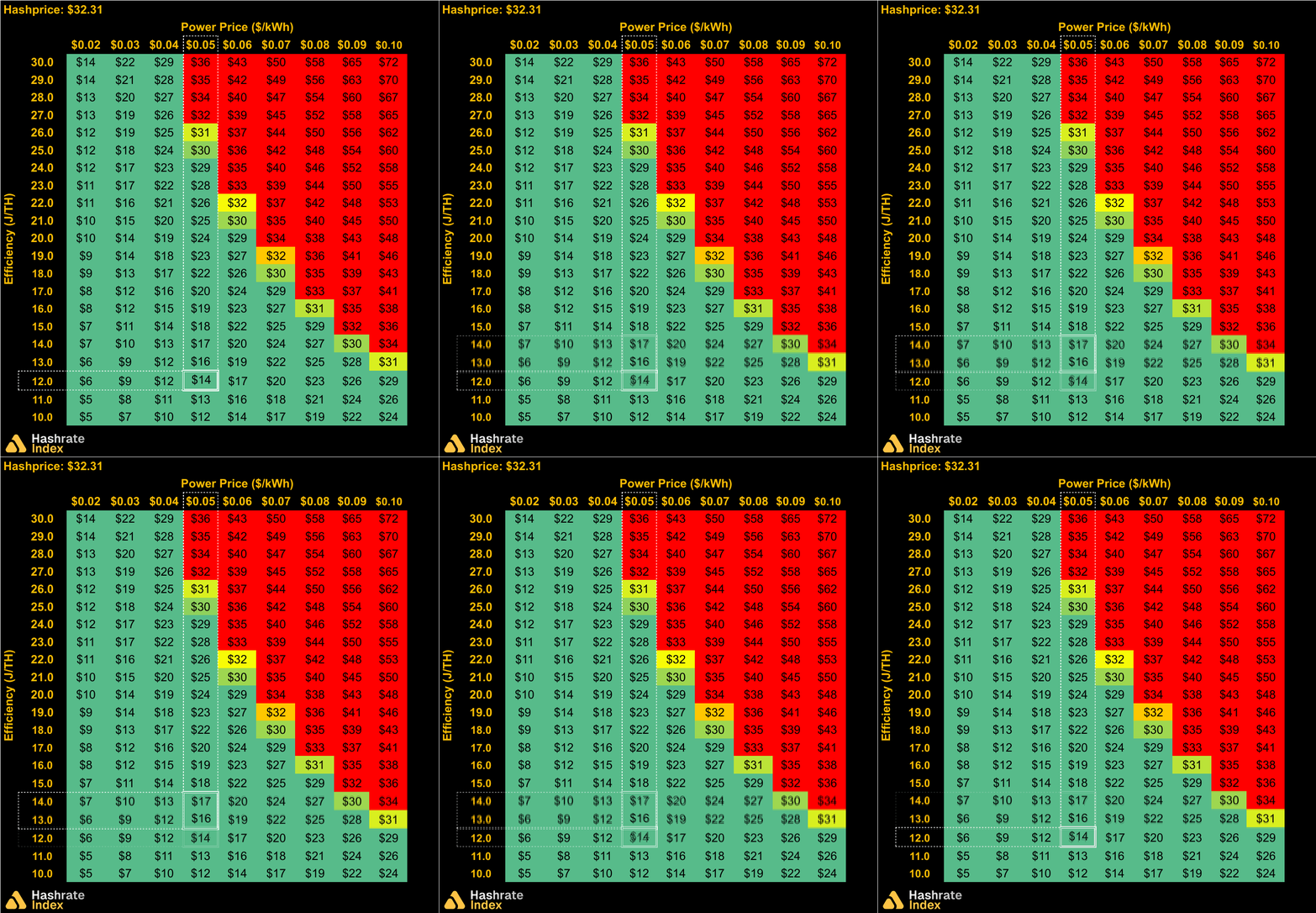
The gains are material across every supported machine model, but most pronounced on older-generation hardware where stock firmware leaves more on the table:
S21 Pro (220–245 TH variants)
- Stock firmware breakeven: $18.00 per PH/s/Day
- LuxOS Optimized: $15.82–$16.09 (-10.6% to -12.1%)
S21+ (216–235 TH variants)
- Stock firmware breakeven: $19.80 per PH/s/Day
- LuxOS Optimized: $17.04–$17.12 (-13.5% to -13.9%)
S19 XP (134 TH)
- Stock firmware breakeven: $25.80 per PH/s/Day
- LuxOS Optimized: $24.53 (-4.9%)
S19j Pro (100 TH)
- Stock firmware breakeven: $35.40 per PH/s/Day
- LuxOS Optimized: $29.42 (-16.9%)
On the S19j Pro, the breakeven hashprice improvement is nearly 17%. For operators running older-generation fleets, this is the difference between staying online versus shutting down.
Custom firmware is the highest-leverage, lowest-cost operational improvement available right now. No hardware purchase required, no power contract change, no infrastructure upgrade. Install LuxOS, turn AutoTuner on, and your fleet is immediately more competitive.
Strategy 2: Strategically Underclock to Survive
Underclocking is often framed as a defensive move — drop hashrate, reduce power draw, minimize losses. This framing misses an important point: the non-linear relationship between power consumption and hashrate.
When underclocking, power consumption falls faster than hashrate does. The result is an improved efficiency (J/TH), meaning each terahash costs less electricity to produce.
In a low hashprice environment where power cost is the central variable, this optionality matters. LuxOS enables control over your fleet’s full performance range, unlocking efficiency “sweet spots” where machines produce the majority of hashrate at a significantly lower energy cost.
Here's what it looks like in practice:
S21 XP
- LuxOS Power: 2,751W vs. 3,645W at stock (−24.5%)
- LuxOS Hashrate: 229.7 TH/s vs. 271.9 TH/s at stock (−14.9%)
- LuxOS Efficiency: 12.0 J/TH vs. 13.5 J/TH at stock (+12.7%)
S21 Pro (245 TH)
- LuxOS Power: 2,480W vs. 3,675W at stock (−32.5%)
- LuxOS Hashrate: 188.7 TH/s vs. 245 TH/s at stock (−23.0%)
- LuxOS Efficiency: 13.1 J/TH vs. 15.0 J/TH at stock (+12.7%)
S21+ (216 TH)
- LuxOS Power: 2,613W vs. 3,564W at stock (−26.7%)
- LuxOS Hashrate: 184.0 TH/s vs. 216 TH/s at stock (−14.8%)
- LuxOS Efficiency: 14.2 J/TH vs. 16.5 J/TH at stock (+13.9%)
S19 XP (134 TH)
- LuxOS Power: 1,673W vs. 2,881W at stock (−41.9%)
- LuxOS Hashrate: 87.2 TH/s vs. 134 TH/s at stock (−34.9%)
- LuxOS Efficiency: 19.2 J/TH vs. 21.5 J/TH at stock (+10.7%)
S19j Pro (100 TH)
- LuxOS Power: 1,711W vs. 2,950W at stock (−42.0%)
- LuxOS Hashrate: 71.4 TH/s vs. 100 TH/s at stock (−28.6%)
- LuxOS Efficiency: 24.0 J/TH vs. 29.5 J/TH at stock (+18.6%)
Note: All data sourced from Luxor’s R&D Fleet. Operational results may vary.
Combined with Strategy 1, strategic underclocking lets older-generation hardware compete meaningfully alongside newer machines during margin compression. LuxOS allows you to flex your fleet dynamically: underclock more when hashprice compresses, and less when mining economics improve.
Strategy 3: Buy Hardware When Everyone Else Is Selling
Every major hashprice compression cycle produces the same pattern: ASIC prices fall in tandem with hashprice, operators with balance sheet capacity acquire hardware at discounts, and those machines drive outsized returns through a hashprice recovery.
We're in that window now.
Secondary market prices for S19-series hardware are near multi-year lows. S21-series supply is also available as operators reduce hashprice exposure.
Exclusive: S21 XP 270T (US-Landed, OEM-Warranted)
The strongest deal currently exclusive to Luxor’s hardware market is the S21 XP at $8.90/TH, US-landed:
- OEM warranty valid through May 2026
- No customs exposure, no import logistics
- MOQ 30 units (volume discounts available)
- Detailed hash reports and photos available on request
Additional ASIC Availability
For operators looking to expand capacity at a lower cost-per-TH, our Hardware desk is currently seeing the following machines move across the S19 series:
- Used S19 XP (138TH | 21.5 J/TH): $2.95/T (10-day DOA protection)
- New S19k Pro (120TH | 23.0 J/TH): $1.95/T
- Used S19j Pro (100TH | 29.5 J/TH): $0.90/T (10-day DOA protection)
The S19j Pro at $0.90/TH deserves particular attention. Combined with LuxOS — which drops breakeven hashprice by 16.9% on this model — the acquisition cost is low enough to work at today's compressed hashprice levels and improves on a hashprice recovery.
Strategy 4: Sell Forward Hashrate to Fund Hardware Purchase
The previous three strategies are operational. This one is financial, and it's what separates miners who thrive and compound their competitive advantage during hashprice downturns.
Scaling a Bitcoin mining operation requires capital, and issuing equity & debt or selling BTC isn't the only way. Luxor’s hashrate-backed hardware financing solutions allow miners to raise capital upfront by monetizing future hashrate production, enabling non-dilutive growth.
Miners sell future hashrate production (typically in 1 to 12-month contracts) at an agreed upon fixed hashprice today. The buyer absorbs hashprice risk for the duration; the miner receives predictable revenue regardless of hashprice moves.
In a low hashprice environment, selling forward achieves two things simultaneously:
- Locks in revenue certainty on your existing fleet during the downturn period.
- Generates capital today that can be deployed into discounted hardware before a recovery reprices those machines.
There is a trade-off: you're capping upside on your existing hashrate for the duration of the contract. If hashprice rallies sharply, the buyer captures that move. However, the capital you unlock today can buy hardware at prices that may look cheap 12 to 18 months from now.
Through Luxor Pool, miners can choose between two repayment structures:
- Fixed Hashrate Repayment – Receive financing today and deliver a defined portion of future hashrate over time. This structure aligns repayment with operational performance and offers downside protection in weaker hashprice environments.
- Fixed Bitcoin Repayment – Secure predictable repayment terms by pairing a deliverable forward sale with a non-deliverable forward purchase. This structure removes hashrate variability from the equation while maintaining exposure to operational upside.
Compounding The Competitive Advantage
These strategies are effective in isolation, but what makes them powerful is the combination.
Consider this: an operator sells forward its current hashrate capacity to self-fund a hardware purchase, and then installs LuxOS to AutoTune and underclock the fleet. They’ve acquired hardware at cycle-low prices, and will exit this downturn period with a lower breakeven hashprice, more hashrate, an improved fleetwide efficiency, and the same or better revenue certainty throughout the forward contract duration.
That's a fundamentally different position versus waiting for spot mining conditions to improve. A hashprice recovery doesn't lift all mining operations equally, it rewards those who prepared for it.
Ready to act?
- Audit your current firmware status. If any machines in your fleet are running stock firmware, that's your highest-leverage first move. Identify which models you're running and confirm whether LuxOS is compatible.
- Find your breakeven hashprice. Benchmark your current fleet based on your actual power cost. If your breakeven hashprice is above current spot hashprice, strategies 1 and 2 should be your immediate focus.
- Evaluate your hardware acquisition window. Review current capacity, planned depreciation on older-gen machines, and available capital. If you have room to add hashrate, request hash reports and pricing on the S21 XP before inventory moves.
- Get a forward market quote. Before committing capital to hardware, talk to Luxor's Financial Services desk about what your existing fleet could generate in a forward sale. The quote costs nothing and tells you exactly how much capital you could unlock without raising equity or debt.
If you’d like to learn more about Luxor’s full-stack Bitcoin mining services, please reach out to [email protected] or visit https://luxor.tech.
About Luxor Technology Corporation
Luxor delivers hardware, software, and financial services that power the global compute and energy industry. Its product suite spans Bitcoin Mining Pools, ASIC Firmware, Hardware trading, Hashrate Derivatives, Energy services, and a bitcoin mining data platform, Hashrate Index.
Disclaimer
This content is for informational purposes only, you should not construe any such information or other material as legal, investment, financial, or other advice. Nothing contained in our content constitutes a solicitation, recommendation, endorsement, or offer by Luxor or any of Luxor’s employees to buy or sell any derivatives or other financial instruments in this or in any other jurisdiction in which such solicitation or offer would be unlawful under the derivatives laws of such jurisdiction.
There are risks associated with trading derivatives. Trading in derivatives involves risk of loss, loss of principal is possible.

Hashrate Index Newsletter
Join the newsletter to receive the latest updates in your inbox.